Bad news
Construction Shrinks and Costs Rise Again as UK Growth Leans on AI Spending
UK output grew 0.7% from July to September, but construction fell 0.7%, new private housing work fell 4.7% and the ONS cannot say how much of the growth is AI. Consumer confidence is already slipping as fuel and energy bills rise.

Read the good side of this story
UK Growth Hits 0.7%, Far Above Forecasts, as AI Spending Lifts Output

The UK economy grew by 0.7% in the three months to September, but the weak parts are easy to find in the same release. Construction output fell 0.7%, new private housing work fell 4.7%, and the Office for National Statistics (ONS) says it cannot measure how much of the growth comes from artificial intelligence. The BBC’s Faisal Islam says even the good number may not last.
Five things sit behind the headline.
1. The growth leans on one industry
The ONS bulletin shows services up 0.9% and computer programming and consultancy up 4.4%. The ONS calls that industry the largest driver of GDP growth across 2026, and says many of the firms reporting the biggest turnover rises work on AI and cloud computing.
Then the caution. Because of how it collects data, the ONS says it is hard to quantify the exact effect of those activities. A growth story that leans on a sector the statistician cannot size is a story with a gap in it. Islam warns that the AI data-centre boom may turn to bust at any point.
The breadth is thinner than it sounds. The ONS says 13 of the 20 subsectors of GDP grew, which means seven did not. Within services, education and accommodation and food service both fell 0.5%, and three of the 14 service subsectors did not add to growth.
2. The builders are going backwards
Construction output fell 0.7% in the quarter and is now 1.7% lower than a year ago. New work fell 1.6%, and within it private housing new work dropped 4.7%. Repair and maintenance grew 0.5%, which only partly cushions the loss.
Islam says construction and private housebuilding remain depressed. That matters for anyone waiting for a home, because a falling housing pipeline does not show up in the headline for years. The food and drink service sector also fell, down 1.9%, with education down 0.5%.
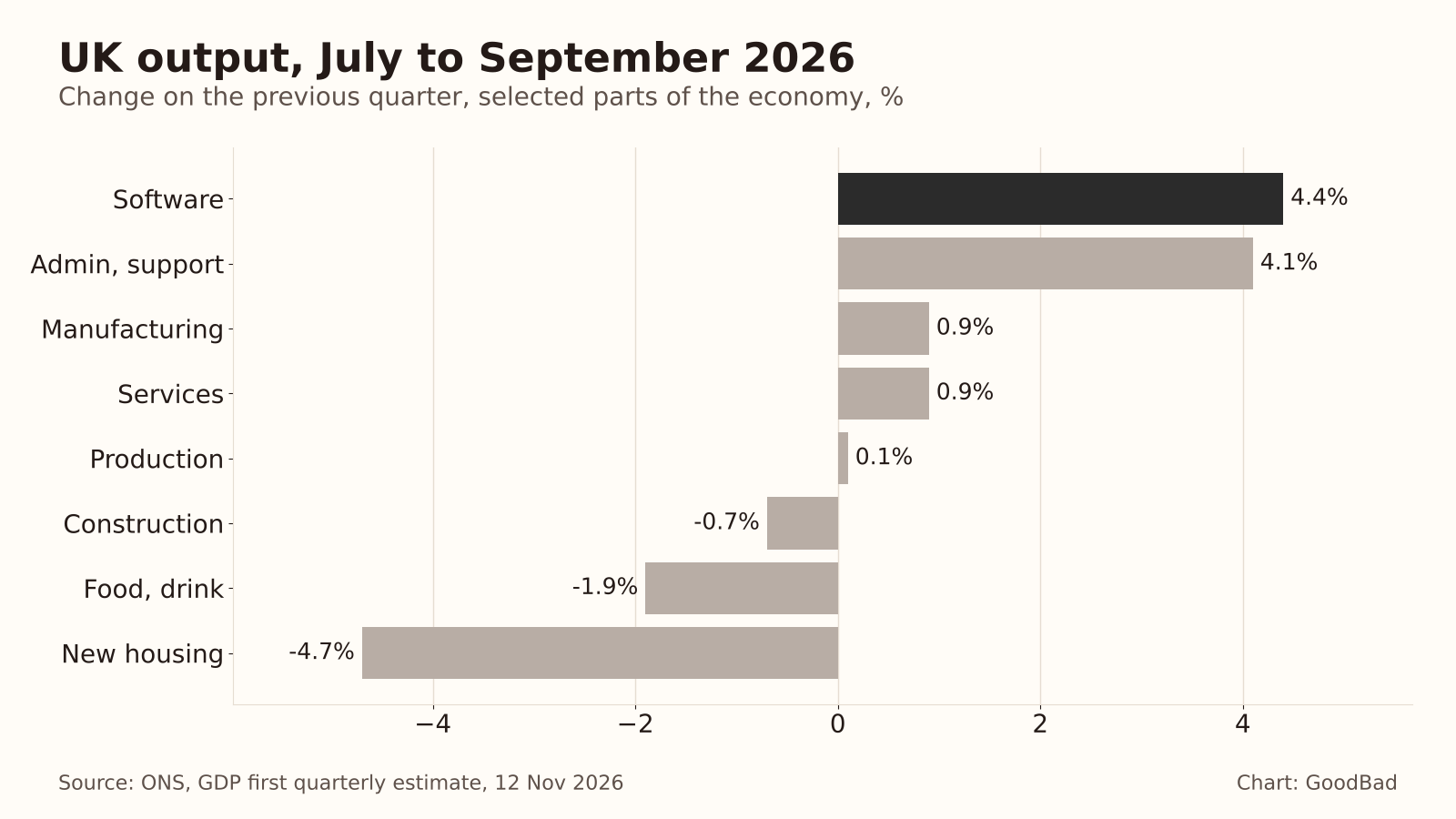 Chart: GoodBad. Data from the ONS, 12 November 2026. “Software” is computer programming, consultancy and related activities.
3. Most of the rest was flat
Production, which covers manufacturing, mining and energy, rose just 0.1% and is 1.5% above a year ago. Manufacturing, up 0.9%, was its only positive part. Mining and quarrying fell 2.2%, electricity and gas supply fell 2.1%, and water and waste fell 1.5%.
The monthly path is also shakier than the quarterly figure. The economy grew 0.4% in July, then did not grow at all in August, a figure revised down from 0.1%. September added 0.2%. A quarter that starts strongly and fades is a weaker signal than the headline suggests.
4. Prices are creeping back
The ONS’s deflator, the broadest measure of domestic inflation, rose 2.3% on a year earlier. Islam notes that consumer confidence has already fallen as petrol and domestic energy prices start to rise again. He says there is a significant challenge with everyday cost-of-living pressures in the coming months.
The UK’s trade deficit stood at 1.3% of GDP in the quarter. Borrowing costs are also a drag: Islam lists rising market borrowing costs and a recent rise in interest rates among the pressures the economy faced. He says the Iran conflict remains the big unknown for energy.
5. The good number may not last
The quarter was a real beat, and the context explains why it surprised: third-quarter growth has averaged less than 0.1% across the four years since the pandemic. Forecasters had expected about 0.1% for this period, and the Office for Budget Responsibility pencilled in about 0.3% three weeks ago. The ONS puts growth at 0.7%, after 0.5% in the spring, and 1.9% above a year earlier, with GDP per head up 0.7%. Business investment rose 0.4% on the quarter and is up 3.0% on the year.
Islam says the figure “kills the doom” but is not a boom, and that the pace may not last through the final three months of the year. Consumers were resilient only until the autumn, in his reading.
What to watch
What would change the outcome is mostly outside Westminster. Islam says some oil and gas production in the Gulf is starting to normalise. A durable end to the Iran conflict after the US midterm elections could bring down petrol prices, energy bills, government borrowing costs and mortgage costs, he adds. Downing Street is investing heavily in a settlement, he reports, and the chancellor called it the best economic policy. Until that happens, the cost pressures remain a live risk for households and for the Treasury.
The first estimate can move. The ONS says first estimates have on average been revised 0.08 percentage points upward by the final version, with a mean absolute revision of 0.27 points. A swing of that size would matter less than whether AI spending holds and energy prices ease.
For households the test is simpler. Growth that comes from data centres and software does not automatically show up in wages, mortgages or the cost of heating a home. Neither source says it will. The BBC’s reading is that budget pressure is about to return, and that is the part of the story the headline number leaves out.