Good news
UK Growth Hits 0.7%, Far Above Forecasts, as AI Spending Lifts Output
The UK economy grew 0.7% from July to September, up from 0.5% and well above the 0.1% economists expected months ago. Software and business services led, and GDP per head rose 0.7%, according to the ONS.

Read the bad side of this story
Construction Shrinks and Costs Rise Again as UK Growth Leans on AI Spending

The UK economy grew by 0.7% in the three months to September, its fastest quarter in more than two years, and well ahead of what forecasters expected. The Office for National Statistics (ONS) put growth at 0.7% for July to September, following 0.5% in the spring. Output is 1.9% higher than a year ago.
The surprise is large. The BBC’s economics editor, Faisal Islam, notes that the average forecast a few months ago for this quarter was only 0.1%. Even the Office for Budget Responsibility pencilled in about 0.3% at the Budget three weeks ago. Third-quarter growth has averaged less than 0.1% across the four years since the pandemic.
Where the growth came from
Services did the work. Output in the sector rose 0.9% in the quarter, and 11 of its 14 subsectors grew. Business-facing services were up 1.0% and consumer-facing ones up 0.5%. Administrative and support services jumped 4.1%, helped by a 6.6% rise in rental and leasing.
The biggest single story is technology. Information and communication grew 2.1%, with computer programming and consultancy up 4.4%. The ONS says this industry has been the largest driver of GDP growth across 2026. Many of the businesses reporting the biggest rises in turnover work on artificial intelligence and cloud computing. The ONS adds a caution: its data collection makes it hard to quantify the exact effect.
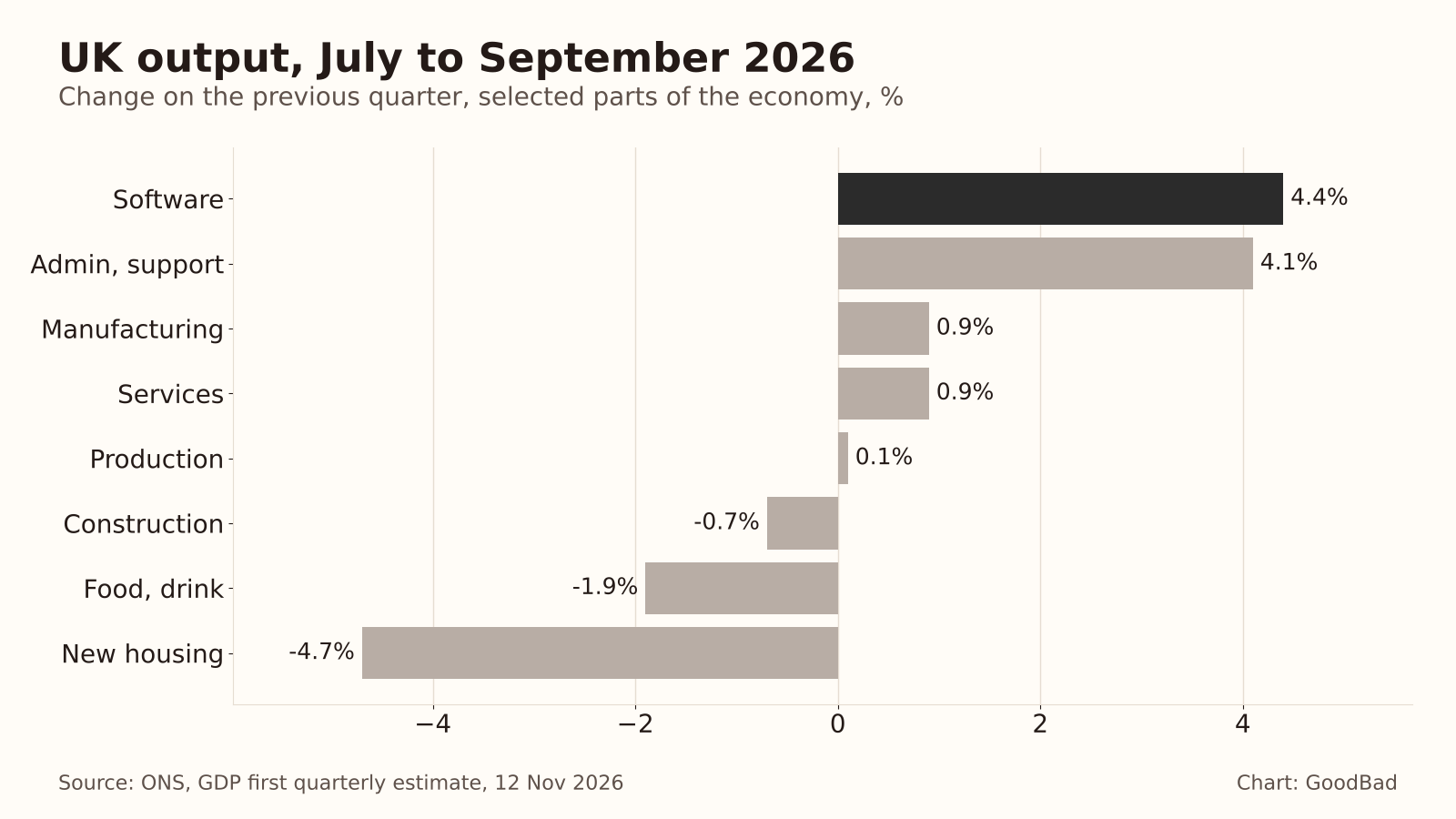 Chart: GoodBad. Data from the ONS, 12 November 2026. “Software” is computer programming, consultancy and related activities.
Spending and investment
Islam points out that this came despite a hard backdrop: the biggest disruption to energy flows in the world, rising market borrowing costs and a recent rise in interest rates. He says it is tempting to ask what the economy would have done without the Iran war and with rate cuts instead. Those counterfactuals cannot be answered with the data, but the strength is more notable for the headwinds it met.
On the demand side, households spent more. Real household consumption rose 0.6% in the quarter and is 1.8% higher than a year earlier. Government consumption rose 0.6%.
Investment is the number to watch. Fixed investment rose 1.7% in the quarter and is 4.1% higher than a year ago. Business investment grew 0.4% on the quarter and is up 3.0% on the year, which Islam calls some of the most encouraging figures, helped by recent revisions. Production as a whole rose only 0.1%, and is 1.5% above a year ago. Manufacturing was its only positive part, up 0.9% and led by computer, electronic and optical products, up 4.6%, while mining, energy supply and water supply all fell.
Output per head also rose 0.7% in the quarter and is 1.7% higher than a year ago. That matters more for living standards than the headline, because it strips out population growth. Islam adds that sterling hit post-Brexit-referendum highs last week.
How it compares
Islam says the figure has not been exceeded outside the pandemic since 2017. He adds that it puts the UK on course to be the second-fastest growing economy in the G7 this year, behind only the United States. The group also includes Canada, Japan, Germany, Italy and France.
The monthly path was uneven. The economy grew 0.4% in July and did not grow in August, a figure revised down from 0.1%. It then grew 0.2% in September. The quarter’s strength therefore comes largely from a strong July and a continuing recovery in September.
What it means for you
For most households the effect is indirect. Faster growth tends to support jobs and tax receipts, which matters for public spending decisions. It does not lower prices. The ONS deflator, the broadest measure of domestic inflation, rose 2.3% on a year earlier, and the UK’s trade deficit stood at 1.3% of GDP.
Islam says the figure “kills the doom” but is not a boom, and he warns that this pace may not last for the final three months of the year. Consumer confidence has fallen as petrol and domestic energy prices start to rise again. Construction fell 0.7% in the quarter and is 1.7% lower than a year ago. Private housebuilding remains depressed.
What happens next
Two things decide the next reading. The first is whether spending on AI and technology continues. Islam says the AI data-centre boom may at any point turn to bust, though the figures suggest the spending is currently helping growth. The second is energy. He says the Iran conflict is the big unknown, and that a durable end to it could bring down petrol prices, energy bills, borrowing costs and mortgage costs.
The next estimate will revise this one. The ONS says its first estimates have on average been revised by 0.08 percentage points upward by the final version, with a mean absolute revision of 0.27 points. That is a reminder that 0.7% is a first count, not the last word. Even so, the direction is clear. The quarter was much better than forecast, led by technology-related services, with investment and household spending both adding to it.