Good news
World Food Prices Dip 1.2 Percent in October as Wheat and Dairy Ease
The UN's food price index fell to 133.9 points in October, helped by cheaper wheat, maize, butter and cheese. Cereal prices are 12.6 percent below a year ago, and the index sits 16.4 percent under its 2022 peak.

Read the bad side of this story
Sugar Rises for a Fourth Month as Food Prices Stay 5.9 Percent Above 2025
The price of the world’s staple foods slipped again in October. The Food and Agriculture Organization (FAO) of the United Nations says its Food Price Index averaged 133.9 points, down 1.6 points, or 1.2 percent, from a revised September figure. The index tracks export prices of a basket of cereals, vegetable oils, dairy, meat and sugar, so it moves before supermarket prices do. It was released on 6 November.
The two heaviest drags came from the foods most people eat every day. The cereal index fell 4.5 percent in the month to 116.8 points and is 12.6 percent below October 2025. Wheat dropped after four straight monthly rises, because international demand is subdued and Argentina’s crop outlook has improved. Maize slipped from a three-year high reached in September. The US harvest and big South American supplies weighed on it, and FAO says hopes of easier Black Sea exports added to the pressure.
Dairy and meat get cheaper
Dairy fell 1.1 percent to 117.8 points, which leaves it 16.9 percent below a year ago. The detail is useful for anyone who buys butter or cheese. Butter is 31.1 percent cheaper than a year earlier and cheese 29.3 percent cheaper. European stocks are high and US exporters are competitive. Skim milk powder moved the other way, up 45.8 percent, so the dairy aisle is not uniform.
The meat index fell 1.2 percent to 125.5 points, with pig, sheep and beef quotations lower. Sheep meat prices retreated further from record highs as Australian supplies rose. Poultry was steady, and FAO notes the recent meat figures partly rest on projected prices that can be revised.
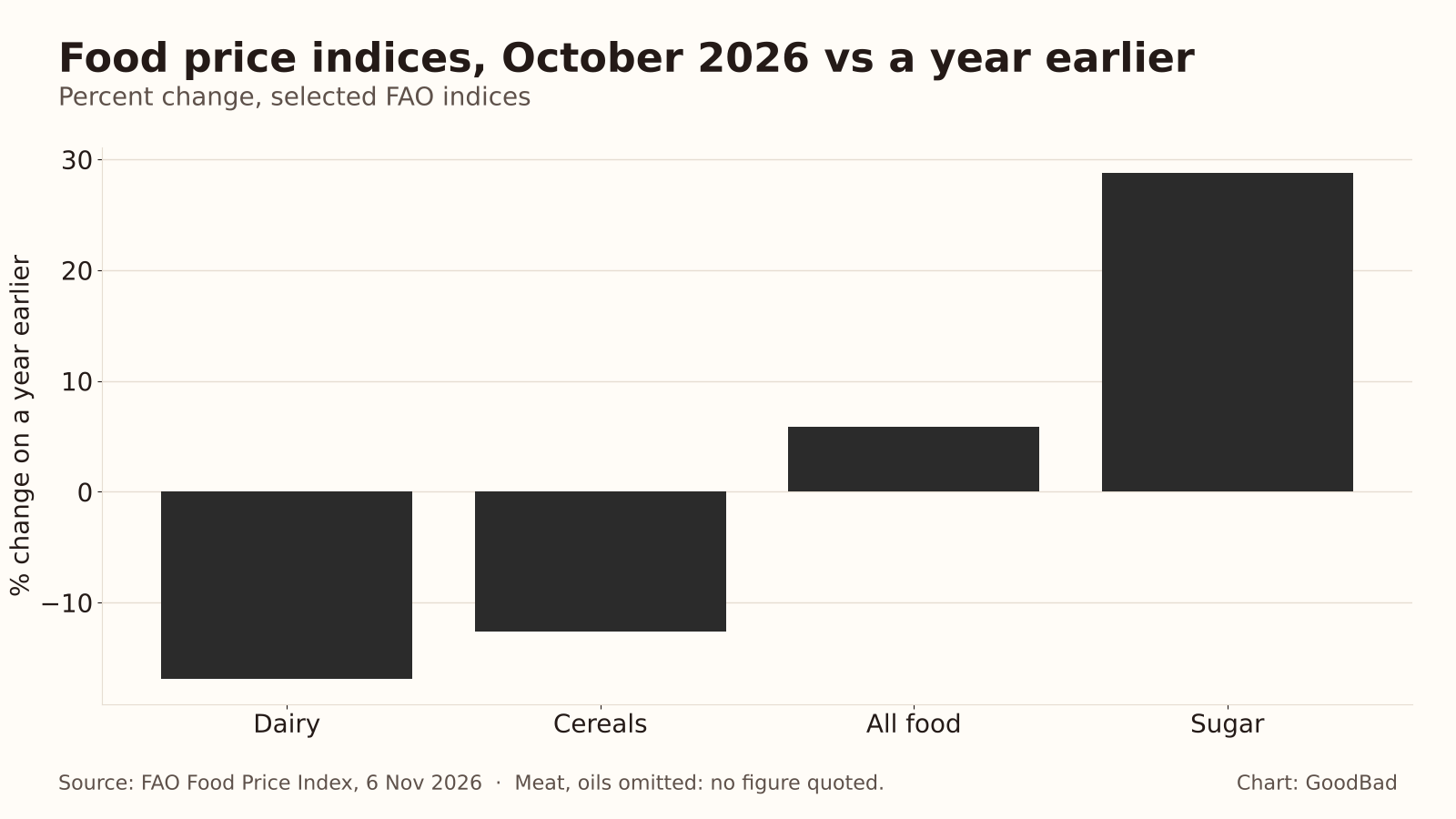 Chart: GoodBad. Data from the FAO Food Price Index, released 6 November 2026.
Does this reach the shelf?
Not directly or quickly. The index measures international export quotes, and retail prices include processing, transport and local taxes. What it does show is the direction of the raw cost that food makers and importers pay. For countries that import most of their wheat, cheaper grain eases the bill for bread and flour, though currency moves can cancel it.
A second FAO release published the same day, the Cereal Supply and Demand Brief, explains why grain is not running short. World cereal production is forecast at 2,999 million tonnes in 2026, down from the 2025 record but the second-highest on record. Global cereal stocks are forecast to rise by 17.2 million tonnes, or 1.8 percent, by the close of the 2027 seasons.
How far prices have come
The index remains 16.4 percent below its March 2022 peak, FAO says, though it is 5.9 percent above October 2025. That year-on-year rise is driven mainly by sugar and vegetable oils, not by cereals. Rice is the exception among grains. Its price index rose 1.6 percent in October after harvest delays and poor weather. FAO expects rice production to fall 2.5 percent to 552 million tonnes, the first contraction in four seasons.
The next reading is due on 4 December. The two things to watch are whether wheat holds its fall as Black Sea shipping improves, and whether the El Niño-related weather that hurt rice spreads to other crops.