Good news
Euclid Opens Its First Big Slice of a 3D Universe Map to Everyone
ESA’s Euclid telescope has released 13 months of observations covering 1,900 square degrees of sky, more than a billion objects and about 15,000 strong gravitational lenses, the first major dataset since its 2023 launch, open to researchers worldwide.
This story runs on the good side only. The biggest stories of the day are told on both sides.
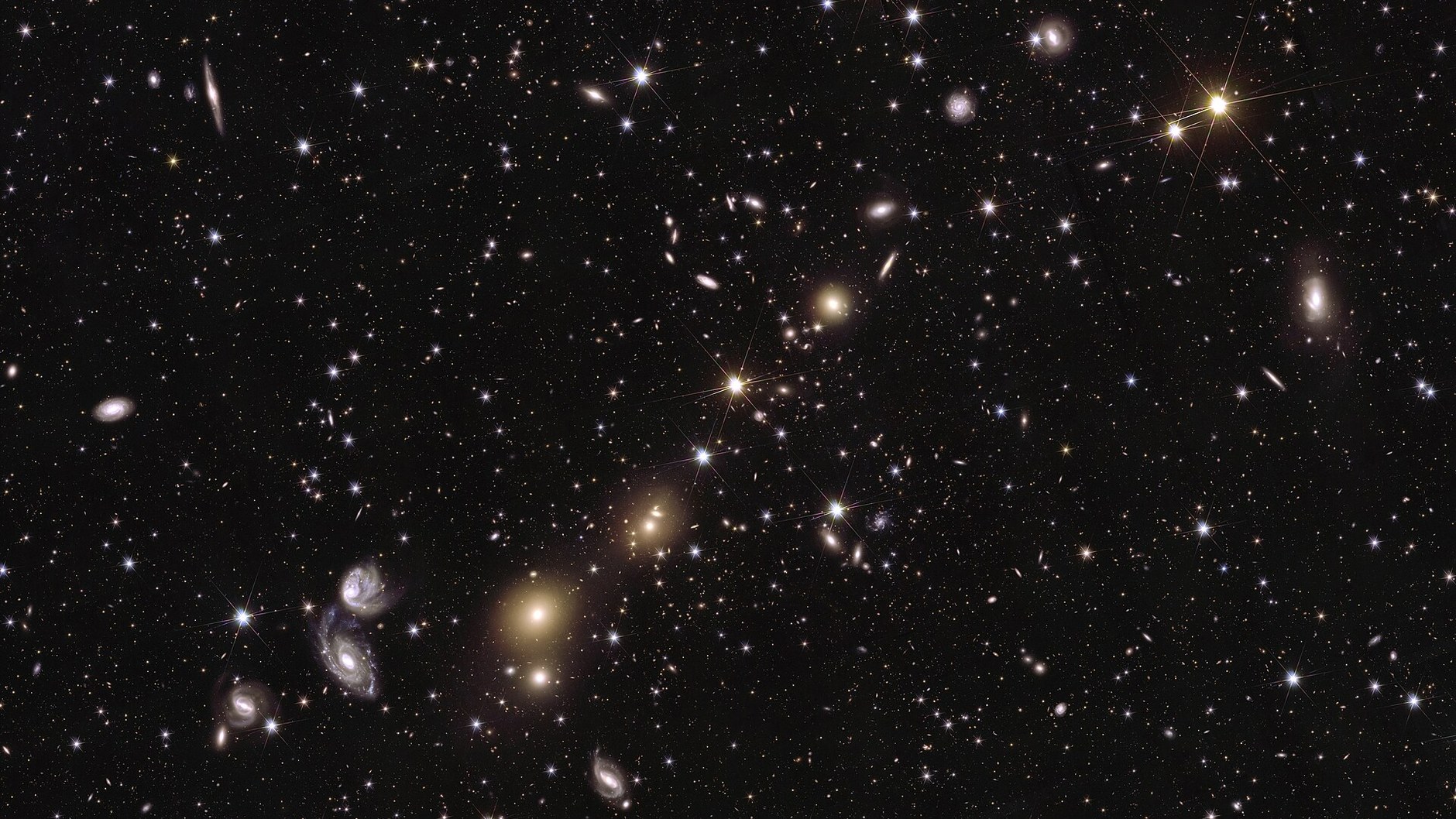
The European Space Agency has released the first major batch of data from its Euclid space telescope, and anyone can now download it. The release, called DR1-Foundation, holds about 13 months of observations. It captures the light of more than a billion objects across a patch of sky as big as 9,500 full Moons, ESA says.
It is the first big release since the telescope launched in July 2023. Euclid is built to map the sky for six years and turn the result into the largest and most accurate 3D map of the Universe. This batch gives scientists the first pieces they need to start building it.
How big a step this is
Until now, Euclid’s public data came in small tastes. Earlier releases covered a few days of observing over about 60 square degrees of sky. The new one is a different scale, as the mission’s project scientist, Valeria Pettorino, put it in ESA’s release.
| Earlier releases | DR1-Foundation | |
|---|---|---|
| Observing time | A few days | About 13 months |
| Sky covered | About 60 square degrees | 1,900 square degrees (Wide Survey) |
| Objects captured | Not stated | More than a billion |
| Spectra | Not stated | 160 million sources |
Source: ESA release, 12 November 2026. “Not stated” means ESA gave no figure for the earlier releases.
The Wide Survey part of the release alone amounts to 1.7 million gigabytes. Storing and sharing catalogues with more than a billion objects was, in the words of ESA archive scientist Bruno Altieri, “no mean feat”. The agency built a platform, the Euclid Data Space, so that researchers can view and process the data without moving all of it.
The data is public. A Euclid Consortium researcher quoted by the Spanish institute said the release “will enable discoveries by researchers around the world”. It carries raw data, calibrated images, catalogues and spectra. That makes it useful to a university group with a laptop and a good idea, not only to the teams that built the instruments.
Why gravitational lenses matter
The headline find is a catalogue of strong gravitational lenses. A lens forms when a massive foreground galaxy bends the light of a more distant one, which can stretch it into arcs or rings. Because the bending depends on the foreground galaxy’s total mass, lenses let astronomers “weigh” galaxies, including the dark matter that cannot be seen. They also act as natural magnifying glasses for galaxies from billions of years ago.
Lenses are rare. Only about one galaxy in several thousand acts as one, and many are too small to pick out through Earth’s blurry atmosphere. Euclid’s team found around 15,000 candidate systems in a haystack of more than a billion stars and galaxies. ESA says that is the largest strong-lens catalogue ever made, bigger than all earlier catalogues combined.
The method matters as much as the number. The lenses were found with machine learning and with help from thousands of citizen scientists who volunteered to scan Euclid images. Because one telescope found all of them in the same way, researchers can study lenses as a population of thousands rather than a handful of one-off curiosities. ESA notes that almost fifty years have passed since the first strong lens was discovered.
What else is in the box
The release also contains spectra, the “rainbows” made by splitting a galaxy’s light, for 160 million sources. Spectra reveal what a galaxy is made of and how far away it is. Euclid will look for the glow of hydrogen gas in them to place galaxies in three dimensions and trace the cosmic web, the mesh of mostly invisible dark-matter filaments that threads through space.
Euclid has also spotted very distant quasars, the brilliant phases of galaxies whose central black holes are feeding. The oldest date from when the Universe was about 5% of its current age. The release adds ancient galaxy clusters and faint starlight spread between galaxies, which acts as a fossil record of how clusters formed.
Scientists have already started using it. A study of more than 40 million star-forming galaxies, the first paper to present data from this release according to the Instituto de Astrofísica de Canarias, reconstructed their true three-dimensional shapes. Its authors report that most are flattened, with the share of elongated galaxies changing over cosmic time. Spanish institutions took part in the mission, and the institute says it helped design the control electronics for one of Euclid’s two instruments.
What is still missing
The release is a foundation, and ESA is plain about its limits. It covers only about 14% of the sky area Euclid will eventually survey. The weak-lensing measurements, which detect the subtler distortion of light by dark matter, are not yet included. Nor are the calculations of how galaxies and clusters sit inside the cosmic web.
Those arrive with the full Data Release 1, planned for mid-2027. Until then researchers around the world will mine the new data. The first results are likely to be analyses of lenses, clusters and galaxy shapes, not final answers about dark energy.
Does this change anything for people outside astronomy? Not directly. The practical gains are in the tools: machine-learning methods for finding rare objects in huge images, and an open platform for handling billion-object catalogues. The scientific prize is slower. ESA’s director of science, Carole Mundell, called it a scientific milestone, and the next test is whether the 2027 release can turn 14% of the survey into a complete map.