Good news
First Immunotherapy for Advanced Anal Cancer Reaches NHS Patients Within a Week
NICE has recommended retifanlimab with chemotherapy for anal cancer that has spread, the first drug it has backed for this disease. About 250 people a year in England are eligible, and in the trial they lived 32.8 months on average against 22.2.
This story runs on the good side only. The biggest stories of the day are told on both sides.
People in England with anal cancer that has spread can now be offered an immunotherapy that helped patients live almost three years in a trial. On 12 November the National Institute for Health and Care Excellence (NICE) recommended retifanlimab, sold as Zynyz by Incyte Biosciences, with platinum-based chemotherapy. It is the first drug NICE has backed for this form of the disease.
The drug is available on the NHS from the same day. NICE published its guidance as the Medicines and Healthcare products Regulatory Agency granted the marketing authorisation. NHS England says the drug reached patients within a week of approval, through its fast-tracking route for new cancer drugs. NHS England counts around 250 patients a year as eligible.
What the trial showed
The evidence comes from a placebo-controlled trial that compared retifanlimab plus carboplatin and paclitaxel with a placebo plus the same chemotherapy. Neither release gives the trial phase or the number of patients, so this is a gap in what can be checked today.
The reported results are consistent across both bodies. People on retifanlimab had a median of 9.3 months before their disease got worse, against 7.4 months on placebo. Their average survival was 32.8 months, against 22.2 months on chemotherapy alone, a difference of about 10.6 months. NHS England rounds that to 11.
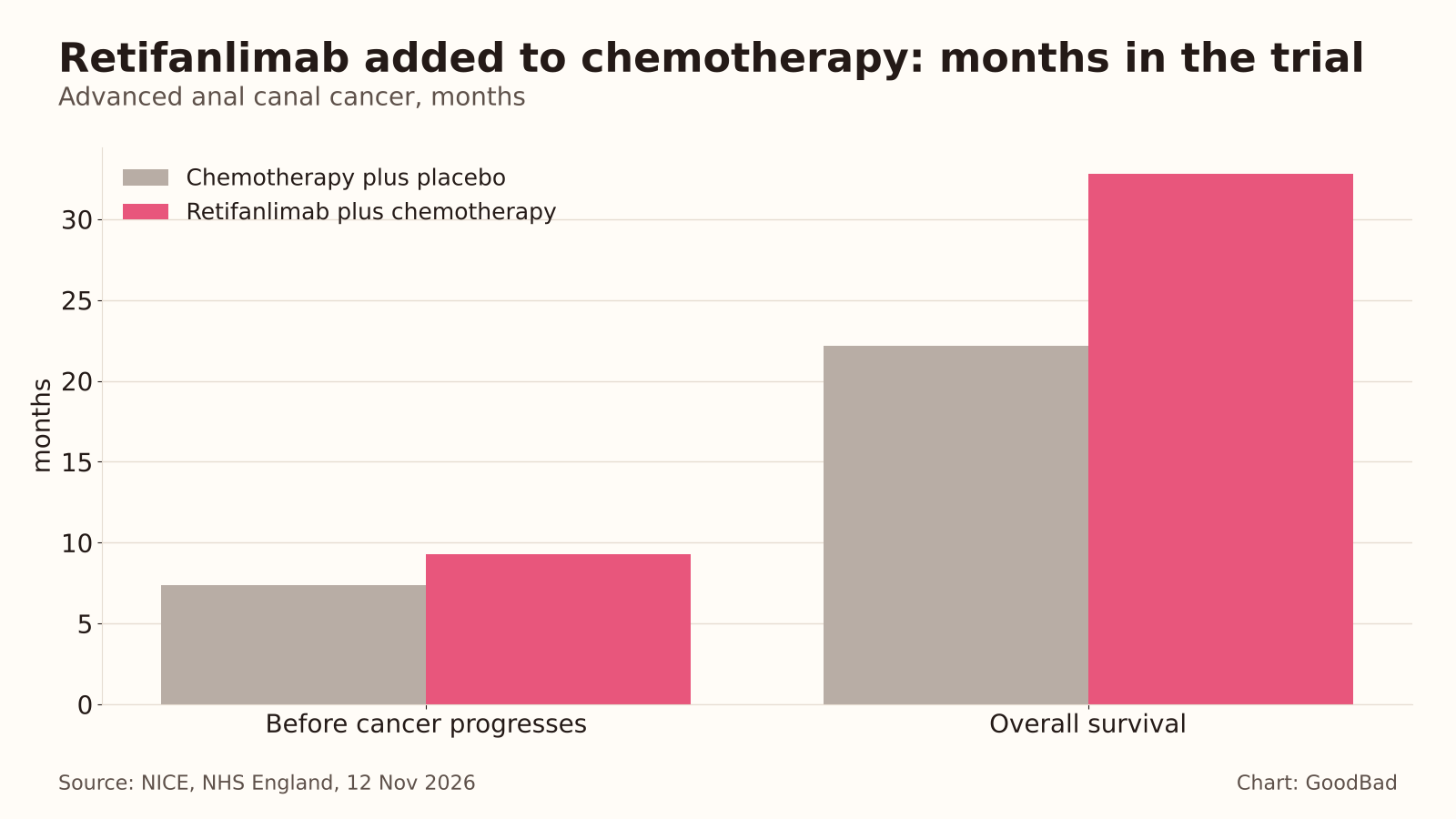 Chart: GoodBad. Data from NICE and NHS England, 12 November 2026.
Some patients had much longer-lasting responses, NICE notes, though it gives no figure for how many. The company, Incyte, says the approval is a milestone for a patient community that has seen few advances, and it will work with the NHS on access. That is a statement from the manufacturer, so it sits alongside the independent bodies’ figures rather than replacing them. The treatment is a monthly intravenous infusion, which NHS England describes as once every four weeks for up to a year, initially alongside chemotherapy.
Why this cancer needed a new option
Anal canal cancer is rare, affecting the end of the large bowel. Symptoms include rectal bleeding, pain or severe itching, and changes in bowel habit. An estimated 1,600 people were diagnosed each year in the UK between 2017 and 2019, two-thirds of them women, and NHS England says incidence has risen sharply over recent decades.
When the cancer is caught before it spreads, around 90% of people are alive after five years. For cancer that has spread, the figure is about 20%. That gap is why treatment choices matter so much for the people covered by this decision. Until now, the standard for untreated metastatic or inoperable locally recurrent squamous cell anal cancer was chemotherapy alone.
The drug is a PD-1 inhibitor. It targets a protein, PD-1, found on some white blood cells called T-cells. In NICE’s words it “releases the brakes” on the immune system, so those cells can recognise and attack cancer cells.
Does it affect you?
For most readers, no: the disease is rare, and the group covered is a few hundred people a year in England. But the numbers carry a wider point. A gain of about 10 months in average survival is large in a cancer where only one in five people with spread disease reaches the five-year mark. The decision also shows a faster path from approval to the ward, because NHS England and NICE moved on the same day the licence arrived.
Who benefits, and who cannot
Eligible patients are adults whose cancer has spread, or has come back locally and cannot be removed by surgery. People whose cancer is caught early are treated differently, and this guidance does not change their care. The guidance applies in England, and the releases do not say when or whether the other UK nations will follow.
NHS England’s national clinical director for cancer, Professor Peter Johnson, called access to the drug “one of the most significant steps in decades” for people with advanced anal cancer. Charities welcomed it too. The Anal Cancer Foundation’s chief executive, David Winterflood, said the cancer had been overlooked for too long.
Bowel Cancer UK’s clinical lead, Dr Claire Coughlan, said the decision expands treatment options. Patient experts also told NICE’s independent committee that low awareness of anal cancer and its symptoms means it is often diagnosed late, when it has already spread.
What is not yet known
Several questions are open. Neither release states the price the NHS will pay, nor the side effects seen in the trial. NICE describes what it published as final draft guidance. Whether the roughly 250 patients a year figure holds in practice will depend on how quickly hospitals set up the infusions.
HPV infection is linked to about 90% of UK cases, and HIV is another risk factor. Prevention and earlier diagnosis therefore sit outside this decision, but they matter for the same group of patients. For now, the change is simple to state. A patient with advanced anal cancer in England who would have had chemotherapy alone last week can be offered a drug that, in the trial, added months of life.
NICE says it is publishing guidance 30% faster for medicines than it did before April 2024. The measure of success here will be how many eligible patients receive retifanlimab in the first year.