 Good news
NASA Opens Astronaut Hiring and Funds a Nuclear Moon Rover for 2028
NASA is taking astronaut applications until 3 December and has awarded Moon Base contracts, including a nuclear-powered rover for the lunar South Pole. The agency still has to finish the spacesuits its crews will wear on the surface.

Read the bad side of this story
Moon Base Contracts Grow While the Spacesuits Astronauts Need Run Behind
NASA spent last weekend filling in the hardware and the crew for its planned base at the Moon’s South Pole. On Saturday 7 November the agency announced a set of Moon Base awards at an air show at Kennedy Space Center. The same day it opened applications for its next class of astronauts. Between them, the two announcements cover cargo, power, a rover and the people.
The centrepiece is a nuclear-powered rover called PROMISE. NASA says the six-wheeled vehicle can work through the long lunar night and inside permanently shadowed craters thought to hold water ice. It carries a drill that reaches about one metre (3 feet) down, plus spectrometers and radiation sensors.
A rover built from spares
The rover is cheaper than it sounds because it is largely recycled. The Jet Propulsion Laboratory in California will build PROMISE from spare flight parts and engineering test models left over from the Curiosity and Perseverance Mars rovers. NASA says proven hardware and software shorten the schedule and cut cost, and that it has checked the parts can tolerate conditions near the South Pole.
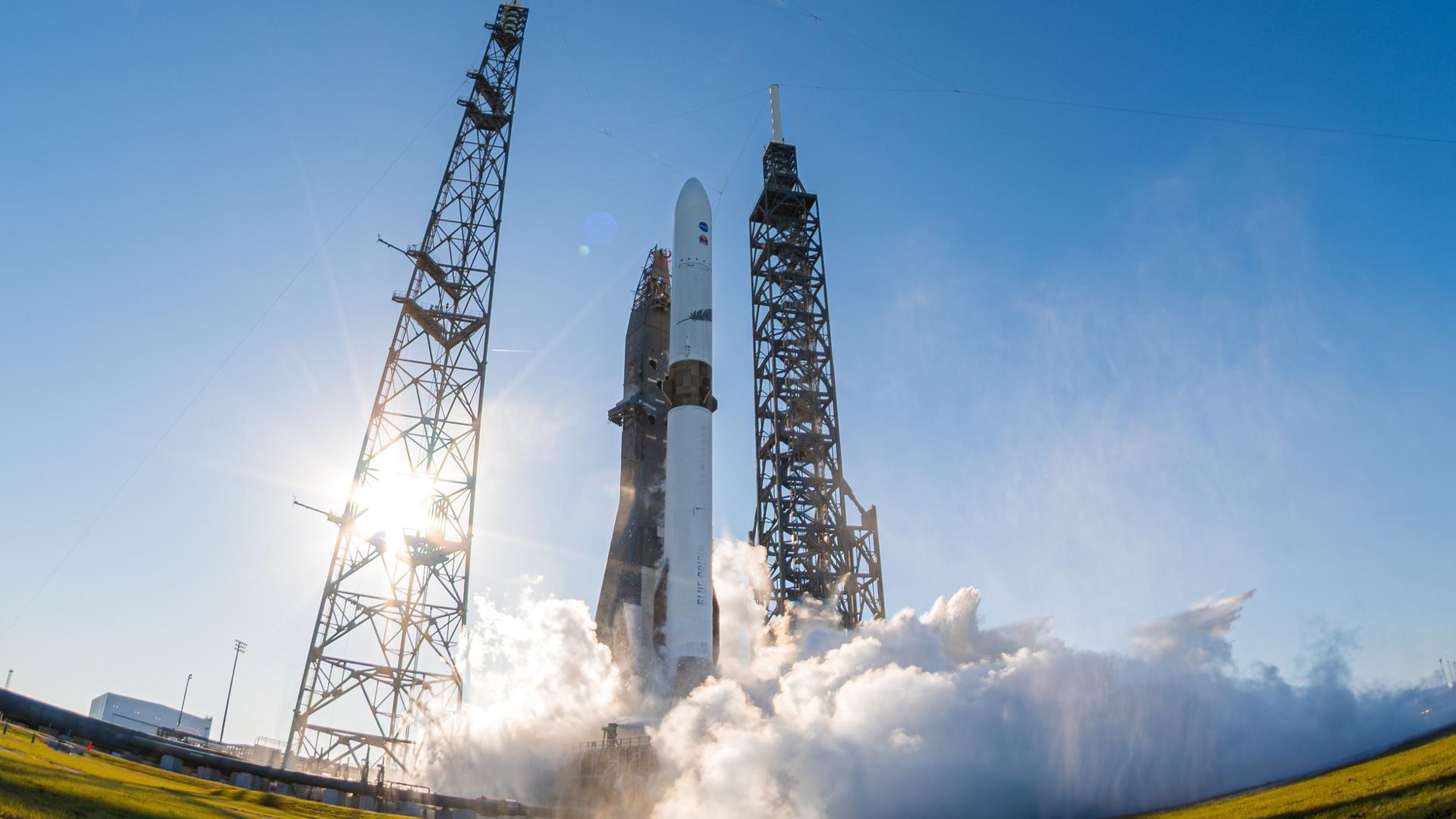
Blue Origin will land it. The company gets a $94 million base contract, with an option worth a further $140 million that depends on performance, to deliver the rover on its Mark 1 lander. NASA is targeting a late 2028 launch and an 18-month mission. The rover’s job is partly practical: it will map ice and help pick the landing sites that crews and later cargo will use.
Eight landers, one ten-year contract
The bigger award is for delivery. NASA picked eight companies for the next phase of its Commercial Lunar Payload Services programme, known as CLPS 2. They are Blue Origin, Firefly Aerospace, Intuitive Machines, iSpace US, Lockheed Martin Space, Northrop Grumman Space Systems, SpaceX and Voyager Technologies. They become eligible to bid for individual delivery missions under a ten-year contract with a combined maximum value of $10 billion.
NASA also raised the ceiling on the original contract, CLPS 1.0, from $2.6 billion to $4.2 billion to cover the first phase of the Moon Base. That contract stays in force until November 2028, with a further five years to finish deliveries already awarded, through November 2033.
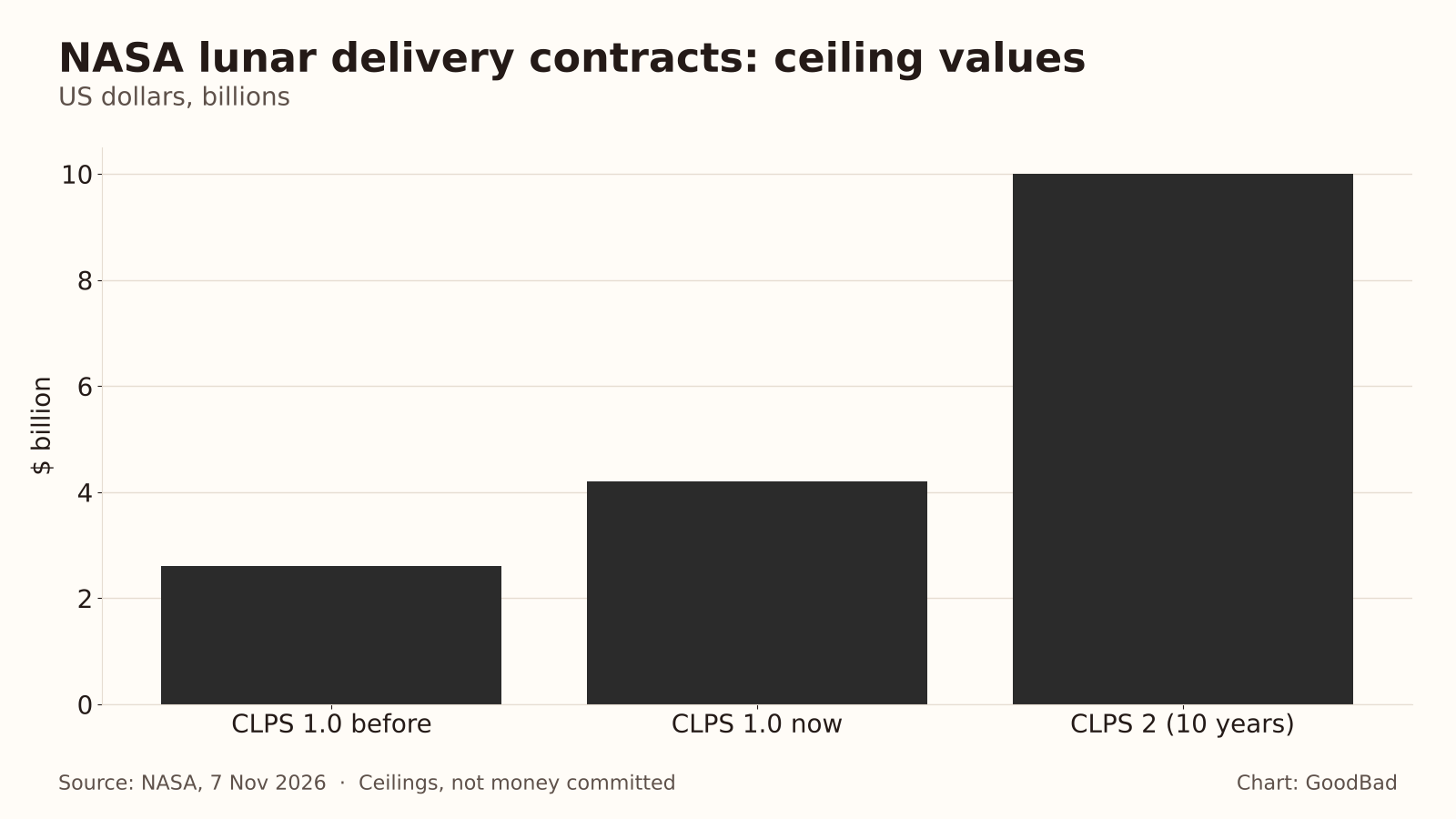 Chart: GoodBad. Data from NASA, 7 November 2026. Ceilings are the most NASA can order, not money committed.
A ceiling is not a budget. The companies compete for each mission, so the money flows only as flights are ordered. The practical effect is competition. Eight firms now have a standing route to NASA’s cargo orders, and the agency can ask them to compete for each flight as it orders it.
NASA also awarded six task orders for launch and orbital transfer services under a separate contract. Arrow Science and Technology, Blue Origin and Impulse Space will carry Moon Base cargo, in what NASA describes as freight-truck services between Earth and the Moon.
Who can apply
The astronaut call is open to US citizens until 11.59pm Eastern time on Thursday 3 December. Applicants need a master’s degree in a science, technology, engineering or mathematics field, or a qualifying alternative such as a medical degree, completed test pilot school or two years of doctoral work. They also need three years of related professional experience. Pilots can meet that with set flying hours, from 750 hours as pilot in command of a high-performance jet to 1,000 hours in helicopters.
NASA expects to choose its class in late 2027. The last call, in 2024, drew more than 8,000 applications and produced 10 candidates, who are about two years into their training. Since the 1960s NASA has selected 370 people for astronaut training, and 32 are active today.
NASA Administrator Jared Isaacman said the people selected could walk on the Moon and live and work at the Moon Base. The agency has said it aims to return Americans to the Moon in 2028, and both SpaceX and Blue Origin intend to support a crewed landing.
The gap that is left
One piece is still unfinished. NASA’s inspector general reported in April that the next-generation spacesuits are at least a year and a half behind schedule. Axiom Space, now the sole supplier after Collins left the programme in 2024, is planning for demonstration readiness in late 2027. The suit contracts are worth up to $3.1 billion. The watchdog said NASA’s earlier goals of 2025 and 2026 were “overly optimistic and unrealistic”, and that if Axiom’s testing follows historical averages the demonstrations would not happen until 2031.
That caveat is the main thing to watch. The awards and the applications show a programme assembling its parts at speed. Whether the suits arrive in time for a 2028 landing is the open question, and the inspector general’s 2031 figure shows how wide the range of outcomes is. The inspector general says NASA is taking proactive steps to help Axiom succeed, but the sources do not say when the first suit will be tested on the Moon.
For readers, the dates to hold on to are 3 December, when applications close, late 2027, when the next astronaut class is chosen, and late 2028, when PROMISE is due to launch.