Bad news
Sugar Rises for a Fourth Month as Food Prices Stay 5.9 Percent Above 2025
The UN's food price index eased 1.2 percent to 133.9 in October, but sugar is up 28.8 percent on a year ago and at a 23-month high. Rice prices are rising and FAO expects the first fall in rice output in four seasons.

Read the good side of this story
World Food Prices Dip 1.2 Percent in October as Wheat and Dairy Ease

Sugar is getting dearer while most other food gets cheaper, and the overall bill is still higher than a year ago. The Food and Agriculture Organization (FAO) of the United Nations says its sugar price index rose 6.6 percent in October to 121.3 points. That is 28.8 percent above October 2025, the fourth consecutive monthly rise and the highest level since December 2024, according to the FAO Food Price Index released on 6 November.
The reasons are weather and supply. Rain disrupted cane harvesting and crushing in Brazil’s Centre-South, the main producing region. FAO adds that below-normal and uneven monsoon rain has raised concern about India’s crop, and that lower output is forecast in the European Union and Thailand for 2026/27.
The headline hides the rises
The all-food index was 133.9 points, down 1.2 percent on September, and still 5.9 percent higher than a year earlier. Vegetable oils edged up 0.3 percent to 199.2, by far the highest of the five groups, and FAO says soybean oil reached its highest since late 2022 on firm biofuel demand. Palm oil stays well above its level a year ago.
Rice is the grain to watch. The FAO all-rice index rose 1.6 percent in October, as harvest delays, adverse weather and higher costs pushed exporters’ prices up. FAO’s Cereal Supply and Demand Brief, also released on 6 November, expects rice production to fall 2.5 percent to 552.0 million tonnes. That is the first contraction in four seasons, and FAO blames poor producer margins and El Niño-related weather. It also expects rice use of 558.8 million tonnes, more than will be produced.
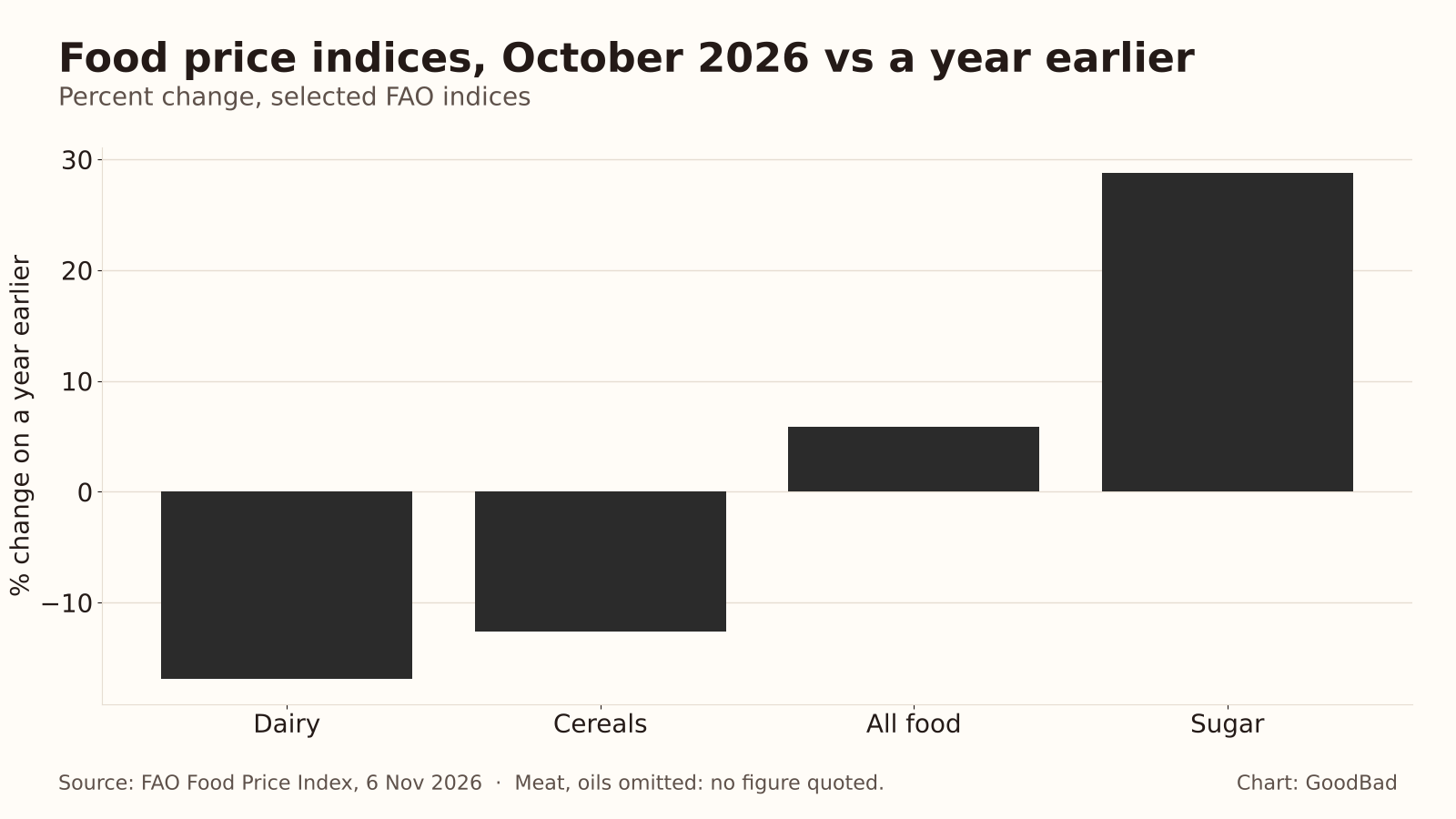 Chart: GoodBad. Data from the FAO Food Price Index, released 6 November 2026.
Cheaper in places, not everywhere
Some of the October decline is real relief. Cereals fell 4.5 percent in the month and are 12.6 percent below a year ago. Dairy fell 1.1 percent to 117.8, with butter down 31.1 percent and cheese down 29.3 percent on the year. Skim milk powder is 45.8 percent higher, so buyers of powder face the opposite market. Meat fell 1.2 percent but remains slightly above its level a year earlier. FAO notes that sheep meat prices, although off record highs, stay well above last year’s because export supplies are tight.
Disruption still hangs over the grain trade. FAO says Black Sea logistics continue to limit how far wheat prices can fall, and its brief says trade is set to contract on logistical constraints. Newcastle disease outbreaks first detected in Brazil’s Santa Catarina state on 18 October have led some trading partners to restrict poultry imports, although regional arrangements are limiting the damage.
What it means
Export indices reach shoppers slowly and unevenly, because retail prices also carry transport, processing and tax. For households in rice-importing countries, and for anyone buying sugar-heavy food, the signals point up. The index remains 16.4 percent below its March 2022 peak, which is the context for a year-on-year rise of 5.9 percent. The next FAO reading is due on 4 December.