Good news
UK Will Make Employers Say What They Pay in Job Adverts
The UK government plans to make salaries in job adverts a legal requirement, and has asked firms to start now. Fewer than half of employers always publish a pay range today, and 94 percent of consultation replies backed the change.
This story runs on the good side only. The biggest stories of the day are told on both sides.
Soon you may never have to apply for a job without knowing what it pays. On 5 November the UK government announced plans to require every job advert to state the salary. Prime Minister Andy Burnham also asked firms to start doing it now rather than wait for the law, which ministers say will be brought forward “as soon as possible”.
The plan is a practical fix to a familiar annoyance. It also puts Britain alongside the European Union, where employers will have to disclose initial pay or a pay range, either in the advert or before an interview, the BBC reports.
Where practice stands
Government figures, published in its announcement, estimate that less than half of employers, 41 percent, always publish salary ranges. Only 18 percent always publish a specific salary. The BBC adds data from the UK jobs site Adzuna: 51 percent of the adverts on the site in September carried pay information, a share that has been falling in recent years.
Earlier research from the CIPD, the body for HR professionals, found that the public sector and charities are more likely to reveal pay than private firms. It also found that ranges are more common than single figures. Not all employers are fully open, and some ranges are wider than £10,000.
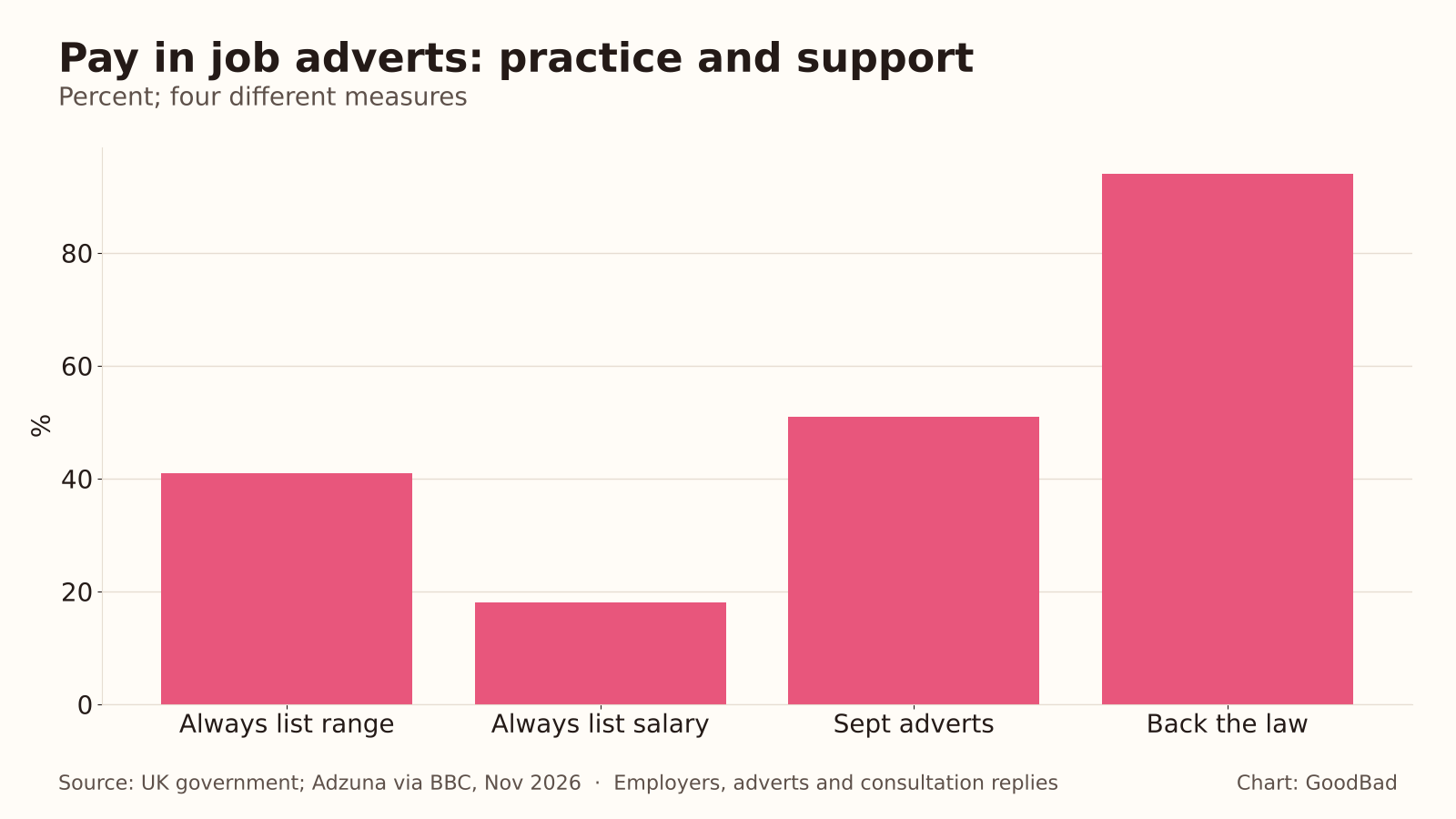 Chart: GoodBad. Data from the UK government and Adzuna via BBC, November 2026. The four bars measure different things: employer practice, adverts on one site, and consultation replies.
Why the government says it matters
The government’s case rests on two groups. The first is young people applying for a first job, who can still be asked to apply without knowing the pay. The announcement is tied to efforts to reduce the nearly one million young people who are not in education, employment or training. The final report of the Milburn Review into youth inactivity is due in the coming weeks.
The second is women. The government says hiding pay forces applicants to negotiate blind, which leaves women more exposed to lower offers. It adds that publishing pay upfront can expose unjustified differences and give workers more confidence to challenge discrimination. Burnham told the BBC that the current system feels weighted against the applicant, and that the change is meant to tilt the scales back.
There is also broad support on paper. Early analysis of a Cabinet Office consultation held over the summer found that 94 percent of respondents backed the requirement, including 93 percent of businesses.
What the law would do for pay gaps
The government links the plan to the gender pay gap, and the Equality and Human Rights Commission has backed the direction. The government’s reasoning is simple. When a salary is public before an offer, every applicant starts from the same figure. A gap between what two people are offered for the same job is then easier to see.
The government is also quick to say it is not working alone. Siemens Mobility, named in the announcement, has promised to give 10,000 young people work experience in engineering and technology, and the government has a target of 200,000 work experience opportunities. Those pledges are separate from the pay rule, but they sit in the same package aimed at getting young people into work.
The objections
Not everyone is persuaded. The CIPD’s chief executive, Neil Carberry, said in principle that giving salary detail is a good thing, but that in practice it is more complicated. He said there is not always a single fixed figure and that employers set pay according to a candidate’s skills, experience and potential. He argued that drafting adverts is best left to good employer practice rather than regulation.
The Conservative shadow business secretary, Julia Lopez, said the law would make life harder for employers who already find it hard to hire. She said it should be up to businesses to decide what to advertise, so long as they are not dishonest, misleading or discriminatory.
What changes for you
If you are a jobseeker, the practical effect is that the pay will be on the page before you spend an evening on an application. The government has not said when. It will set out what information adverts must include, and how the rule will be enforced, “in due course”. Until then, the call for voluntary publication is only a request.
If you are an employer, the likely question is whether to give a single salary or a range. The government says its aim is to make openness about pay the minimum standard, and the EU model allows a range, but the UK details are not yet published.
The change builds on a week of related moves. A week before the announcement, the Equality and Human Rights Commission said publishing salaries in adverts would be a positive step. It also said bosses should have to answer questionnaires about colleagues’ pay, and that employers should be barred from asking about a candidate’s current salary. Burnham was also challenged over MPs advertising for office staff without giving a salary, and said the rule would apply to them too.
What to watch
Three things will decide how much this changes. The first is the bill itself and its date. The second is how ranges are treated, since the CIPD found some already span £10,000 or more. The third is enforcement. Until there is a law, the best evidence of progress will be whether the share of adverts with pay, now about half on Adzuna’s figures, keeps falling or turns around.