Bad news
No Overall Survival Data Yet for Melanoma Vaccine That Cut Relapse Risk by 42%
A personalized mRNA vaccine plus Keytruda cut melanoma recurrence or death by 42%, but overall survival is not mature, the first six months showed no gap, and no source gives a price or approval date.

Read the good side of this story
Personalized Melanoma Vaccine Cuts Relapse Risk by 42% in First Phase 3 Success
The first phase 3 results for a personalized cancer vaccine show a real benefit in melanoma, and also a long list of things not yet known. Merck and Moderna report that adding the vaccine intismeran autogene to Keytruda cut the risk of recurrence or death by 42% in 1,137 patients. The measure that matters most to patients, whether they live longer, has not been reported. The trial was also run by the two companies that stand to sell the treatment, Moderna and Merck, which makes Keytruda.
What is still missing
Overall survival data are not mature, and the companies describe only a favorable trend. The headline figure is recurrence-free survival, which counts a recurrence even if the patient is later treated successfully. Median follow-up was 24.6 months, and the trial (NCT05933577) is continuing. The results come from the sponsors’ own release and conference presentation, not yet from a published paper, although the New England Journal of Medicine has accepted them.
The benefit also took time to appear. In the first six months the two groups did about equally well (hazard ratio 0.99). The sponsors say that is because Keytruda began at randomization while each personalized vaccine had to be manufactured first. For a patient with fast-moving disease, that delay is a cost. It also means the headline 42% blends a flat first half-year with a stronger second period, so the benefit depends on patients staying well long enough to feel it.
The numbers behind 42%
At two years, 82.2% of vaccinated patients had no recurrence or death, against 70.0% on Keytruda alone. That is a gap of 12.2 percentage points, and it means about one in six vaccinated patients still relapsed or died within that window. Keytruda alone already left most patients relapse-free at two years, so the vaccine’s gain is measured against a strong baseline. Distant spread or death was 38% less likely, with 88.5% free of it against 80.2%.
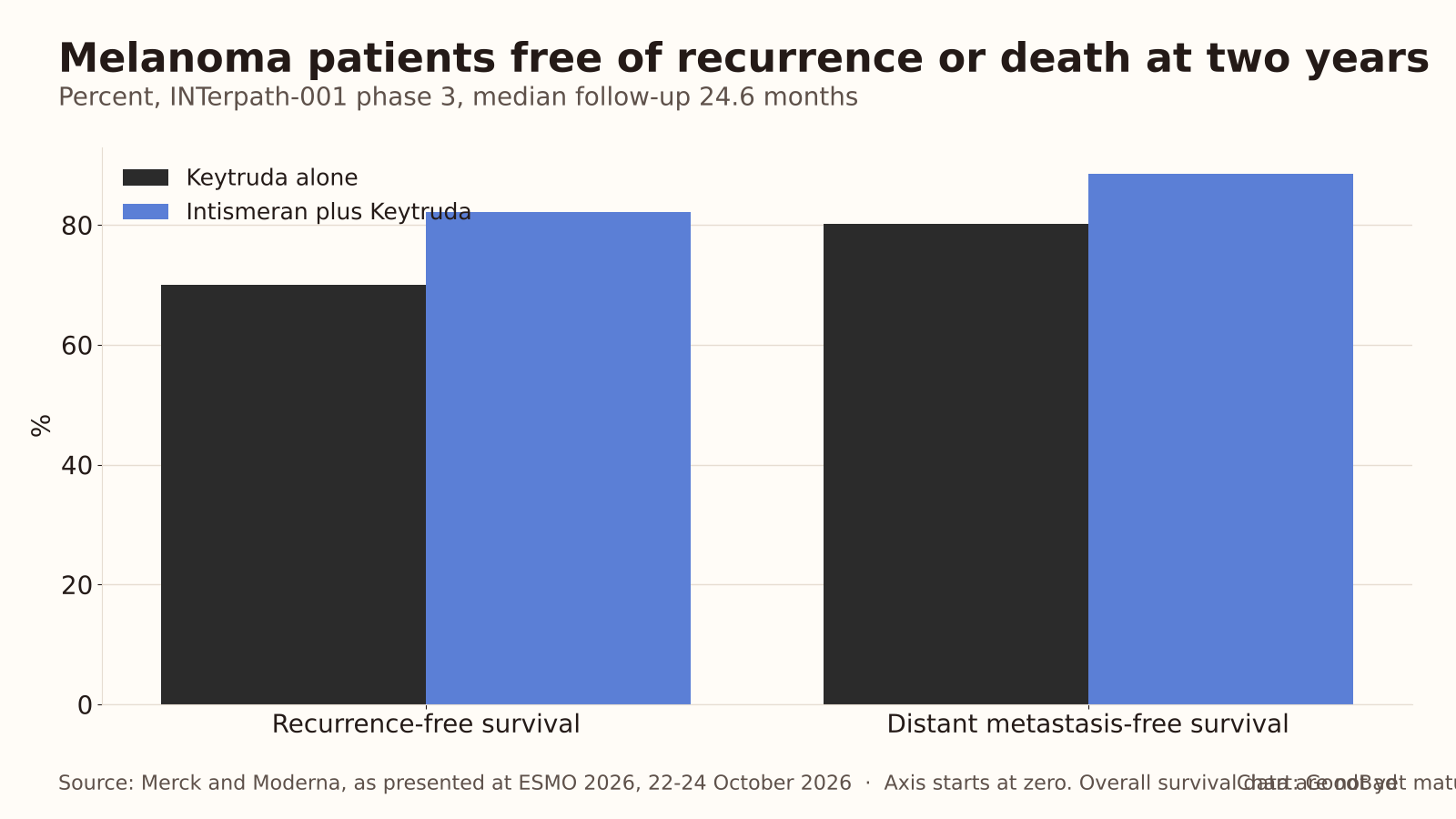 Chart: GoodBad. Data from Merck and Moderna, as presented at ESMO 2026, 22 to 24 October 2026.
Treatment-related side effects of grade 3 to 5 occurred in 14.2% of the vaccine group and 13.4% of the Keytruda-only group, the companies say. The sponsors report no new safety signals, but the vaccine arm saw more side effects overall, led by fever, injection-site pain and fatigue.
Who it may not reach
The trial enrolled people with stage IIB to IV melanoma whose tumors had been fully removed. It says nothing about patients whose cancer cannot be operated on, or about other cancers. STAT reports that experts are debating how broadly the technology can be applied.
Each dose is made from a patient’s own tumor, which makes the treatment slower and harder to scale than an off-the-shelf drug. None of the sources consulted for this report gives a price, a regulatory timetable or a plan for patients outside wealthy health systems.
STAT calls the result a clear victory for the field, and quotes Vinod Balachandran of Memorial Sloan Kettering describing a century of failed cancer vaccines before it. What would change the picture is the overall survival figure. Until it arrives, the finding is a strong signal that fewer people relapse, not yet proof that more of them live.