Good news
Personalized Melanoma Vaccine Cuts Relapse Risk by 42% in First Phase 3 Success
A personalized mRNA vaccine added to Keytruda cut the risk of melanoma returning, or of death, by 42% in a 1,137-patient phase 3 trial, which STAT calls the first successful phase 3 test of a cancer vaccine.

Read the bad side of this story
No Overall Survival Data Yet for Melanoma Vaccine That Cut Relapse Risk by 42%
Adding a personalized mRNA vaccine to standard immunotherapy cut the risk of melanoma returning, or of death, by 42% in a phase 3 trial of 1,137 patients. Merck and Moderna released the detailed results on 22 October and presented them at the European Society for Medical Oncology congress in Madrid on 24 October. STAT describes it as the first successful phase 3 trial of a cancer vaccine.
What the trial tested
The trial, INTerpath-001 (NCT05933577), enrolled people whose stage IIB to IV melanoma had been completely removed by surgery. All of them received Keytruda (pembrolizumab), a checkpoint inhibitor that is the standard follow-up treatment. Two-thirds were also given intismeran autogene, a vaccine built from the genetic mutations in each person’s own tumor. The rest received a placebo.
The trial was run by the two drugmakers, Moderna and Merck, which makes Keytruda. The vaccine uses the same mRNA technology behind the Covid-19 shots, according to STAT. It trains the immune system to recognize the unique mutations, called neoantigens, in that patient’s cancer. Every dose is therefore made for one person. Merck and Moderna co-sponsored the study, so the figures are the companies’ own until the journal paper appears.
How big was the benefit?
After a median follow-up of 24.6 months, the risk of recurrence or death was 42% lower with the vaccine (hazard ratio 0.58, 95% confidence interval 0.45 to 0.75). At two years, 82.2% of vaccinated patients were free of recurrence or death, against 70.0% on Keytruda alone. The risk of the cancer spreading to distant organs, or of death, was 38% lower, and 88.5% of vaccinated patients were free of that outcome at two years, against 80.2%.
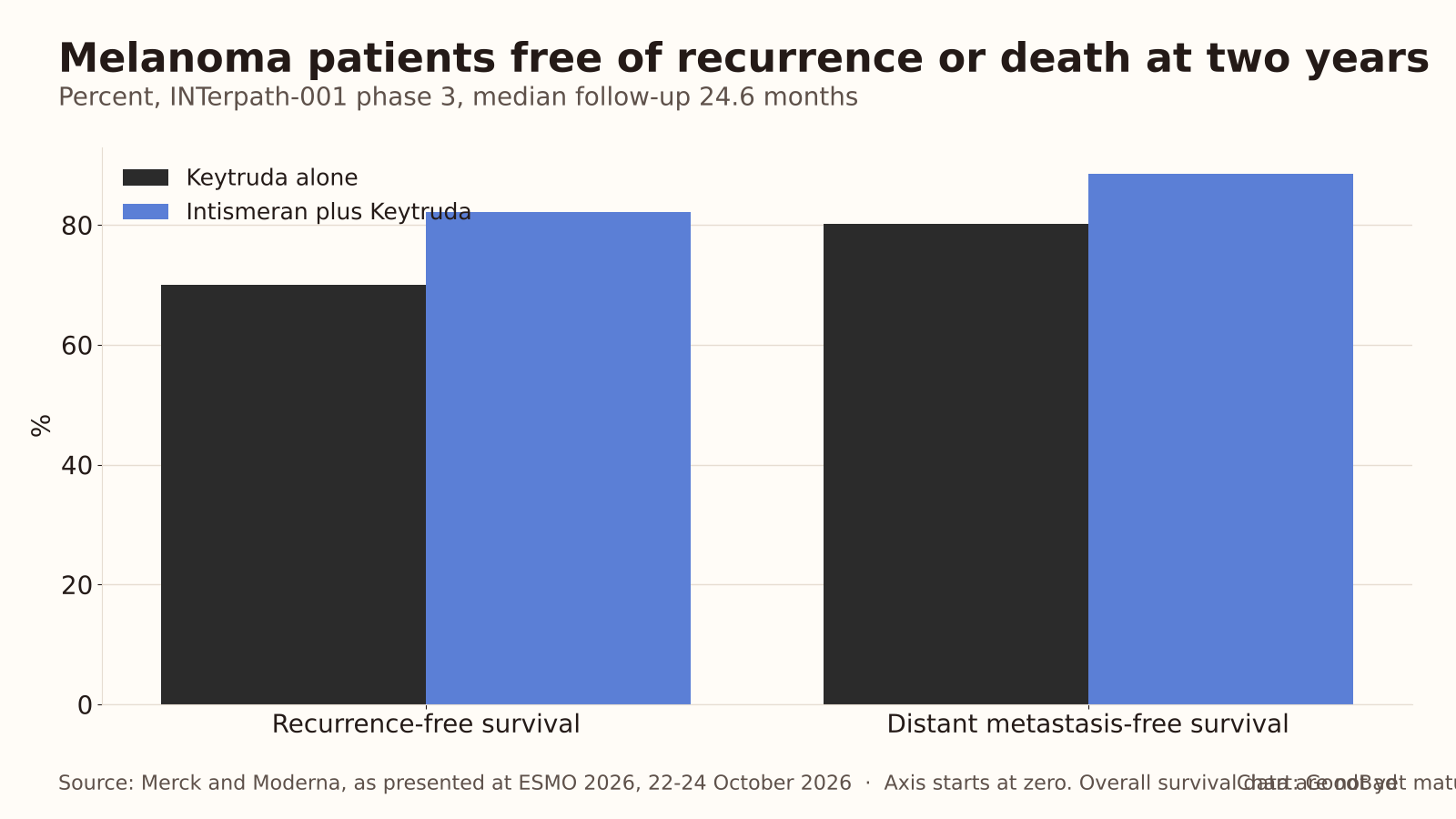 Chart: GoodBad. Data from Merck and Moderna, as presented at ESMO 2026, 22 to 24 October 2026.
The gap widened over time. In the first six months the two groups did about equally well, which fits the design: Keytruda started at randomization, while the vaccine began only once the personalized dose had been manufactured. After six months, a prespecified analysis found a 58% lower risk of recurrence or death in the vaccine group.
How safe is it?
The companies report that treatment-related side effects of grade 3 to 5 occurred in 14.2% of the vaccine group and 13.4% of the Keytruda-only group. Fever, injection-site pain and fatigue were the most common problems. The sponsors say they found no new safety signals.
What happens next?
The results have been accepted by the New England Journal of Medicine, and the study is still following patients to measure overall survival. The companies say early survival data lean in the vaccine’s favor, but they are not yet mature. No source consulted for this report gives an approval date or a price.
Specialists are already asking how far the approach can travel. James Larkin of London’s Royal Marsden Hospital, scientific co-chair of the congress, told a press conference that it may apply to other tumor types, STAT reports. Vinod Balachandran of Memorial Sloan Kettering called the field’s history one of repeated failure, which is why a positive phase 3 result matters.
For patients with high-risk melanoma, the practical message is narrow but real. A treatment that adds to the current standard has, in a large randomized trial, kept more people cancer-free at two years. Whether it also keeps them alive longer is the next number to watch.