 Good news
Two Cholesterol Drugs Together Shrank Artery Plaque 21% in Danish Trial
In a randomised trial of 104 adults in Denmark, rosuvastatin plus ezetimibe cut coronary plaque volume by 21.1% in 18 months, against 13.6% for atorvastatin alone. It is not yet known whether that prevents heart attacks.
This story runs on the good side only. The biggest stories of the day are told on both sides.
Hardened fat in the arteries of the heart can shrink, and an intensive two-drug regimen shrank it further than a standard high dose of one. In a randomised trial in Denmark, adults who took rosuvastatin plus ezetimibe for 18 months lost 21.1% of their coronary plaque volume. Those on atorvastatin alone lost 13.6%, according to Medical News Today, which reported the results from a paper in JAMA Cardiology.
The trial was small and short, and it measured plaque on scans, not heart attacks. The authors say more research is needed to know whether the shrinkage lowers the risk of heart attacks, strokes and other cardiovascular events. Within those limits, it is among the clearest recent demonstrations that atherosclerosis, often described as a one-way condition, can go into reverse.
Who was in the trial
The study enrolled 104 adults in Denmark who had stable chest pain and significant coronary artery disease. Every participant had an artery narrowed by more than 50% on a coronary CT angiogram. The trial is registered as NCT04737408 and sponsored by Aarhus University Hospital.
Researchers randomly assigned participants to one of two treatments for 18 months. One group took atorvastatin 40 milligrams a day, a standard intensive statin dose. The other took rosuvastatin, a different statin, plus ezetimibe. Scans were done before treatment, at nine months and at 18 months. The lead author, Dr Mortensen of Aarhus University, says the benefit was seen particularly in patients who had not taken statins before.
What the scans showed
Cholesterol fell much further on the combination. LDL, the “bad” cholesterol, dropped 65% in that group, from an average of 127.4 milligrams per decilitre to 42.5. In the atorvastatin group it fell 38%. Average LDL at the end was about 1.1 millimoles per litre on the combination and 1.8 on atorvastatin alone.
Plaque followed LDL. Total plaque volume fell 21.1% on the combination and 13.6% on atorvastatin. The part that doctors worry about most, non-calcified plaque, fell 28.2% against 20%. That type is more biologically active and considered high-risk because it can rupture and trigger a clot.
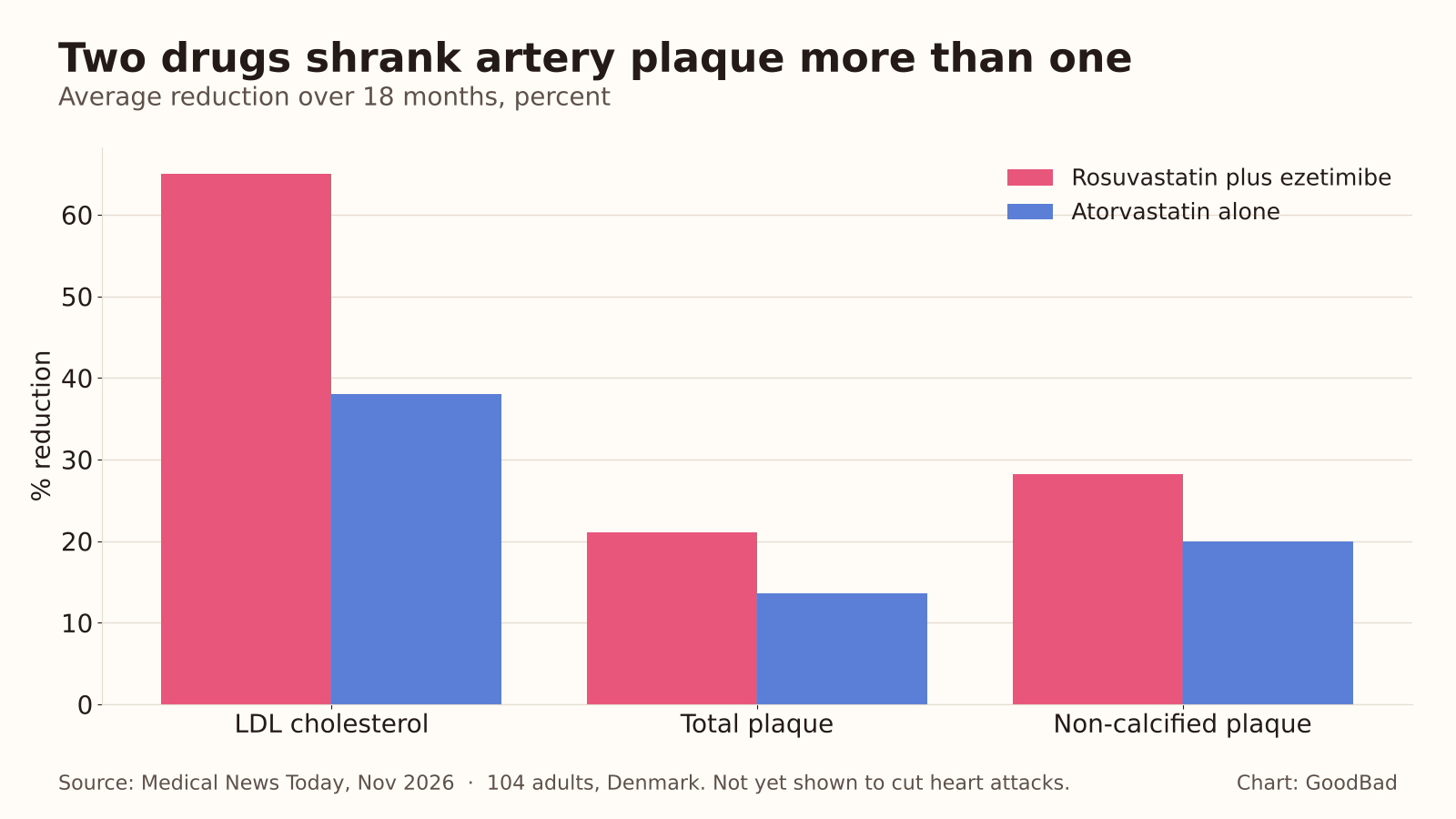 Chart: GoodBad. Data from Medical News Today’s report of the JAMA Cardiology trial, November 2026.
How many people improved
The share of people who benefited is as striking as the average. Ninety percent of those on the combination had a reduction in total plaque volume, against 75% of those on atorvastatin. For non-calcified plaque, 51 of 52 people on the combination saw a reduction, compared with 39 in the atorvastatin group.
| Measure | Rosuvastatin plus ezetimibe | Atorvastatin alone |
|---|---|---|
| LDL cholesterol change | down 65% | down 38% |
| Total plaque volume change | down 21.1% | down 13.6% |
| Non-calcified plaque change | down 28.2% | down 20% |
| People with less total plaque | 90% | 75% |
The standard dose worked too
It is easy to miss that both groups improved. People on atorvastatin alone lost 13.6% of their total plaque, and three in four of them had less plaque at the end than at the start. That fits Mortensen’s view that atherosclerosis is not necessarily irreversible, and it suggests that even standard intensive statin treatment can start the process. The combination simply went further, and Mortensen says the effect was clearest in patients who had not taken statins before. Those are the people for whom a first prescription could matter most, though the trial was not built to prove that.
The measurement itself is also worth noting. Plaque volume was tracked with coronary CT angiography, a scan of the arteries, at baseline and twice during treatment, so each person served as their own comparison. That design makes the percentage changes more reliable than a single snapshot would.
Why two drugs beat one
The two drugs work in different places. Statins reduce the amount of cholesterol the liver makes. Ezetimibe reduces how much cholesterol the intestine absorbs. Together they lower LDL by two complementary routes.
Mortensen says the main explanation is probably the lower LDL itself, not any special effect of the drugs. Lower achieved LDL was consistently linked to more plaque regression. That is a useful message: the target matters more than the brand, and a combination is one way of reaching a low target.
What it means for patients
The trial does not change guidelines on its own. It involved 104 people with stable chest pain and narrowed arteries, and its design and size cannot show whether anyone avoided a heart attack. Anyone taking a statin should not change their dose or add a drug because of one trial; that is a decision for their own clinician.
The finding still matters for what comes next. If larger outcome trials show fewer heart attacks, intensive early lowering of LDL could become standard for more people with narrowed arteries. No source we found gives a date for such a trial, or says who funded this one.
What we still do not know
Several questions remain open. The trial lasted 18 months, so it says nothing about longer effects. The reports we read do not say how many people stopped treatment or had side effects. The sample is small, so a difference of a few percentage points could shift in a bigger study.
What is clear is the direction. With a stronger drive on cholesterol, scans of the heart’s arteries looked better in nine out of ten people in that group, and the plaque most prone to rupture shrank the most.