 Good news
Oil Surplus Returns and Crude Falls 32% as Gulf Exports Recover
The IEA says the world will pump about 1.7 million barrels a day more than it uses in the fourth quarter, and North Sea crude has fallen a third since early October. Diesel and fuel exports are still short.

Read the bad side of this story
Diesel Stays 77% Above Prewar as Oil Stocks on Land Fall Further
For the first time since the war with Iran began in late February, the world is producing more oil than it burns. The International Energy Agency (IEA) said on 13 November that supply will average about 105 million barrels a day in the fourth quarter, roughly 1.7 million barrels a day above demand. A month earlier the agency expected a shortfall.
The change shows up in the price. The IEA says North Sea Dated crude fell 32% from an early-October high of $136 a barrel to about $93 at the time of its Oil Market Report. That is still $22 above the pre-war level, so this is relief, not a return to normal. The Guardian and Reuters both lead with the move into surplus.
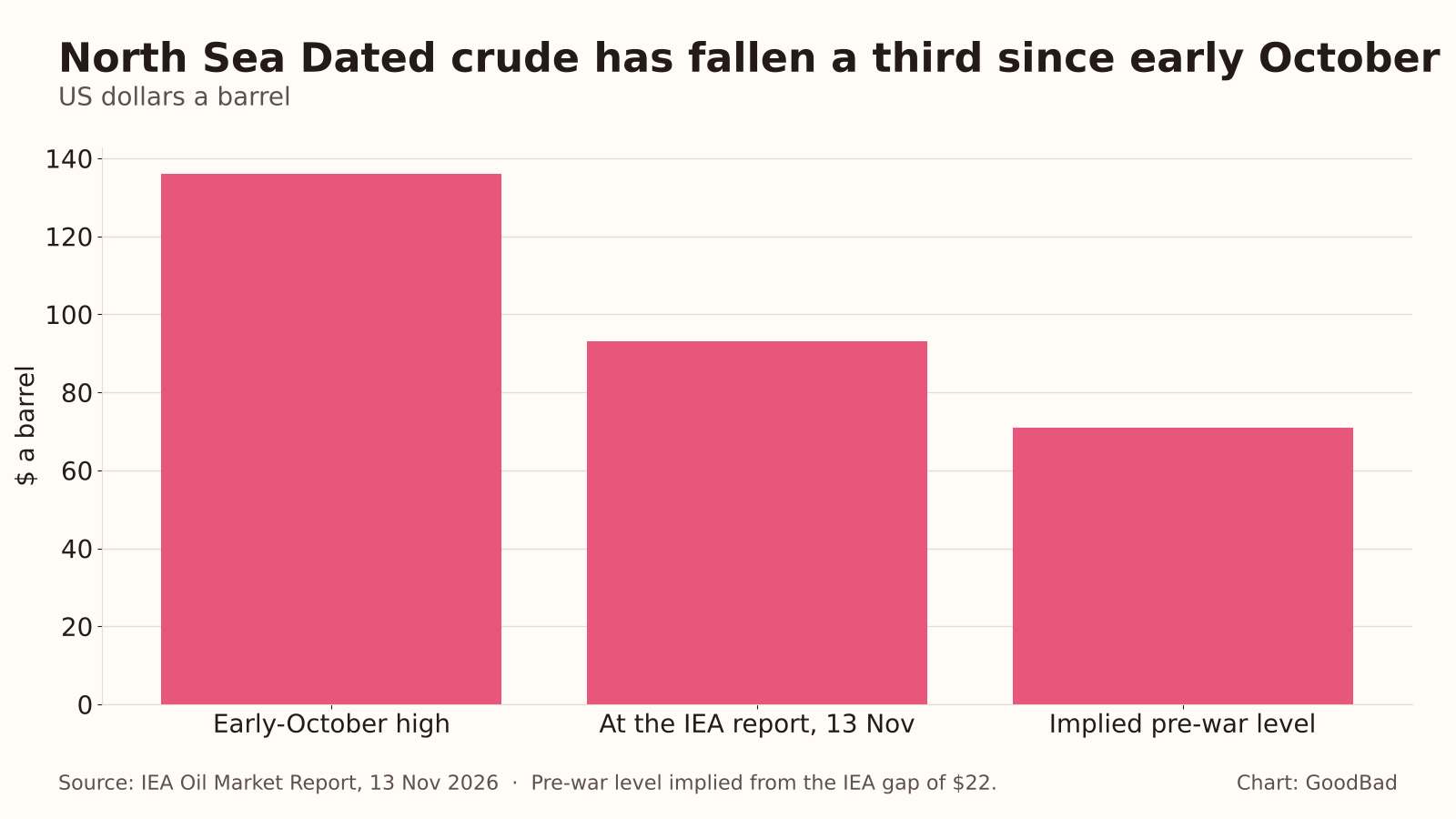 Chart: GoodBad. Data from the IEA Oil Market Report, 13 November 2026, as summarised by Oil & Gas Journal. The pre-war level is implied from the IEA’s $22 gap.
Where the extra oil came from
Gulf producers are shipping again. According to the Oil & Gas Journal, which summarises the report, global supply rose 2.3 million barrels a day in October to 105.4 million, after a 3 million rise in September. Output is up 5.3 million barrels a day since August. Gulf exports, excluding Oman, reached 18.4 million barrels a day in October, and crude alone reached 15 million, or 82% of its pre-war volume.
Supply also grew outside the Gulf. The IEA expects the United States, Canada, Brazil, Argentina and Guyana to add 1.6 million barrels a day this year. The OPEC+ group pumped 41.23 million barrels a day in October, 97% of its February level, according to figures the group released this week.
Oil that had been stuck at sea is arriving. The IEA says oil on the water jumped by 86 million barrels in October to its highest since January, and observed global inventories grew by 52 million barrels. Members of the agency have also released about 349 million barrels from emergency stocks since 11 March, with another 71 million due by the end of February.
Why the year still looks smaller
The surplus arrives after a bad year, and the agency does not hide that. It raised its fourth-quarter supply estimate by 3.3 million barrels a day, but still expects supply to fall by an average of 4.8 million barrels a day over the whole of 2026. The recovery is a rebound from a deep hole, which is how the agency frames it. Gulf exports excluding Oman, at 18.4 million barrels a day, are still 26% below where they stood before the war.
Why demand is part of the story
Surplus has two halves: more supply and less demand. The IEA expects world demand to fall by 2.7 million barrels a day in 2026, to 102.3 million, because high prices have cut consumption. It forecasts a rebound of about 2 million in 2027 to 104.3 million barrels a day.
The agency says expensive fuel is also speeding up a switch to electric vehicles and more efficient fleets. It expects gasoline and diesel use to stay nearly flat next year. In China, demand fell 7.1% in September from a year earlier, a drop the IEA ties to high prices, electrification and a sluggish economy.
What it means for you
A lower crude price is a first step, not a lower pump price. The IEA says refined products remain tight, and diesel is the tightest. European diesel prices are still near $180 a barrel, roughly 77% above pre-war levels, according to the report as relayed by gCaptain. Gulf exports of refined products and liquefied petroleum gas sit at about half their pre-war volume.
The relief should still reach buyers in stages. Refiners are coming out of seasonal maintenance. Runs fell by 1.3 million barrels a day in October to 81.3 million, and the IEA expects them to recover to 84.7 million in December. About 15 million barrels of the emergency release is diesel, taken mainly from government stocks in France and Germany.
What could go wrong
The agency is plain about the risk. Attacks on tankers and energy sites continue. It calls renewed attacks the main threat to its supply outlook. gCaptain cites the shipping-security body UKMTO. It says vessel traffic through the Strait of Hormuz is still about 65% below pre-conflict levels. Seven tanker attacks were logged in the latest reporting period.
Stocks held on land also remain thin. The IEA says they fell again in October and are at their lowest since at least 2016. OECD inventories dropped by 47 million barrels in the month, and observed global stocks have fallen by a cumulative 462 million barrels since the war began. A new disruption would therefore hit a market with little cushion, which is why the agency calls the improvement tentative.
The next test
The IEA expects supply to keep outrunning demand into 2027. It projects global supply to rise 6.6 million barrels a day next year to 108.1 million, led by further recovery in the Gulf. Its next monthly report is due in December. Until then, watch two numbers: whether Dated Brent holds below $100, and whether diesel follows crude down. The first is a measure of relief; the second decides whether you feel it.