Good news
Emerging Economies Outside China to Match Advanced Ones in New Renewables
The IEA expects almost 4,800 gigawatts of new renewable capacity by 2031, with emerging and developing economies outside China matching advanced economies for the first time. Solar supplies three-quarters of it, and India becomes the second-largest market.

Read the bad side of this story
Renewable Additions Set to Fall 11% in 2026, Ending 21 Years of Records
For the first time, emerging and developing economies outside China are set to install as much new renewable power as the rich world. That is the central forecast of the International Energy Agency’s (IEA) Renewables 2026 report, published on 6 November. The agency expects global renewable capacity to grow by almost 4,800 gigawatts (GW) between 2026 and 2031, about 57 percent more than in the previous six years.
Solar does most of the work. It supplies more than three-quarters of the growth, with utility-scale plants adding roughly 2,075 GW and distributed systems, mainly rooftops, about 1,530 GW. Renewables account for over 80 percent of all new power capacity in the forecast, averaging nearly 800 GW a year. They generate about a third of the world’s electricity today, and IEA Executive Director Fatih Birol says they will be getting closer to half within five years.
Why the spread is widening
The reason is less about the climate than about fuel bills. Birol says that “today, it’s mainly energy security” is driving renewables, as countries try to cut their exposure to imported fuels. The IEA points to disruption in global energy markets since the Iran war began in February. Reuters carried the same headline finding: emerging economies are catching up with advanced ones.
Households are part of the story. Small rooftop systems go up quickly, and the IEA says they have already improved electricity supply for around 70 million households worldwide. Outside China, annual additions are forecast to rise 27 percent between 2025 and 2031. The IEA has also lifted its forecast for emerging and developing economies by almost 20 percent.
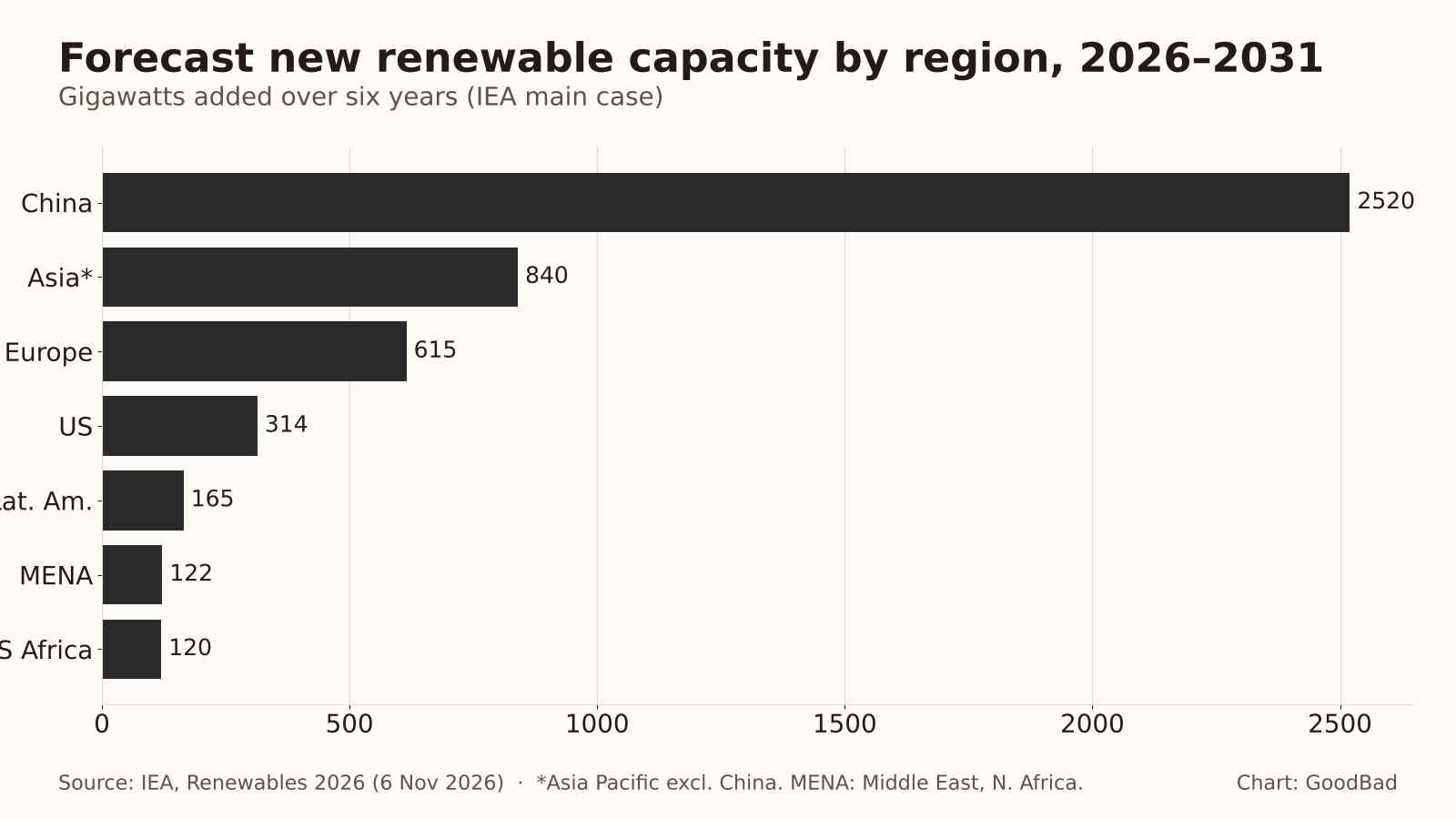 Chart: GoodBad. Data from the IEA, Renewables 2026, 6 November 2026. Several regions are given by the IEA as “more than”.
Where the new capacity goes
China still leads, adding nearly 2,520 GW, though its share of global growth falls from over 60 percent in 2025 to 53 percent. India becomes the second-largest market: its additions rise 2.6-fold, lifting its share of the global total to 8.5 percent, and its renewable capacity more than doubles by 2031. Asia Pacific outside China adds more than 840 GW, nearly half of it in India.
Growth also spreads. Southeast Asia, the Middle East and North Africa, and sub-Saharan Africa are each forecast to add almost three times as much as in the previous six years. Europe adds more than 615 GW and the United States about 314 GW. Latin America and the Caribbean add 165 GW, the Middle East and North Africa 122 GW, and sub-Saharan Africa more than 120 GW.
The batteries behind it
Storage is catching up with generation. The IEA expects more than 550 gigawatt-hours of new storage between 2026 and 2031, over five times the previous six years, and behind-the-meter capacity above 670 GWh by 2031. Commercial batteries make up almost half of that, and China accounts for roughly 60 percent of them.
One caution belongs in the first read. The IEA expects 2026 additions to fall 11 percent to 733 GW, ending 21 consecutive years of records. The main cause is China, where solar installations were almost 55 percent lower in the first nine months of 2026 than a year earlier. It still calls 2026 the second-highest year on record, and the six-year forecast assumes a recovery.
For readers watching their bills, the report is about direction, not prices: it gives no household saving figure that we could verify. What it does show is more countries buying their own sunshine, and building the batteries to use it after dark.