Bad news
Renewable Additions Set to Fall 11% in 2026, Ending 21 Years of Records
The IEA expects the world to add 733 gigawatts of renewable capacity in 2026, 11 percent less than last year, as Chinese solar installations drop by almost 55 percent. Its six-year forecast still assumes a rebound.

Read the good side of this story
Emerging Economies Outside China to Match Advanced Ones in New Renewables
The world will add less renewable power capacity in 2026 than it did in 2025, for the first time in 21 years. The International Energy Agency (IEA) forecasts additions of 733 gigawatts (GW), down 11 percent, in its Renewables 2026 report of 6 November. It still expects 2026 to be the second-highest year on record, so this is a pause in a long climb, not a collapse. The pause has a single cause, and the six-year forecast depends on it ending.
China’s solar slump
China installed almost 55 percent less solar power in the first nine months of 2026 than in the same period a year earlier, the IEA says. The agency links this to a change in June 2025, when Beijing moved from fixed payments for solar output to competitive auctions, which weakened project economics. It has cut its forecast for Chinese solar by almost 116 GW compared with its previous report.
The damage reaches the factories. According to the IEA, more than 90 percent of China’s major solar manufacturers report losses in 2026. More than 70 companies have gone bankrupt since 2024 as overcapacity and falling prices erode margins. A forecast of record deployment elsewhere does not repair that on its own.
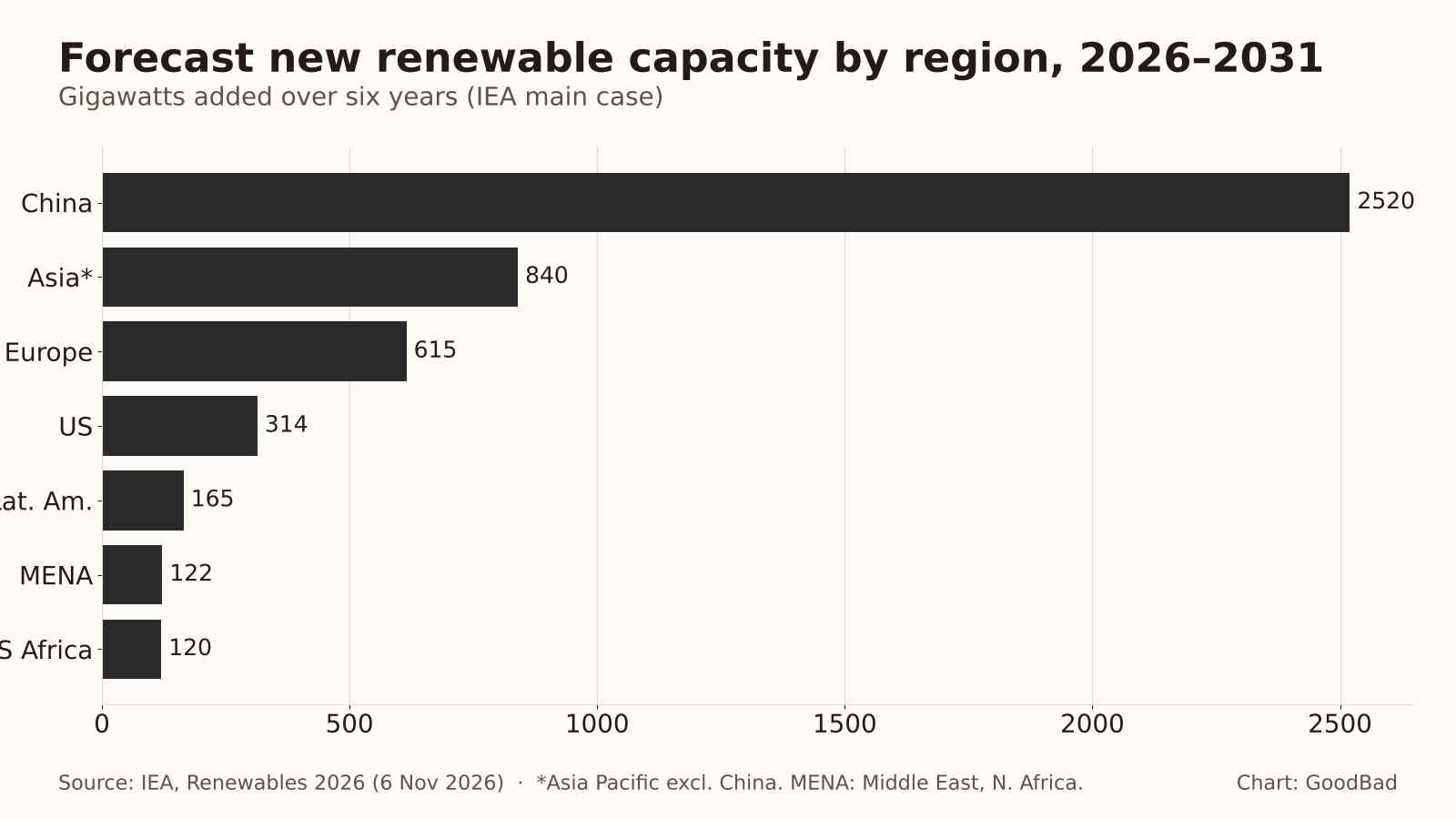 Chart: GoodBad. Data from the IEA, Renewables 2026, 6 November 2026. Several regions are given by the IEA as “more than”.
A forecast that needs a rebound
The IEA’s central case is almost 4,800 GW of new renewable capacity between 2026 and 2031, about 57 percent more than in the previous six years and nearly 800 GW a year. That average sits above this year’s 733 GW, so the forecast needs additions to climb again. China is expected to supply nearly 2,520 GW of the total, a 53 percent share, down from over 60 percent in 2025.
The rest of the world is asked to fill the gap. Outside China, annual additions are forecast to rise 27 percent between 2025 and 2031, and emerging and developing economies outside China are set to match advanced economies for the first time. The United States is expected to add about 314 GW and Europe more than 615 GW. Reuters headlined the emerging-economy finding.
Security, not climate, is the driver
The reasons for growth elsewhere are also a warning about durability. IEA Executive Director Fatih Birol says that “today, it’s mainly energy security” is driving renewables, as countries try to cut their exposure to imported fuels. Energy markets have been disrupted since the Iran war began in February. Demand that rests on fuel scares can fade when prices settle.
Renewables generate about a third of global electricity today, and Birol expects them to approach half within five years. Solar supplies over three-quarters of the forecast growth, and the IEA says rooftop systems have already improved electricity supply for around 70 million households. Storage is expected to add more than 550 gigawatt-hours by 2031, over five times the previous six years.
What would change the outcome is a recovery in Chinese installations, which the IEA ties to project economics under the new auctions. The report gives no date for it, and none of the sources we read says when the 2026 decline will end.