Bad news
Under Four Years of Carbon Budget Remain for 1.5C as Total Emissions Rise
Total CO2 emissions rise to 43.3 billion tonnes in 2026 even as fossil CO2 slips 0.4%, the Global Carbon Budget says. About 150 billion tonnes remain for 1.5C, less than four years at the current rate.

Read the good side of this story
Fossil CO2 Emissions Edge Down 0.4% as Solar and Wind Meet Most Demand Growth
The world can still emit about 150 billion tonnes of carbon dioxide before warming is likely to pass 1.5°C for good. At the current rate, that is less than four years of emissions. The figure comes from the Global Carbon Budget, an annual assessment by more than 140 scientists presented on 10 November at the COP31 climate talks in Antalya, Turkey.
The same report finds that all CO2 emissions, fossil fuels and land use together, will rise from 42.8 billion tonnes in 2025 to 43.3 billion in 2026. Atmospheric CO2 is set to reach 427.7 parts per million, which is 54% above pre-industrial levels. The Guardian adds that temperatures have already exceeded 1.5°C for more than two years.
Why the total went up
Fossil CO2 is projected to fall 0.4%, to 38.2 billion tonnes. Land-use emissions more than offset that: they are projected to rise to 5.1 billion tonnes, driven by peat fires and forest degradation in Southeast Asia during El Niño conditions. Permanent deforestation still emits about 3.8 billion tonnes a year (2016–25), and reforestation offsets about half of it.
Technology that removes carbon does not yet change the sum. The release says novel carbon dioxide removal offsets less than 30 minutes of a year’s fossil emissions.
A dip that may not last
The authors do not call the fossil fall a turning point. Oil emissions drop 1.9% and gas 0.3%, but coal rises 0.6%. The Guardian says the oil fall follows the war involving Iran, as high prices push drivers to use less fuel or switch to electric vehicles. The release describes the oil decline as likely a short-term response to the energy shock.
Dr Patrick McGuire of the University of Reading evaluated land carbon models for the report. He calls the slight fall welcome but “not yet the turning point the world needs.” Bill Hare, chief executive of Climate Analytics, goes further. He says the 0.4% figure is statistically indistinguishable from zero, so the picture is a flatline.
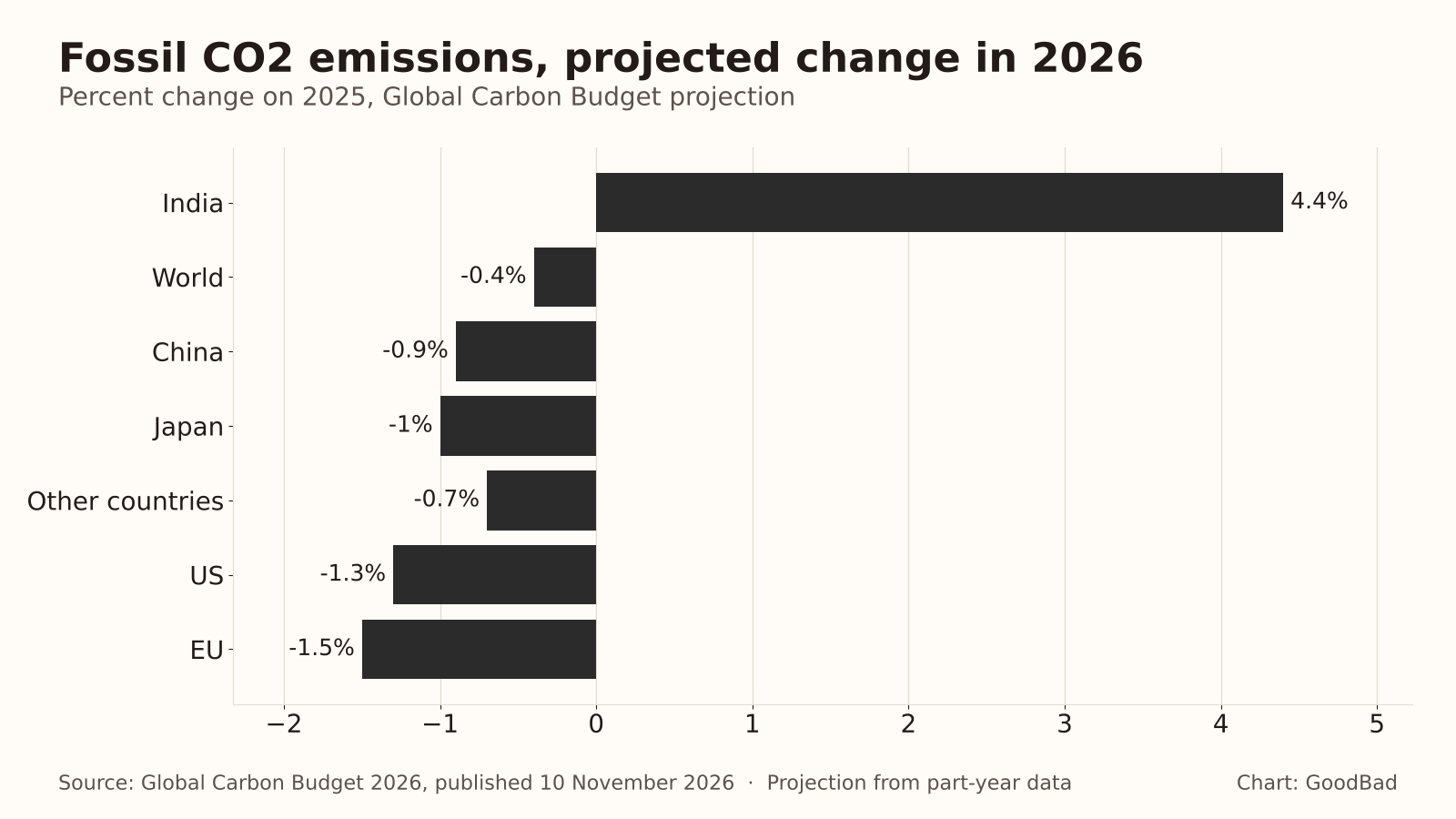 Chart: GoodBad. Data from the Global Carbon Budget 2026, published 10 November 2026.
Who is still rising
India’s fossil emissions are projected to climb 4.4%, above its 3.5% average annual growth over the past decade. The Guardian says the rise is mostly coal. China, which produces 32% of the world’s fossil emissions, is projected to fall 0.9%, yet its coal use still rises 0.3%. The Guardian reports that most of China’s fall comes from a 5% cut in oil use after the Iran war.
The United States is down 1.3%, mainly because less coal is burned. The EU is down 1.5%, Japan 1%, and other countries together 0.7%. International aviation and shipping are each down 1%. Those cuts are real but small beside the 150 billion tonnes still available.
What could reverse it
Three risks are on the record. Glen Peters of the Cicero Centre for International Climate Research says one year’s drop is not a peak unless structural change drives it. The Guardian lists an intensified expansion of coal in India, easing oil prices and US government enthusiasm for fossil fuels as factors that could undo the trend.
The natural sinks are the third. The land sink recovered to its former levels after weakening in the 2023–24 El Niño, the authors say. A strong El Niño in 2026 is expected to weaken it again and to feed more peatland fires next year. Climate change has already cut global land uptake by almost a fifth over the last decade, according to McGuire.
Is clean energy keeping pace?
Not yet, the report concludes. Solar and wind avoided 4.1 billion tonnes of emissions in 2025, up from 0.28 billion in 2010, with 4.6 billion projected for 2026. Total CO2 has grown 0.3% a year over the past decade, against 1.7% a year in the decade before, and 59 countries emitted less in 2025 than in 2019 while their economies grew.
Even so, a companion paper in Nature Climate Change finds that new clean power offsets only 64% to 79% of the emissions from new energy demand by 2028. Electric vehicles are still a small share of the fleet, the release says. Clean energy is meeting about two-thirds of the rise in demand, which means the rest is met by something else.
What it means for the 1.5C goal
The Guardian reports that emissions would have to peak imminently and then fall rapidly to limit the overshoot above 1.5°C. Hare says governments in Canada, the US and New Zealand are rolling back climate policy, and that Australia, co-president of COP31 with Turkey, continues to press ahead with large coal and gas developments. He sees little sign that the COP31 hosts mean to build on the three-year-old commitment to transition away from fossil fuels.
More than 90 heads of state and government and representatives from over 190 countries are gathering for the fortnight of talks, the Guardian says. What would change the outcome is a sustained fall in oil, gas and coal use that survives a drop in oil prices. The report gives no sign that such a fall has begun, and the budget it reports is now measured in years.