Good news
Fossil CO2 Emissions Edge Down 0.4% as Solar and Wind Meet Most Demand Growth
The Global Carbon Budget projects fossil CO2 at 38.2 billion tonnes in 2026, down 0.4%, with oil emissions falling 1.9%. Solar, wind and electric vehicles met about two-thirds of the growth in energy demand.

Read the bad side of this story
Under Four Years of Carbon Budget Remain for 1.5C as Total Emissions Rise
Burning coal, oil and gas will release about 38.2 billion tonnes of carbon dioxide in 2026, which is 0.4% less than in 2025. That is the central projection of the Global Carbon Budget, the 21st annual assessment by more than 140 scientists at over 90 institutions. It was presented on 10 November at the COP31 climate talks in Antalya, Turkey, and posted as a preprint in Earth System Science Data.
The fall is small, and the authors say so. Atmospheric CO2 is still set to reach 427.7 parts per million in 2026, which is 54% above pre-industrial levels. What makes it worth a report is the direction of travel. Clean power is now absorbing most of the growth in the world’s appetite for energy, which any lasting decline has to achieve.
What fell, and what did not
Oil did most of the work. Emissions from oil are projected to drop 1.9%, natural gas edges down 0.3%, and coal rises 0.6%. The Guardian reports that drivers are economising on fuel and switching to electric vehicles as oil and gas prices climb after the war involving Iran.
Solar, wind and electric vehicles met about two-thirds of the rise in global energy demand, the Reading release says. The rest of the rise was covered by the oil-price shock, which the authors treat as a short-term effect.
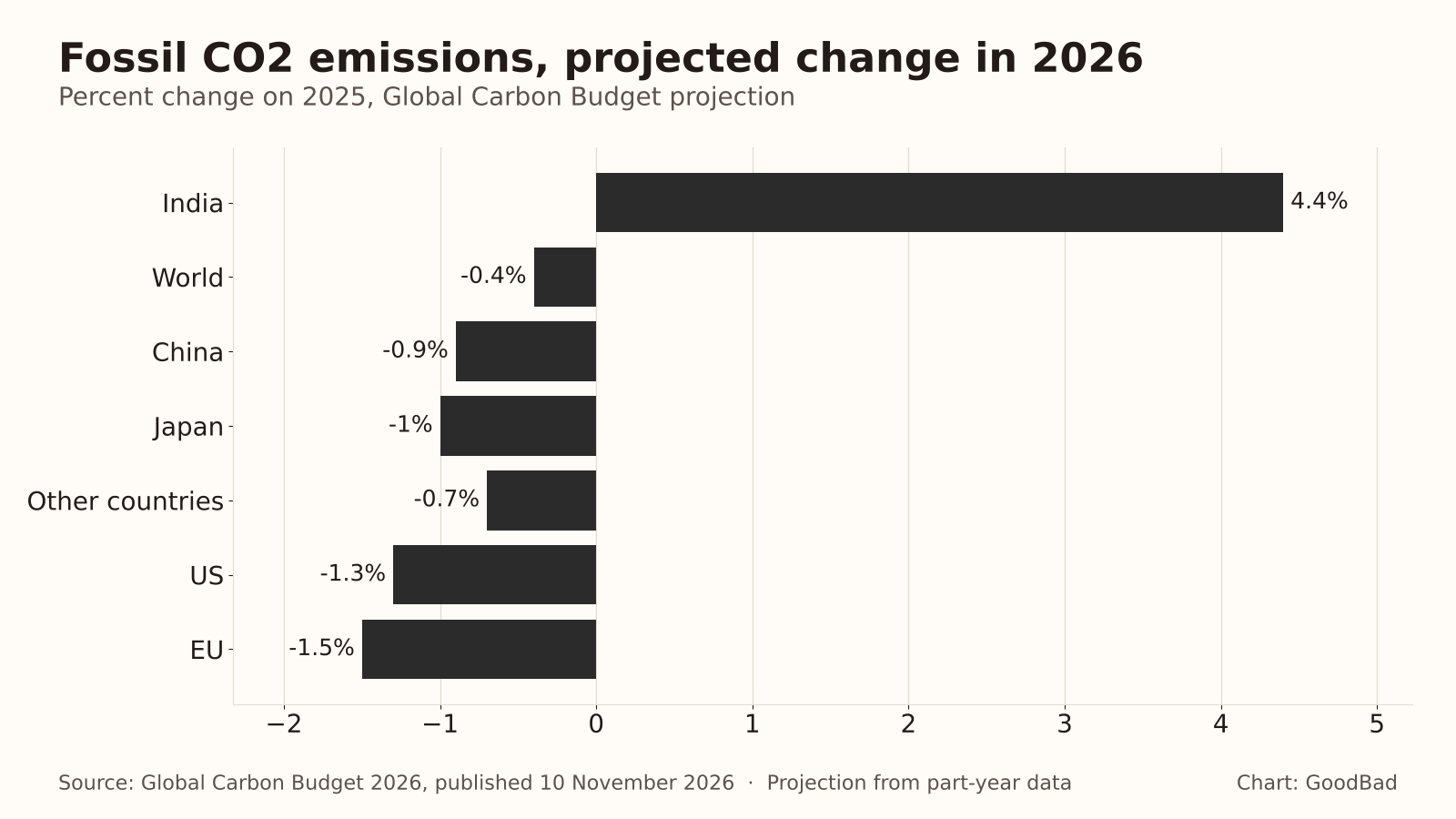 Chart: GoodBad. Data from the Global Carbon Budget 2026, published 10 November 2026.
Where emissions are falling
The EU is projected to cut fossil CO2 by 1.5% and the United States by 1.3%, mainly because less coal is burned. Japan falls 1%. China, which produces 32% of the world’s fossil emissions, falls 0.9% even though its coal use rises 0.3%. The Guardian adds that China’s oil use is down about 5%, which accounts for most of its fall.
India is the exception: its emissions are projected to rise 4.4%, above its 3.5% average annual growth over the past decade, driven mostly by coal. Other countries together are down 0.7%, and international aviation and shipping are each down 1%.
The long view
The budget’s longer record is the stronger case for the good side. Emissions avoided by solar and wind rose from 0.28 billion tonnes in 2010 to 4.1 billion in 2025, and the report projects 4.6 billion for 2026. Total CO2 emissions, counting land use as well as fossil fuels, have grown 0.3% a year over the past decade, against 1.7% a year in the decade before.
The release also reports that 59 countries emitted less in 2025 than in 2019 while their economies grew. That matters because the question for governments is whether growth and falling emissions can coexist, and these cases say they can.
A companion paper in Nature Climate Change tests how far clean energy has to go. It finds that new clean power offsets 64% to 79% of the emissions from new energy demand by 2028. Closing that gap is the task the authors set for the coming years.
What it does not show
Dr Patrick McGuire of the University of Reading evaluated land carbon models for the report. He calls a slight fall in fossil emissions welcome but “not yet the turning point the world needs.” The caveats are on the record, and they are not small.
Total emissions still rise this year, from 42.8 billion tonnes in 2025 to 43.3 billion in 2026. Permanent deforestation alone emits about 3.8 billion tonnes a year, and reforestation offsets about half of that. Land-use emissions climb to 5.1 billion tonnes because of peat fires and forest degradation in Southeast Asia during El Niño conditions. The remaining carbon budget for holding warming to 1.5°C is about 150 billion tonnes, less than four years of emissions at today’s rate. The Guardian notes that temperatures have already exceeded 1.5°C for more than two years.
Analysts outside the project urge caution. Glen Peters of the Cicero Centre for International Climate Research says a one-year drop is not a peak unless structural change drives it. Bill Hare, chief executive of Climate Analytics, says the 0.4% fall is statistically indistinguishable from zero, so the picture is a flatline rather than a decline.
What to watch next
Three things decide whether this dip becomes a trend. Oil prices are the first: if they ease, driving and flying may recover. India’s coal use is the second, since its 4.4% rise offsets much of the fall elsewhere. The third is the land sink, which recovered after the 2023–24 El Niño but is expected to weaken again as a strong El Niño develops in 2026, the authors say.
For readers, the practical effect is indirect. Electric vehicles cut a household’s exposure to fuel prices, and solar and wind add power that does not depend on them. The release says electric vehicles are still a small share of the fleet, so the shift has far to run.
The COP31 talks run for a fortnight, and the Guardian reports that more than 90 heads of state and government are gathering, with Australia as co-president alongside Turkey. Delegates carry a commitment made three years ago to transition away from fossil fuels. This year’s numbers give them a measured starting point. Clean energy is growing fast enough to matter, and not yet fast enough to finish the job.