Good news
China's Emissions Fall 3.1% in a Quarter as Clean Power Outgrows Demand
China's CO2 output fell 3.1% in the third quarter, the biggest drop since the 2022 Covid lockdowns, as new solar, wind and nuclear supply grew more than twice as fast as electricity demand, an analysis for Carbon Brief finds.

Read the bad side of this story
China's Emissions Fell 3.1% With Help From a Fuel Shock and Weak Growth
China’s carbon dioxide emissions fell by 3.1% in the third quarter of 2026 compared with a year earlier, the largest quarterly drop since the 2022 Covid lockdowns. The figure comes from an analysis by the Centre for Research on Energy and Clean Air (CREA) for Carbon Brief, published on 6 November and reported by Reuters. It covers fossil fuels and cement, and it makes the world’s biggest emitter a country whose output has now been flat or falling for more than two years.
Clean power outran demand
Lauri Myllyvirta, the CREA analyst who wrote the piece, finds that solar, wind and nuclear generation rose by 110 terawatt-hours (TWh) on the year. That is more than twice the growth in total electricity demand, and roughly equal to Germany’s entire power output over the same period. With clean supply growing faster than demand, there was no need for more coal, and coal-fired generation fell by 3.3%.
Coal use overall fell by 3% and oil use by 4% in the quarter. Another factor was less wasted wind and solar: grid bottlenecks have forced Chinese operators to switch off clean plants, and the analysis says that waste shrank in the third quarter.
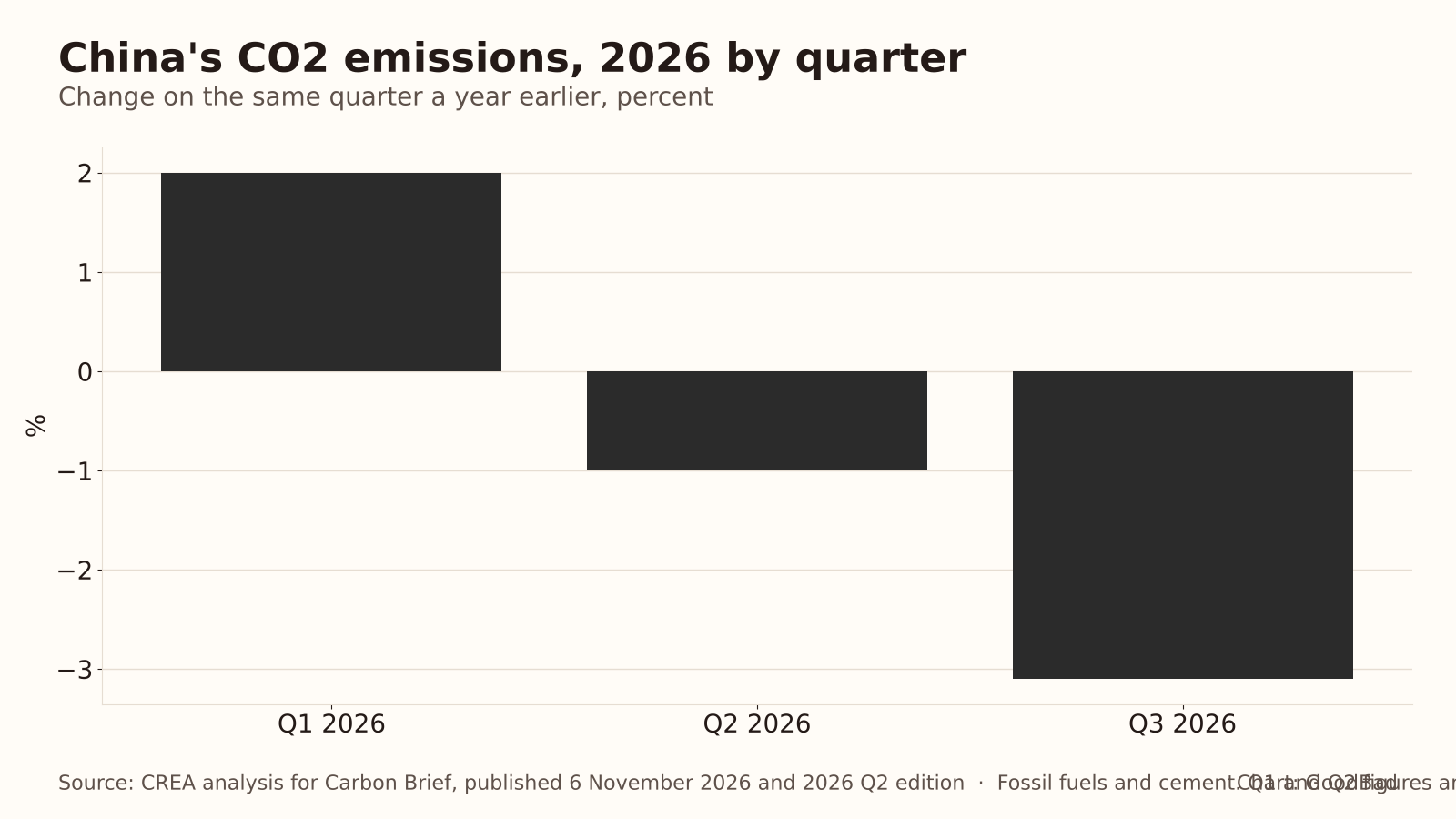 Chart: GoodBad. Data from CREA analyses for Carbon Brief, 2026. Q1 and Q2 are rounded in the source.
The road is getting cleaner
Transport oil use fell 9% on the year in the third quarter, according to the analysis. Electric vehicles reached a record 67% of passenger car sales and 50% of heavy truck sales in September. Electricity used by EVs grew 53%, much faster than the number of cars, which suggests owners are driving their electric cars more and their fuelled ones less.
The earlier analysis for the second quarter found the same pattern. Oil displaced by EVs in the first half of 2026 exceeded the UK’s total oil consumption over six months. Emissions rose 2% in the first quarter, fell 1% in the second and fell 3.1% in the third, so the trend is bending in the right direction.
What this means for the year
Emissions across the first nine months are down an estimated 0.5%. Reuters reports that the trend could hold for the full year. The analysis says it is likely that clean power growth will exceed overall energy demand growth in 2026, which would keep fossil fuel use on a downward path.
For anyone outside China, the effect is global. China emits more CO2 than any other country, so a fall of this size is visible in world totals, and cheaper electric vehicles and panels made there are sold abroad. For households, the direct effect is small, but the direction matters for the climate targets every country is negotiating around.
What the figures do not say
The drop did not come only from clean energy. The analysis names the Hormuz crisis, which disrupted Gulf oil supply and cut Chinese oil demand, as a main driver. It also says mild weather and weaker economic growth held down energy use, and high coal prices slowed the coal-to-chemicals industry. China is also still building new coal plants at near-record rates, although they are running for fewer hours.
The next test is whether grid upgrades keep clean power from being wasted and whether demand grows again. The analysis says the outlook is a race between energy demand growth and clean energy growth. CREA and Carbon Brief will publish the next quarterly update in early 2027, and the full-year figure will show whether the fall holds.