Good news
Astronomers Find Oldest Compact Quasar Pair, 900 Million Years After Big Bang
Two black holes of 1.5 billion and 400 million solar masses, just 18,100 light-years apart, are seen feeding 900 million years after the Big Bang. NSF NOIRLab says nothing yet explains how they grew so fast.
This story runs on the good side only. The biggest stories of the day are told on both sides.
Two giant black holes have been found side by side, both feeding on gas and shining brighter than the galaxies around them. The Universe was only 900 million years old at the time. Astronomers say it is the oldest and most compact pair of quasars ever observed. The pair, catalogued as J1602+4228AB, was announced on 13 November by NSF NOIRLab, the US National Science Foundation’s centre for ground-based optical and infrared astronomy.
Its discoverers have given it a Hawaiian name, Nāpōwawāʻenakaulua. It is only the third quasar pair known from cosmic dawn, the era when the first stars, galaxies and black holes were still forming. The result rests on one discovery in a Webb survey and a quick, lucky follow-up from Hawaii.
What was found
A quasar is a supermassive black hole that is actively pulling in matter and radiating the energy as it does. The two in this pair have masses of 1.5 billion and 400 million times that of the Sun, according to Sci.News, which reports the figures from the discovery paper. They sit just 18,100 light-years apart. That is roughly one-fifth of the width of the Milky Way.
The light we see left them when the Universe was a thirteenth of its present age. Silvia Onorato, a postdoctoral researcher at NOIRLab who led the study, says their black holes are as massive as those seen in the Universe today. The team calls the setting “a really unique environment” for studying how early massive galaxies and their central black holes came together.
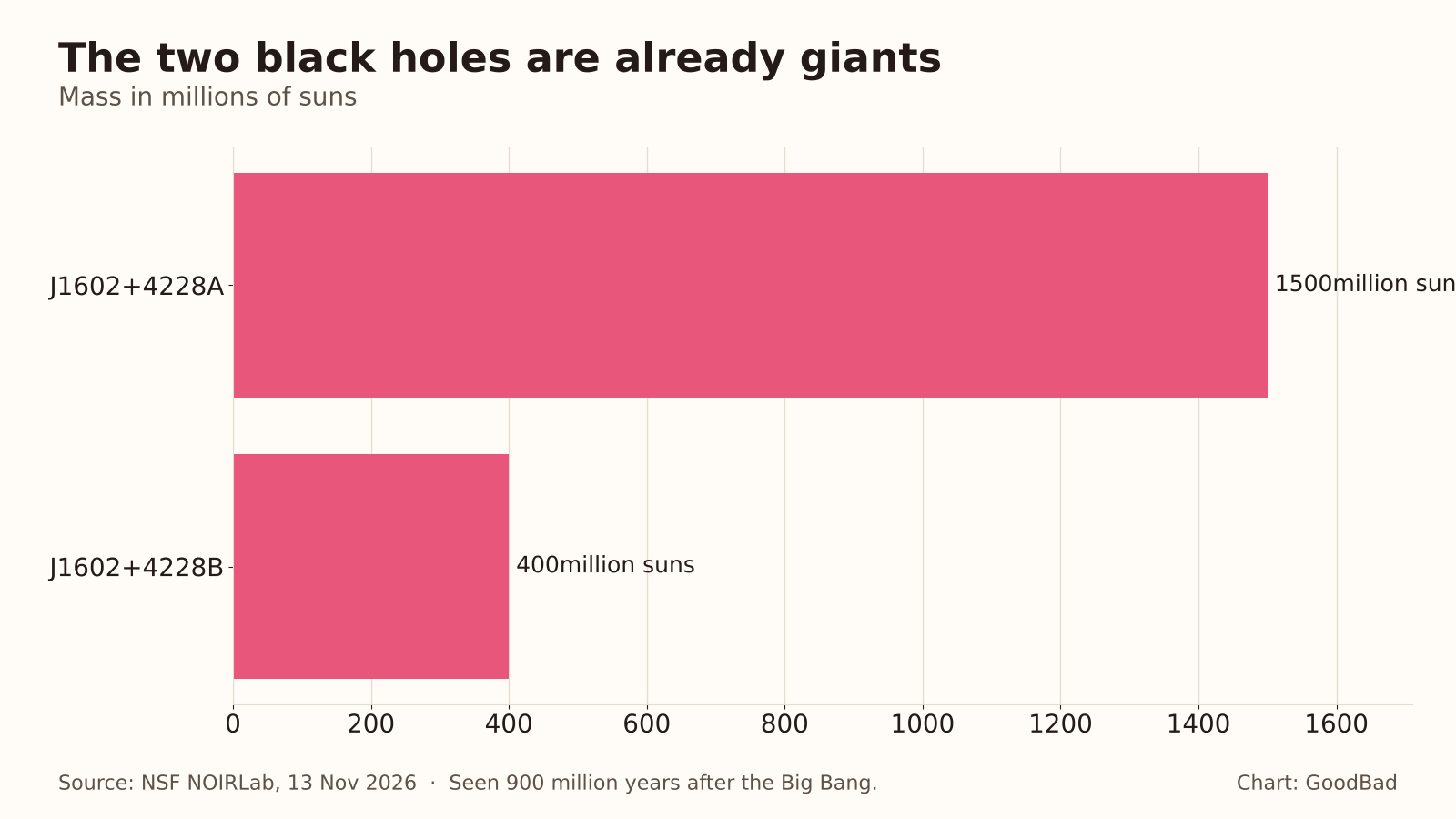 Chart: GoodBad. Data from NSF NOIRLab, 13 November 2026.
How it was spotted
The pair turned up in a Webb survey called Aether, led by Emanuele Paolo Farina of NOIRLab. Its goal is a census of objects in the early Universe. It gathered a sample of 200 quasars, which NOIRLab says is 43% of all quasars known from that stage of cosmic history. The team found the companion while inspecting the data by eye, using Webb’s Near-Infrared Spectrograph.
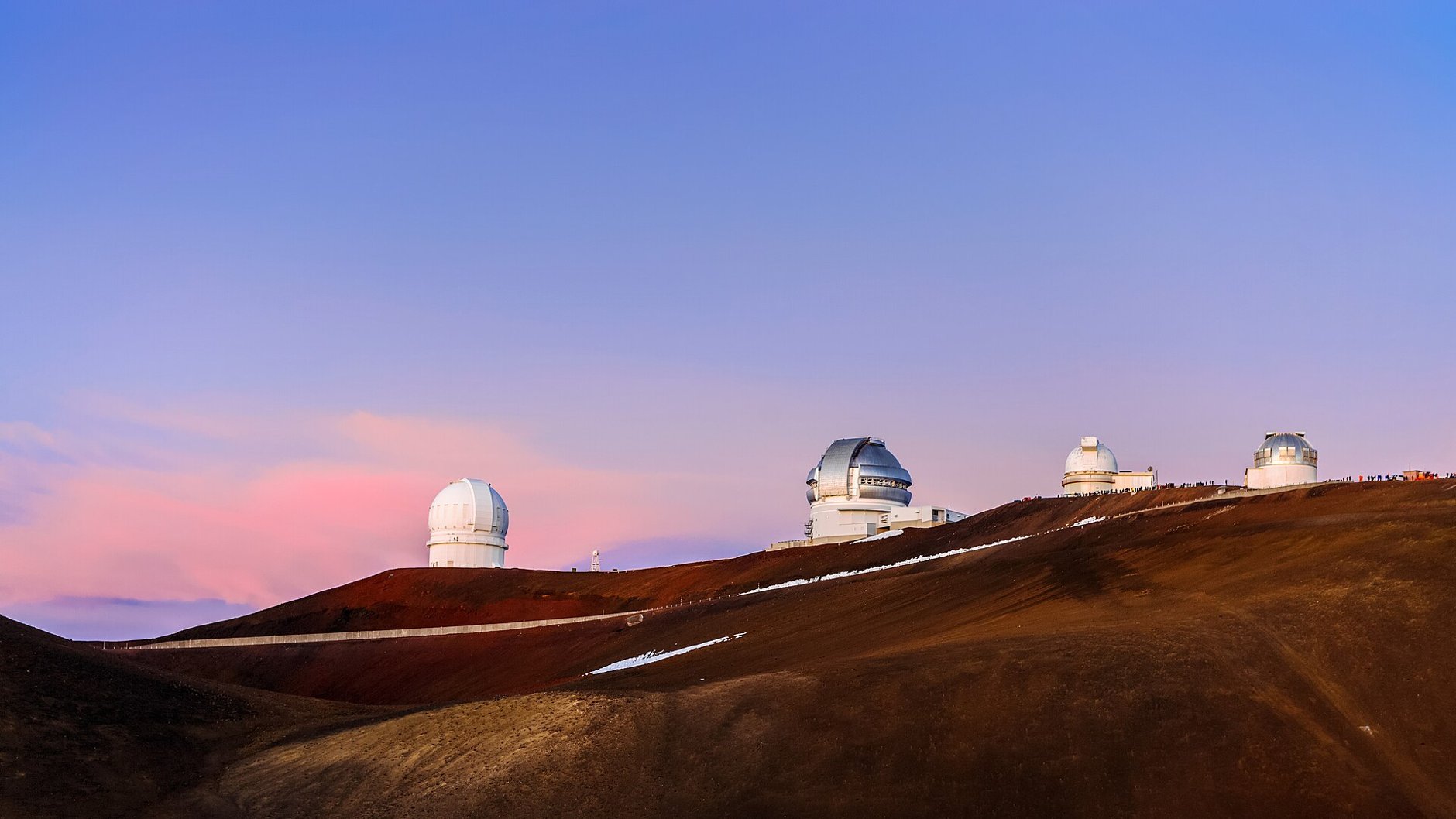
Webb alone could not split the two. They are so close, and the second so faint, that NOIRLab says observing it from the ground should have been nearly impossible. The Gemini North telescope on Maunakea resolved them anyway. According to Onorato, the sky was so clean and sharp that the team collected its data in just two nights.
Why it is hard to find these pairs
Astronomers expect quasar pairs to be common, because galaxies collide and merge often, and mergers feed black holes. Finding them is another matter. NOIRLab gives three reasons. A black hole’s quasar phase is relatively short, the objects are very distant and faint, and at such small separations the two members are hard to resolve as individuals.
That explains why only three pairs are known from cosmic dawn, and why this one is the closest of them. The team proposes that it may mark an extreme peak in the density of matter in the early Universe. There, interacting galaxies fed star formation and black hole growth at the same moment.
The puzzle it adds
The result raises a question as well as answering one. Onorato says there is no definitive theoretical explanation for how a single quasar this large exists so early, never mind two. Current models of black hole growth struggle with masses this big at this age, Sci.News reports.
This is a good kind of puzzle. A pair this early gives theorists a specific system to test their models against. It also comes with an explanation to check, which is that the two black holes grew together through a direct galaxy interaction. NOIRLab calls it a laboratory for studying how the first massive galaxies and their black holes assembled.
Reading the name
The name has a meaning worth knowing. NOIRLab says it combines Hawaiian words for fathomless powerful darkness, which stands for the supermassive black holes, and for reincarnation or procreation. Further parts mean the brilliance of heat radiated by the accreting matter, and a double or pair. It also echoes two earlier objects named under the same programme: the first image of a black hole, in 2019, and the furthest quasar known at the time, in 2020.
A caveat
The team checked whether the second, fainter quasar might be a trick of gravity, an image of the first bent by a massive object in front of it. They used the Gemini Multi-Object Spectrograph for this. Differences in the shape of each quasar’s light led them to favour a real physical pair. NOIRLab says a lens model is still needed to rule out gravitational lensing definitively.
What it means for the rest of us
This changes nothing in daily life. It is a result about how the Universe was built. It came from two public observatories: the NASA, ESA and Canadian Webb space telescope, and the international Gemini North telescope, operated for the US National Science Foundation. The name comes from NOIRLab’s A Hua He Inoa programme, which uses traditional Hawaiian naming practice. It was created by Larry Kimura, a professor of the Hawaiian language.
The next step is the lens model, and then further observations of the pair. The reports we read give no timetable for either.