Bad news
Whole-Village Malaria Vaccination Cut Infection Odds by Only 25% in High-Transmission Burkina Faso
A Lancet trial found R21 vaccination of whole villages cut infection odds by 25% in Burkina Faso, against 70% in The Gambia, as WHO counts 610,000 malaria deaths a year and says progress is far off track.

Read the good side of this story
Vaccinating Whole Villages Cut Malaria Infection Odds by 70% in Gambian Trial
Where malaria is most intense, vaccinating the whole village helped far less. In Burkina Faso, a randomised trial published in The Lancet found that giving everyone the R21 vaccine before the rains cut the odds of infection by 25%, and clinical malaria by 30%. In The Gambia, where transmission is lower and seasonal, the same approach cut the odds of infection by 70% and clinical malaria by 47%.
The results were released on 20 November by the London School of Hygiene & Tropical Medicine (LSHTM), which ran the study with the Clinical Research Unit of Nanoro in Burkina Faso. The trial was open-label, so participants knew which villages were vaccinated. It tested vaccination as an addition to bed nets and seasonal preventive drugs, which continued in every village.
What the numbers say
The trial covered 54 villages, 30 in The Gambia and 24 in Burkina Faso. Half were randomly picked to receive three monthly doses of the R21/Matrix-M vaccine between May and August. The other half got none. The main outcome was the share of people infected at peak transmission in November.
Vaccinated Gambian villages had 70% lower odds of infection and 47% fewer clinical cases, with the drop visible in all age groups. In Burkina Faso the odds fell by 25% and clinical cases by 30%, according to the LSHTM release. The biggest gain there was in children under five, who are most at risk of severe disease. Smaller effects appeared in older groups.
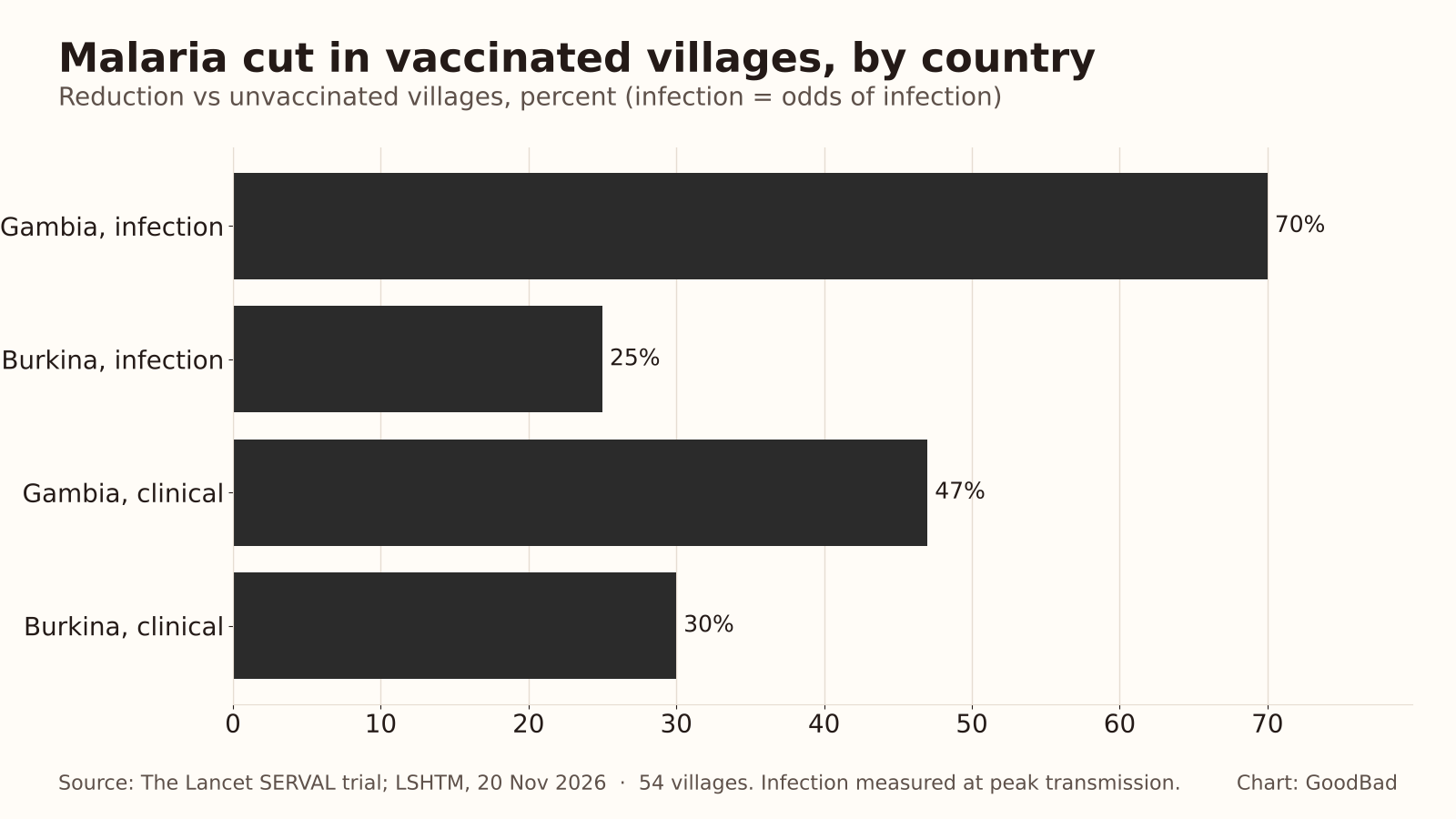 Chart: GoodBad. Data from The Lancet SERVAL trial and LSHTM, 20 November 2026.
Two details help with the headline figures. The trial randomised whole villages, not individuals, which keeps the comparison clean. And “odds of infection” compares the chance of being infected with the chance of not being infected. A 25% fall in odds is therefore not the same as a 25% fall in the share of people infected.
The authors add one more point. Because the burden in Burkina Faso is so much higher, even a smaller percentage drop could mean more infections prevented in absolute terms than the larger drop in The Gambia. They present that as a possibility, not a measured result, and it is the strongest argument against writing the 25% figure off.
Why the smaller effect matters
Burkina Faso is where the burden is heavy. Professor Halidou Tinto, who led the study there, said children are intensely and repeatedly exposed each rainy season. In that setting the vaccine’s protection was concentrated in the youngest children. Even with three doses for the whole community and nets and preventive drugs running alongside, the odds of infection in vaccinated villages stayed at three quarters of those in unvaccinated ones.
The trial also shows what a vaccine campaign adds, and what it does not. It reaches older children and adults. Professor Umberto D’Alessandro is the principal investigator in The Gambia. He said it disproves “previous assumptions that the vaccine would not be effective in these age groups.” But a campaign that covers entire villages needs three monthly visits to every household. The sources do not give a cost per person, and no source says who would pay.
The disease this is up against
The World Health Organization estimates 282 million malaria cases and 610,000 deaths in 2024, about nine million more cases than the year before. The WHO report says the African Region carries the greatest burden, with 11 countries accounting for about two thirds of cases and deaths. It says progress in cutting the mortality rate remains far off track, and that partial resistance to artemisinin drugs has been confirmed or suspected in at least eight African countries.
The trial authors themselves point to the lack of progress as the reason to try the approach. The WHO credits new tools with saving a million lives in 2024, and it counts 47 countries and one territory as certified malaria-free. So the tools do work. The question is how much more this one can do where transmission is highest. The WHO also says antimalarial drug resistance is a growing threat, which is part of why a new tool is wanted.
What is still open
The sources leave several gaps. They describe one season of results from two countries. They do not say how long protection lasts. They do not say whether villages would need three doses again each year, or how a government on a tight budget would weigh this against other measures.
The study is also open-label, which is a limit on how firmly the results can be read. The vaccine was safe and well tolerated, with mild and short-lived headache and fever the main side effects. Funding came from MRC-UKRI and the UK Foreign, Commonwealth & Development Office.
No source reports a rollout. Wandifa Samateh, programme manager at The Gambia’s National Malaria Control Programme, called the findings an important signal. The programme looks forward to assessing how the strategy could be integrated into national control and elimination plans. That is a first step, not a decision. For Burkina Faso and similar settings, the trial points to a smaller gain than the headline number suggests.