Bad news
Women’s World Cups for 2031 and 2035 Awarded Without a Rival Bid
FIFA’s members approved the 2031 and 2035 Women’s World Cups by acclamation with no competing bids, as the US-led bid sets a $4bn revenue target and the UK faces a tax-status dispute with FIFA.

Read the good side of this story
Two 48-Team Women’s World Cups Confirmed for 2031 and 2035

Nobody competed for either tournament. FIFA’s 211 member federations approved the 2031 and 2035 Women’s World Cups by acclamation on Monday. The Associated Press reports that the two winning bids had been alone in the contest for 20 months. The United States, Mexico, Costa Rica and Jamaica take 2031. England, Northern Ireland, Scotland and Wales take 2035. Both will have 48 teams and 104 matches.
It is the second time in under two years that FIFA has confirmed a double award with no rival. In December 2024 members approved the six-nation bid for the 2030 men’s World Cup, which cleared the way for Saudi Arabia to be given 2034 in a fast-track process, the AP says. A vote with one name on the ballot tests nothing about price, terms or delivery.
The terms nobody bid against
With no competitor, the terms are set by negotiation. The Guardian reports that FIFA is at odds with the UK government and the four football associations over its demands for tax-free status and exemption from exchange-rate fees at the tournament. The dispute is not resolved. The same report says all four associations called on FIFA’s president, Gianni Infantino, to resign in the summer.
The UK’s presentation in Zurich was led by a Sky Sports News presenter and four schoolchildren, not by the association chiefs, who had travelled to the city. FA sources rejected the suggestion that this was meant to keep distance from Infantino, the Guardian says. After the award, the FA chair, Debbie Hewitt, hugged him on stage.
A $4bn target four times the forecast
The US-led bid book promises total revenue of $4bn. The Guardian says the 2023 tournament in Australia and New Zealand earned $570m, and FIFA forecasts about $1bn for Brazil in 2027. The paper judges a further fourfold rise by 2031 “challenging”.
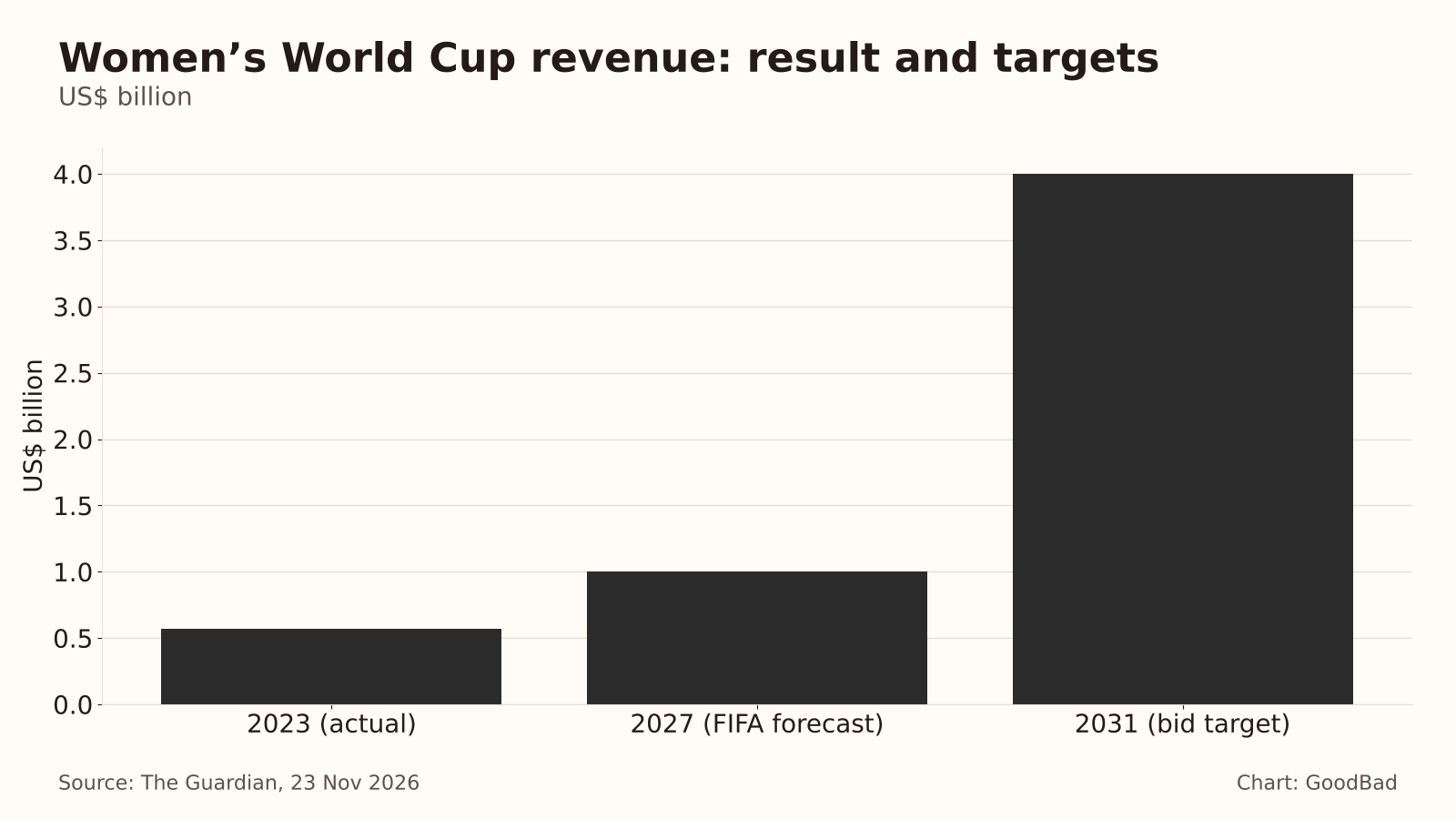 Chart: GoodBad. Data from The Guardian, 23 November 2026: the 2023 result, FIFA’s forecast for 2027 and the 2031 bid-book target.
The plan needs 4.5 million tickets sold, about 43,000 a match, and $550m in ticket revenue. The 2023 tournament sold 1.8 million tickets for $43m. The bid counts on $1.4bn from commercial deals, $1.25bn from matchday income and $1bn from broadcasting. US Soccer’s vice-president of strategy, Emily Cosler, told the Guardian she has “a high level of confidence” in the number.
The 2035 bid sets no revenue target at all. It sets targets of 4.5 million tickets and a television audience of 3.5 billion, which the Guardian says are the bid’s own figures. The reports do not say who covers a shortfall if tickets do not sell.
Venues still to be decided
The 2031 shortlist of 20 cities is provisional. The Guardian says the bid lists 50 stadiums in 35 cities, and FIFA will not choose the final venues until the end of 2028. Of the 20 listed, 14 are in the United States, four in Mexico, with one each in Costa Rica and Jamaica. Thirteen hold more than 60,000 people. One US option, the redeveloped RFK Stadium in Washington, is not due to be finished until 2030.
In the UK, 22 stadiums are listed and FIFA has assessed 19. It scored Elland Road in Leeds 3.9 out of five, and Easter Road in Edinburgh, Windsor Park in Belfast and Nottingham’s City Ground 3.6 each. Every other assessed ground scored at least four. Three are not assessed because they are proposed or need rebuilding: Birmingham City’s planned ground, Wrexham’s Racecourse Ground and a Chelsea stadium. The list will be cut to between 14 and 16.
Northern Ireland is the exposed case. BBC Sport reports that Windsor Park holds 18,500 and needs 5,000 more seats, plus changes to pitch and floodlights. The Irish Football Association is “still working through” funding plans with the government, its director of women’s football said. Belfast was dropped from Euro 2028 after the government declined to fund the rebuild of Casement Park in time.
What this means for fans
Ticket prices for either tournament have not been announced, and neither bid says what an average seat will cost. A target of $550m from 4.5 million tickets implies about $122 a ticket on average, by our arithmetic. That figure is revenue per ticket sold, not a price list, and it will be shaped by hospitality sales that the bid counts separately at $300m.
What was promised, and what is not yet shown
The winning candidates and Infantino promised commercially successful tournaments and said every profit would be reinvested in women’s football. That is a pledge, not an audited result. The Guardian says 2023 was the first women’s World Cup to break even, so the profit record is one tournament long. FIFA has also not yet published its accounts for the 2026 men’s tournament.
The next checks come soon. Brazil’s 2027 tournament has a 32-team field, runs from 24 June to 25 July and carries a forecast of $1bn. The 2035 dates are not fixed, though 21 June to 29 July has been used as a template. If the tax dispute is settled quietly, the public may only learn the terms once the stadiums are chosen.