Good news
Two 48-Team Women’s World Cups Confirmed for 2031 and 2035
FIFA’s members confirmed North America as 2031 hosts and the United Kingdom for 2035, each with 48 teams and 104 matches. The US-led bid projects $4bn in revenue, against $570m in 2023.

Read the bad side of this story
Women’s World Cups for 2031 and 2035 Awarded Without a Rival Bid

The biggest women’s tournaments in football history now have addresses. On Monday FIFA’s 211 member federations approved the 2031 and 2035 Women’s World Cups by acclamation in an online meeting, according to the Associated Press. The United States, Mexico, Costa Rica and Jamaica take 2031. England, Northern Ireland, Scotland and Wales take 2035.
Both tournaments will have 48 teams for the first time at a Women’s World Cup. That lifts the number of matches from 64 to 104, The Guardian reports, and it gives more national teams a realistic shot at a place on the world stage. The 2027 tournament in Brazil keeps 32 teams and runs from 24 June to 25 July, Euronews notes.
The money case for 2031
The US-led bid book projects total revenue of $4bn. The Guardian says the last tournament, in Australia and New Zealand in 2023, earned $570m and was the first women’s World Cup to break even. FIFA itself forecasts about $1bn for Brazil in 2027.
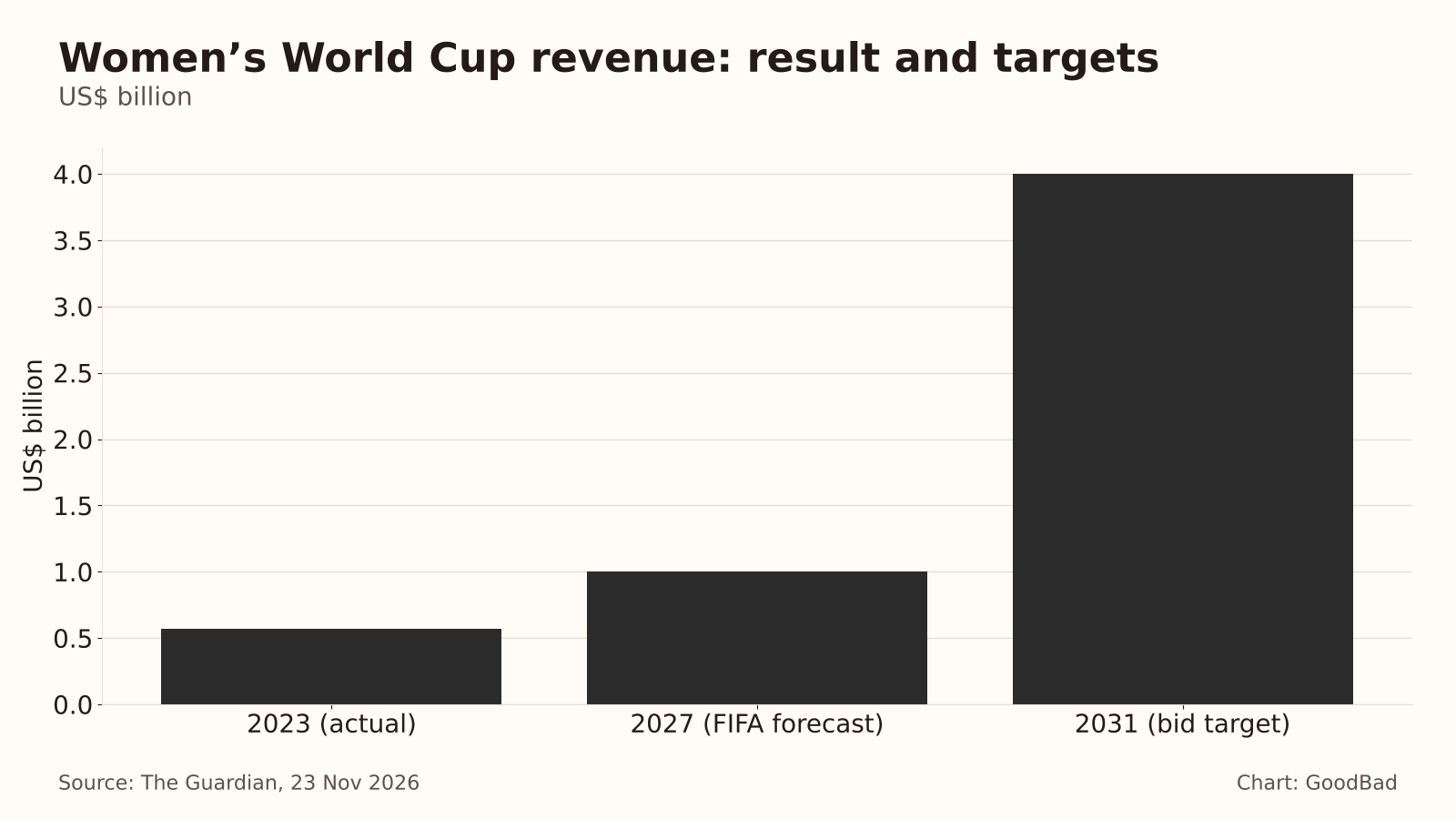 Chart: GoodBad. Data from The Guardian, 23 November 2026: the 2023 result, FIFA’s forecast for 2027 and the 2031 bid-book target.
The route to $4bn runs through the stadiums. According to the Guardian, the plan counts on $1.4bn from commercial deals, $1.25bn from matchday income and $1bn from broadcasting. Thirteen of the 20 provisional venues hold more than 60,000 people. Seven of the US grounds staged matches at the 2026 men’s World Cup.
Ticketing shows the scale of the change. The hosts are targeting 4.5 million tickets sold, an average crowd of about 43,000 per match and $550m in ticket revenue. In 2023 the tournament sold 1.8 million tickets for $43m. US Soccer’s president, Cindy Parlow Cone, called it “the largest women’s sporting event in history” in her presentation in Zurich.
Where the matches will be played
The 2031 shortlist covers 20 cities: 14 in the United States, four in Mexico, plus San José in Costa Rica and Kingston in Jamaica. It is provisional. The Guardian says the bid lists 50 stadiums in 35 cities, and FIFA will choose the final venues by the end of 2028.
For 2035, the UK bid lists 22 stadiums: 16 in England, three in Wales, two in Scotland and one in Northern Ireland. FIFA has assessed 19 of them and scored all but four at 4.0 or higher out of five. The final is proposed for Wembley, which staged the 2022 European Championship final. The list will be cut to between 14 and 16 grounds.
England has never hosted a Women’s World Cup. It would be the first World Cup of any kind in the UK since the men’s tournament of 1966. The bid sets targets of 4.5 million tickets sold and a global television audience of 3.5 billion, the Guardian reports. It also says 63 million people live within two hours of at least one proposed venue.
What it could mean for players and fans
Dates for 2035 are not fixed, though 21 June to 29 July has been used as a template. The tournament is planned for 104 matches over 39 days. The four associations’ chief executives called the award a “landmark moment”. They said eight and a half years of work now begins. It covers facilities, coaching, officiating and the pathway from a girl’s first game to a professional contract.
The winning candidates and FIFA’s president, Gianni Infantino, promised commercially successful tournaments and said all profits would be reinvested in women’s football, the AP reports. Infantino listed his priorities as more women players, coaches, referees and administrators, and closing the gaps that remain. Those are pledges, and the first test is Brazil in 2027.
Northern Ireland shows how local the work will be. The Irish Football Association told BBC Sport that Windsor Park needs 5,000 more seats on top of its 18,500 capacity, plus pitch and floodlight changes. It says the Northern Ireland Executive has committed to back the upgrade. A lasting stadium gain for Belfast would be the kind of legacy supporters can see.
What the bigger format changes
The jump from 32 to 48 teams adds 16 places, so more federations, including smaller ones, can plan for a World Cup rather than hope for one. The jump from 64 to 104 matches adds 40 fixtures, which means 40 more match days for broadcasters, sponsors and fans in host cities. Both rest on the same bet: that demand has grown faster than the old format could serve.
There was no rival bid for either tournament. That removes a contest, but it also means the hosts do not have to outbid anyone, and the winning pledges can be judged on delivery alone. One negotiation is still open: the Guardian reports FIFA is at odds with the UK government and the four associations over its demand for tax-free status. The AP notes that England and the United States are two of the heavyweights of women’s football, and that the United States has won the tournament four times.
What to watch next
The next dates are practical ones. Brazil kicks off in June 2027 with 32 teams. FIFA chooses the 2031 venues by the end of 2028. The UK narrows its 22 stadiums to between 14 and 16.
For fans, the early signal is the 2023 tournament, which sold 1.8 million tickets, against a 2031 target of 4.5 million. If crowds in the United States come anywhere near 43,000 a match, the women’s game will have its first routine stadium-scale audience. The hosts have promised that every profit goes back into the sport.