Good news
Adding Wind Cuts the Cost of Round-the-Clock Solar Power by Nearly a Fifth
Ember’s new modelling finds that wind alongside solar and batteries lowers the median cost of meeting 90 percent of demand from $105 to $86 a megawatt-hour, and shrinks the battery needed from 20 hours to 12 in the US and Europe.
This story runs on the good side only. The biggest stories of the day are told on both sides.
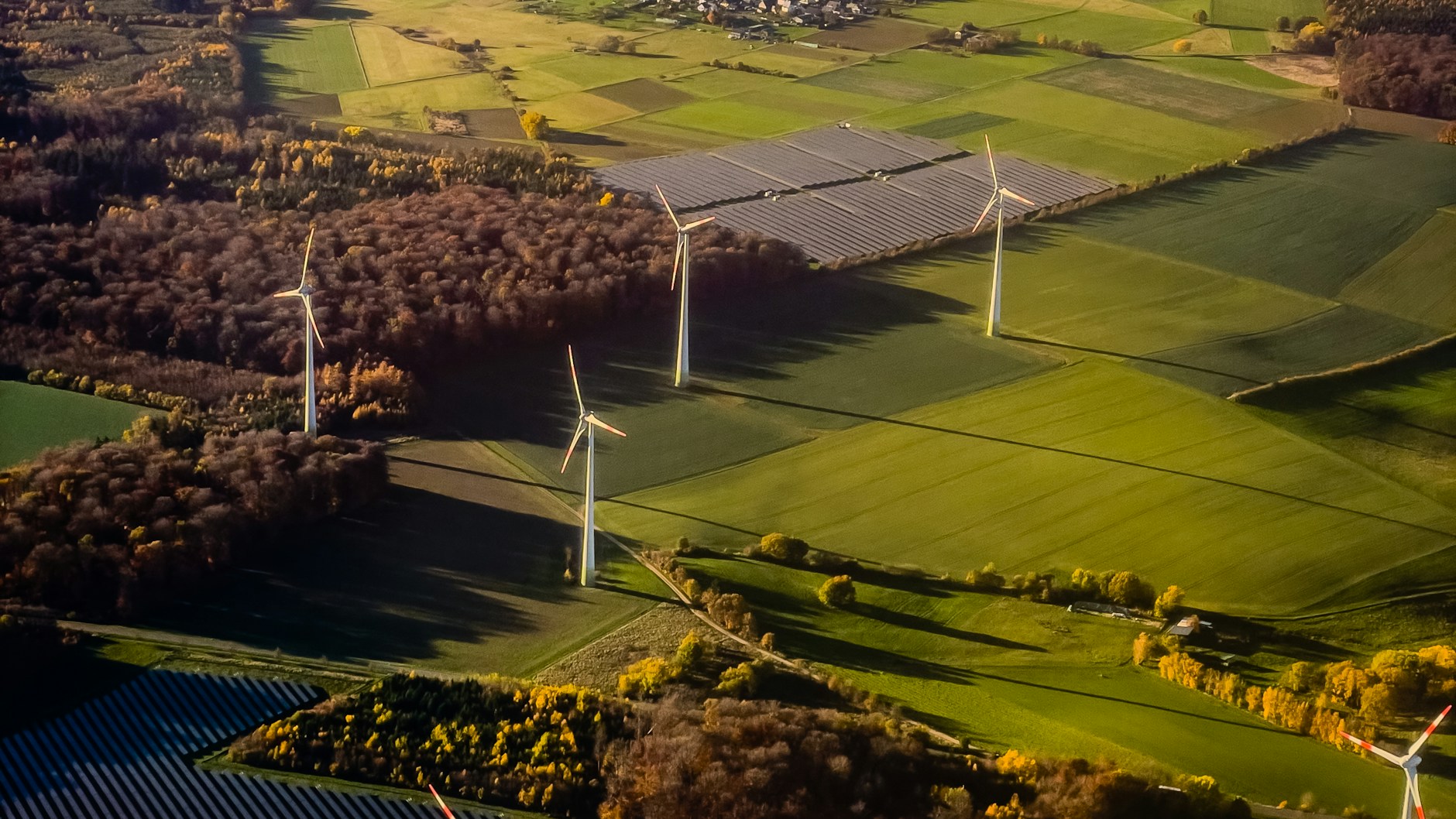
Solar panels are cheap, but they stop at night, and the batteries needed to bridge long winter gaps are expensive. A new analysis from the energy think tank Ember, published on 13 November, finds that adding wind to the mix cuts that bill sharply almost everywhere. Across the world, the median cost of meeting 90 percent of electricity demand from solar, wind and batteries is $86 per megawatt-hour. With solar and batteries alone it is $105, according to Ember’s report.
That is a fall of nearly a fifth. The reason is simple: solar and wind produce at different times of day and in different seasons, so a system with both needs less stored energy to cover the gaps. Ember’s authors are Daan Walter, Sam Butler-Sloss, Antoine Issac and Kingsmill Bond, and the Global Wind Energy Council supplied data and review.
What the model measures
Ember ran every region of the world through ten years of hourly weather, from 2015 to 2024. It asked how much of a flat, always-on demand a system could meet from its own solar, wind and batteries, with gas or diesel backup covering the rest. The test is deliberately tough. Real demand is more flexible, so Ember calls the costs a stress test, not a forecast.
All costs use 2026 prices and a 7 percent cost of capital everywhere. That holds finance constant, so the comparison shows what the weather and the technology allow. It also hides a real gap: where the median person in Africa lives, borrowing costs 14 percent, against 8 percent in Europe.
Less storage, lower bills
The biggest saving is in storage. For 90 percent uptime, the battery needed in the United States falls from 20 hours of demand to 12 when wind is added. Europe sees the same drop, and China falls from 18 hours to 12. In Canada it falls from 24 hours to 10. In India, nearer the equator, the battery stays at 14 hours.
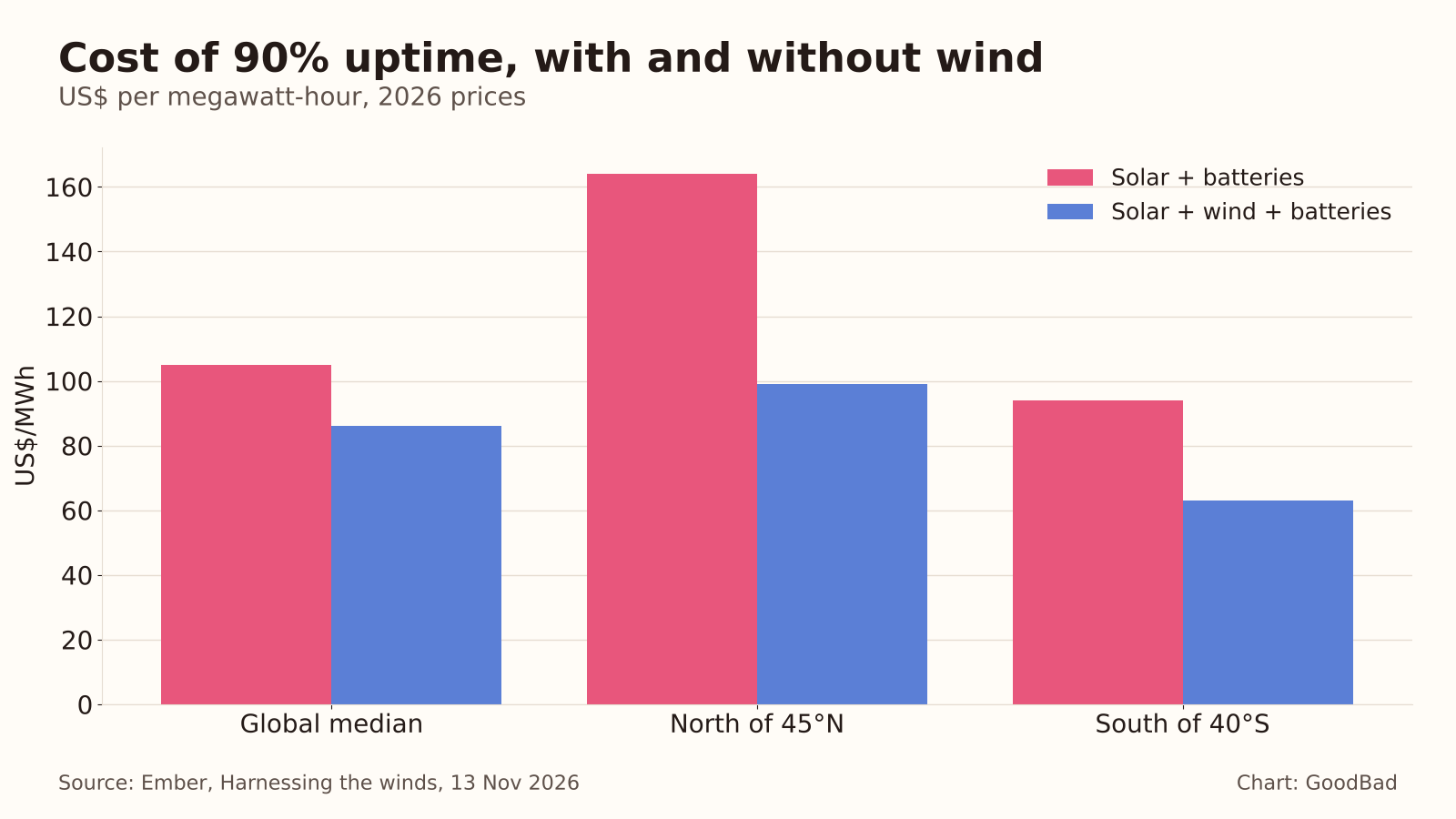 Chart: GoodBad. Data from Ember, “Harnessing the winds”, 13 November 2026. Costs are in 2026 dollars at a 7 percent cost of capital.
Wind matters most far from the equator. Without it, firm solar power near the equator costs under $60 per megawatt-hour, while above 55 degrees north the same target costs $280. With wind, the cost stays under $100 at every latitude. North of 45 degrees north, wind cuts the median from $164 to $99. South of 40 degrees south, in Chile and Argentina, it falls from $94 to $63.
The seasons explain it. In Germany, wind delivers 44 percent of its yearly output between November and February, against 12 percent for solar. Wind tends to blow hardest in the grey months when solar is weakest.
Fewer blackouts on paper
Ember also counted the still, dull weeks that worry grid planners. It defines a lull as seven days with output below half the average. Weighted by electricity demand, solar has one roughly four times a year and wind roughly eight times. Both at once, known as a Dunkelflaute, happens about once every four years.
Wind also shrinks the worst week. In Germany, the worst dark and still week of the decade leaves a gap of about five days of average demand with both sources, against six with either alone. A system with solar and wind needs less backup, too. For $98 per megawatt-hour, a system with wind meets 95 percent of demand, leaving the backup about half as much to cover than at 90 percent.
What it means for new fossil plants
The world has 845 gigawatts of coal and gas plants in planning, Ember says, citing Global Energy Monitor. At 90 percent uptime, adding wind raises the share of that pipeline sitting where renewables could meet demand for under $100 a megawatt-hour from 71 percent to 90 percent. In China alone, wind brings another 91 gigawatts into that range.
Ember cautions that these are alternatives for meeting the same demand in its model, not like-for-like replacements for each plant’s services to the grid. Its report also points to higher gas and coal prices since the disruption in the Strait of Hormuz, and says new fossil power is heading above $100 a megawatt-hour in many importing countries.
Limits and what comes next
Ember is a think tank that promotes clean energy, and the numbers come from its own model. Grist reports that an outside researcher at Project Drawdown, Al-Amin Bugaje, said that on cost and reliability clean power can be competitive. The model also uses one simulated wind site per region and notes known regional biases in its wind data.
Wind and solar supplied 17 percent of the world’s electricity in 2025, Ember says. Its own estimate is that today’s technology can take that to 80 percent and beyond. By 2050, the report projects the cost of firm solar and wind power falling from $89 to $52 a megawatt-hour on local cost paths. Whether builders and financiers act on it is the next test. On supply, Ember says global wind potential is at least 19 times the world’s electricity demand on conservative assumptions, so the resource is unlikely to be the limit.