Good news
Oil Demand Levels Off by 2030 in IEA Outlook as Electrification Spreads
The IEA’s 2026 outlook sees global oil demand levelling off near 103 million barrels a day by 2030 under stated policies, with 25 countries adding electrification policies since February and cooling demand passing heating for the first time.

Read the bad side of this story
Data Centre Emissions to Rise 70% by 2030 as Energy Shock Revives Coal Case
The world’s oil demand is heading for a plateau, and the energy crisis of 2026 is pulling it there faster. The International Energy Agency’s World Energy Outlook 2026, published on Thursday, says that under today’s stated policies oil demand levels off at around 103 million barrels a day by 2030 and then declines. The Iran war, which cut off the Strait of Hormuz, is the reason governments are acting.
That is a central scenario, not a forecast, and the agency says so. It assumes Gulf exports ease into 2027 and that ships can pass Hormuz freely by the end of 2027, as summarised by Oil & Gas Journal. The spread between scenarios is where the good news sits.
Three paths for oil
The outlook compares three cases. Under current policies only, oil demand keeps rising to about 106 million barrels a day in 2035 and 114 million in 2050. Under stated policies, which include formally proposed measures, it falls to 102 million in 2035 and 96 million in 2050.
The third case, called Additional Response, adds the measures governments are now considering to cut import dependence and speed up electrification. In it, oil demand is more than 4 million barrels a day below the stated-policies path by 2035 and reaches 85 million in 2050.
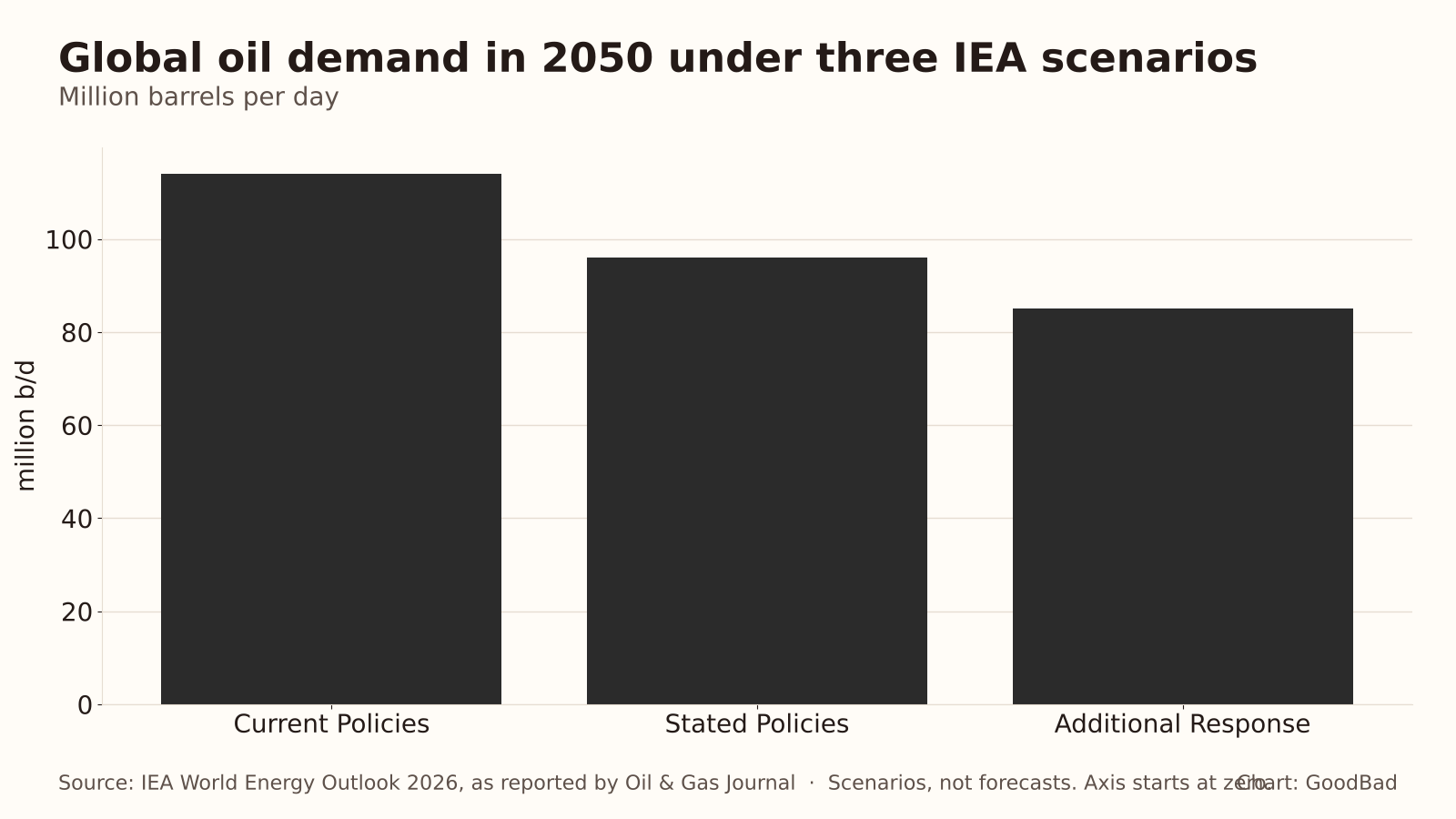 Chart: GoodBad. Data from the IEA World Energy Outlook 2026, as reported by Oil & Gas Journal.
Lower demand brings lower prices. The IEA’s oil price projections for 2050 are $106 a barrel under current policies, $70 under stated policies and $62 in the Additional Response case, according to the same account. For a household or a government that imports fuel, that gap is the practical prize.
Why countries are electrifying
Climate Home News reports that 25 countries, most of them in Asia, have announced new electrification policies since February. They cover electric motors in industry, electric vehicles, renewable power and heat pumps. The logic is simple: a country that runs its trucks and factories on its own electricity cannot be cut off by a closed strait.
The Associated Press quotes the IEA’s director of sustainability, Laura Cozzi. She says that, for the first time, energy-security policies and transition policies are closely aligned. AP says the IEA names solar and nuclear power as the biggest beneficiaries of governments favouring domestic supply.
China shows the scale. The report sees its electrification rate rising from 32% last year to 43% by 2035, the highest among major economies, AP reports. Turkey is asking COP31 to agree that electricity should supply 35% of global final energy by 2035, up from roughly 21% today.
A milestone in cooling
One number marks how far the system has moved already. The IEA calls it a striking milestone that energy demand for cooling overtook demand for heating for the first time this year. Cozzi told AP this is the start of a trend that will last for the next decade and beyond.
That shift is a mixed signal, since it follows from heat, but it also changes what grids must deliver. It adds to the case for solar, which produces most when air conditioning is needed most. It also means the electricity system, not the oil market, now carries the fastest-growing part of household energy use in hot places.
What the crisis cost
The IEA’s Executive Director, Fatih Birol, told AP that he sees no credible path back to the energy system as it was before the war. The longer the crisis lasts, he said, the deeper its effects will be. That is a warning from the agency, and it is also the reason many governments are not waiting to see how the war ends.
The scale of the shock explains the policy turn. The IEA says cumulative losses from the Gulf reached 2.8 billion barrels of oil and 60 billion cubic metres of gas. Global oil supply fell by 16.1 million barrels a day at its worst. Diesel prices passed $200 a barrel. IEA members released 400 million barrels from emergency stocks on 11 March.
Demand has already responded. The agency’s November oil report expects global oil demand to fall by around 2.7 million barrels a day in 2026, the first annual decline since 2020. Gas demand is expected to fall about 1.5%.
Oil flows through Hormuz may not recover to old levels. AP reports that the IEA projects them falling from 20 million barrels a day before the war to 8.5 million in 2030 and below 2 million by 2035, as buyers diversify.
Limits and next steps
This outlook is not a guarantee. The IEA says the longer the crisis lasts, the deeper its effects will be, and the report also notes that coal-rich Asian economies are keeping coal as a fallback. Data centres are pushing the other way. The agency expects their emissions to rise 70% by 2030, according to Bloomberg, with about $4 trillion of investment by 2030 after $565 billion in 2025. Fewer than 100 major AI projects alone would need 50 gigawatts, close to Great Britain’s peak demand.
The reader’s practical question is cost. No source here gives a household figure, but the price paths above show where the agency expects fuel costs to settle under each scenario. The next test is political. COP31 in Antalya is due to close on Friday, and its draft text includes the electrification target. The IEA’s scenarios give negotiators a number to aim at: the 4 million barrels a day separating the central path from the faster one.