Good news
First Limb-Girdle Muscular Dystrophy Drug Approved After Trial Shows Gains in Walking
The FDA approved BridgeBio’s Welgemda on 23 November, the first treatment for any form of limb-girdle muscular dystrophy. In a 112-patient phase 3 trial, treated patients walked faster and breathed better than those on placebo.
This story runs on the good side only. The biggest stories of the day are told on both sides.

For the first time, people with a form of limb-girdle muscular dystrophy have an approved medicine. The US Food and Drug Administration approved BridgeBio’s Welgemda (ribitol) on Monday for LGMD type 2I/R9, according to STAT. It is the first drug approved for any form of limb-girdle muscular dystrophy, a group of progressive muscle diseases that has had little attention from drug developers.
The evidence is a randomised, placebo-controlled phase 3 trial called FORTIFY, registered as NCT05775848. It enrolled 112 people aged 12 to 60 with genetically confirmed disease. At a planned 12-month interim analysis, 74 had been assigned to the drug and 38 to placebo, NeurologyLive reports. The trial continues, and its estimated primary completion date is September 2027.
What the trial found
LGMD2I/R9 is caused by mutations in the FKRP gene. They disrupt how a protein called alpha-dystroglycan is built, and without it muscle cells become fragile and break down over time. The drug is a small molecule taken twice a day by mouth. It is designed to supply the raw material the partly working enzyme needs, so more of the protein is made correctly.
In treated patients, levels of the correctly built protein rose from 22.7 percent to 44.5 percent of control. On placebo they stayed near 20 percent. NeurologyLive reports the figures from data presented earlier this year. On the 100-metre timed test, treated patients sped up by 0.14 metres a second while placebo patients slowed by 0.12. The gap between the groups was 0.27 metres a second.
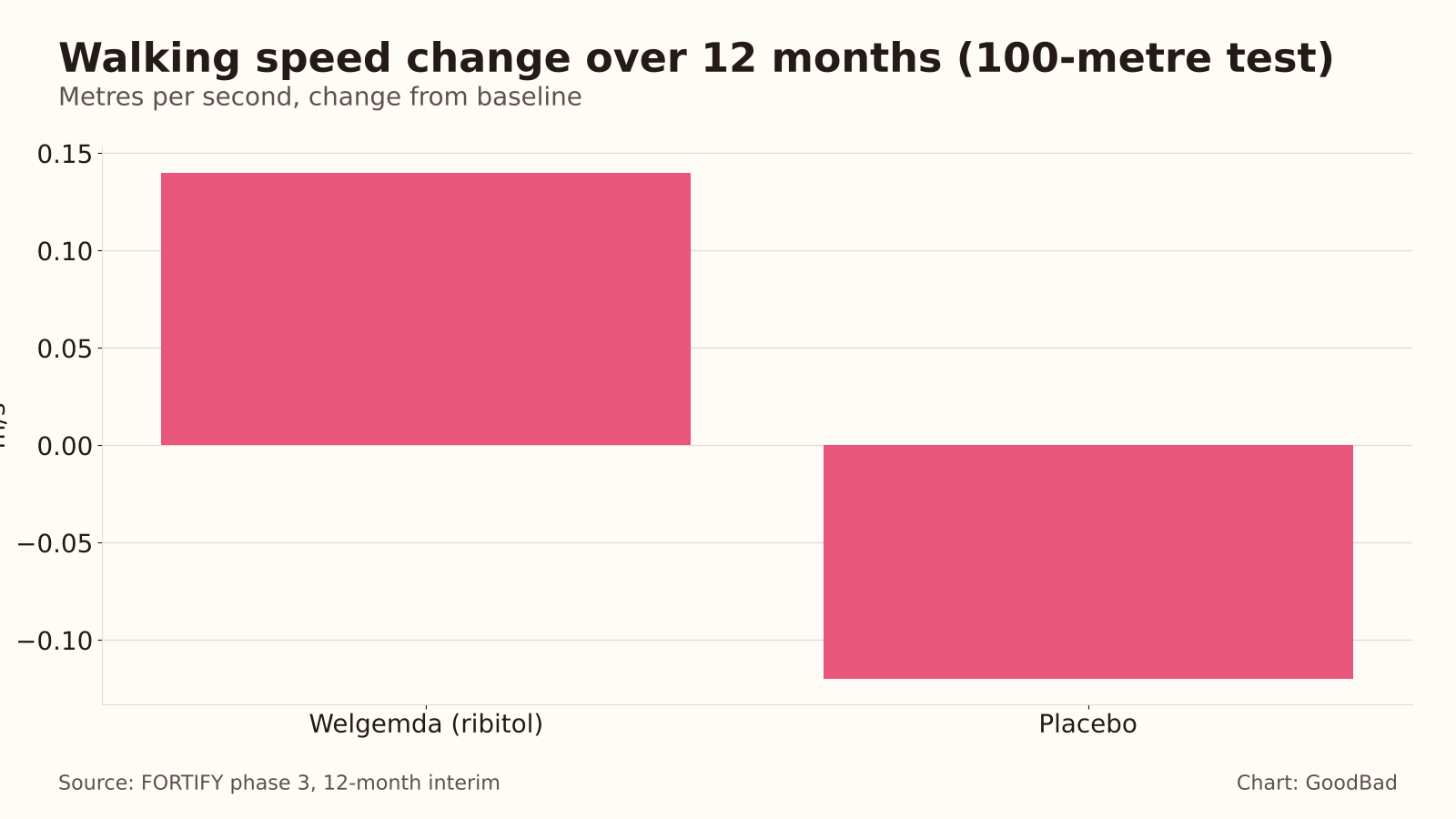 Chart: GoodBad. Data from the FORTIFY phase 3 12-month interim analysis, as reported by NeurologyLive.
Lung function moved the same way. Forced vital capacity, a measure of breathing strength, rose by about 3 percentage points with treatment, a difference of about 5 points against placebo. Serum creatine kinase, a marker of muscle damage, fell 82 percent from baseline. NeurologyLive says the effects were consistent across genotype, age and starting lung function.
Who can take it
The approval covers adults and children who weigh at least 30 kilograms, the American Journal of Managed Care reports. BridgeBio estimates the subtype affects 2,000 to 3,000 people in the United States and another 4,000 to 5,000 in Europe, STAT says. Without a treatment, care until now has meant managing symptoms.
The disease is serious. NeurologyLive notes that in the most common genotype about 25 percent of adults lose independent walking, 10 percent need assisted ventilation and 30 percent develop heart muscle disease. Other genotypes start earlier and hit harder. A small exploratory heart analysis found all treated patients with raised troponin returned to the normal range by month 12, against 40 percent on placebo, though that analysis was small and not definitive.
Who has the disease
LGMD2I/R9 is rare but not evenly spread. A Norwegian cohort study cited by AJMC found 153 genetically confirmed patients, a prevalence of 2.84 per 100,000, the highest reported anywhere. In that cohort 88 percent carried the same FKRP variant, which implies about one person in 101 carries it. Symptoms usually appear in childhood or early adulthood and worsen with time.
That matters for the reader’s next question: does this reach me? Only a genetic test can confirm this subtype, and the approval is specific to it. Other forms of limb-girdle muscular dystrophy are not covered by this approval, though the first approval for the group is a signal to developers.
What it costs and what is safe
Cost is the open question for families. BridgeBio said it will charge insurers $75,446.58 for a 28-day supply, which STAT says is just under $1 million a year. Thirteen supplies in a year come to about $981,000, by our arithmetic. STAT does not say what patients will pay out of pocket, and no source in our reading gives that figure yet.
On safety, the most common side effects were diarrhoea, stomach pain and joint pain. Diarrhoea hit 39.2 percent of treated patients and 52.6 percent of placebo patients, all mild or moderate. Serious grade 3 or 4 events were 5.4 percent and 5.3 percent. There were no deaths and no one stopped treatment because of side effects, NeurologyLive reports.
What comes next
The drug travelled a fast route. It held orphan drug, fast track and rare pediatric disease designations, NeurologyLive reports. The trial ran at sites in the United States, Australia, Denmark, Germany, Italy, the Netherlands, Norway and the United Kingdom, according to the registry. That spread of countries means the data does not rest on a single clinic or health system.
The numbers here are interim, from 12 months of a 36-month study. The FDA has not published effect sizes in its announcement, AJMC notes, so the figures above come from the trial data presented earlier this year. The long-term question is whether the faster walking and better breathing translate into more years of independent life.
Outside the United States, BridgeBio has said it will pursue European approval. Younger children are not covered, and the company plans trials for them. For now, the practical change is simple. A family given a genetic diagnosis of LGMD2I/R9 can now ask a neurologist about a treatment that did not exist last week.