Bad news
Data Centre Emissions to Rise 70% by 2030 as Energy Shock Revives Coal Case
The IEA says emissions from data centres will climb 70% by 2030, and that the Hormuz crisis strengthens the argument for keeping coal as a backup. Its central scenario keeps oil demand near 103 million barrels a day through 2030.

Read the good side of this story
Oil Demand Levels Off by 2030 in IEA Outlook as Electrification Spreads
Carbon emissions from data centres will rise 70% by 2030, the International Energy Agency says, because the extra electricity comes partly from plants that burn gas and coal. The finding sits in the agency’s World Energy Outlook 2026, published on Thursday, as reported by Bloomberg. The same report describes the greatest energy shock on record and the countries now reaching for coal as insurance.
The data centre bill
Investors will put about $4 trillion into data centres worldwide by 2030, after $565 billion in 2025, Bloomberg reports the IEA as saying. Around three-quarters of the expected growth is in centres built to train and run artificial intelligence.
The agency has started using satellite imagery to follow 93 major AI data centres. It finds a tenfold rise in their capacity in two years. Fewer than 100 major AI projects together would need 50 gigawatts, roughly the peak demand of Great Britain. In some fast-growing markets, planned projects would exceed current peak demand if all were built.
Technology companies are the largest corporate buyers of green electricity, Bloomberg notes. Even so, the growth is lifting demand for fossil fuels, and the 70% rise in emissions follows from that. The article also reports growing resentment in communities that fear higher electricity bills.
Coal gets a second argument
The shock that is reshaping energy also strengthens the case for the dirtiest fuel. According to AP, the IEA says energy security concerns reinforce the case for keeping coal as a backup in a crisis. That is especially true in coal-rich Asia, which went into energy triage when the Iran war closed the Strait of Hormuz.
The agency’s executive director, Fatih Birol, told reporters that coal has momentum and that it is not yet clear whether it will last. The industry-backed group FutureCoal, formerly the World Coal Association, says domestic coal remains an important energy security asset. That is an interested party’s view and is reported as such.
India will account for more energy demand growth over the next decade than any other country, AP says. Birol also said he sees no credible path back to the energy system that existed before the war.
Heat adds to the load
The IEA calls it a striking milestone that energy demand for cooling overtook demand for heating for the first time this year. Laura Cozzi, the agency’s director of sustainability, told AP that this marks the beginning of a trend that will last for the next decade and beyond. Warming raises the electricity load that data centres are already straining.
The agency also expects flows through Hormuz to shrink as buyers diversify. AP reports a projection from 20 million barrels a day before the war to 8.5 million in 2030 and below 2 million by 2035. Solar and nuclear power are named as the biggest beneficiaries of governments prioritising domestic supply.
Oil falls slowly, even in the good case
Headlines about falling oil demand need a second look. In the central scenario, built on stated policies, demand levels off at about 103 million barrels a day by 2030 and is still 96 million in 2050, according to Oil & Gas Journal. Under current policies it keeps climbing, to about 106 million in 2035 and 114 million in 2050, because petrochemicals, aviation and heavy trucks outgrow the savings from electric cars.
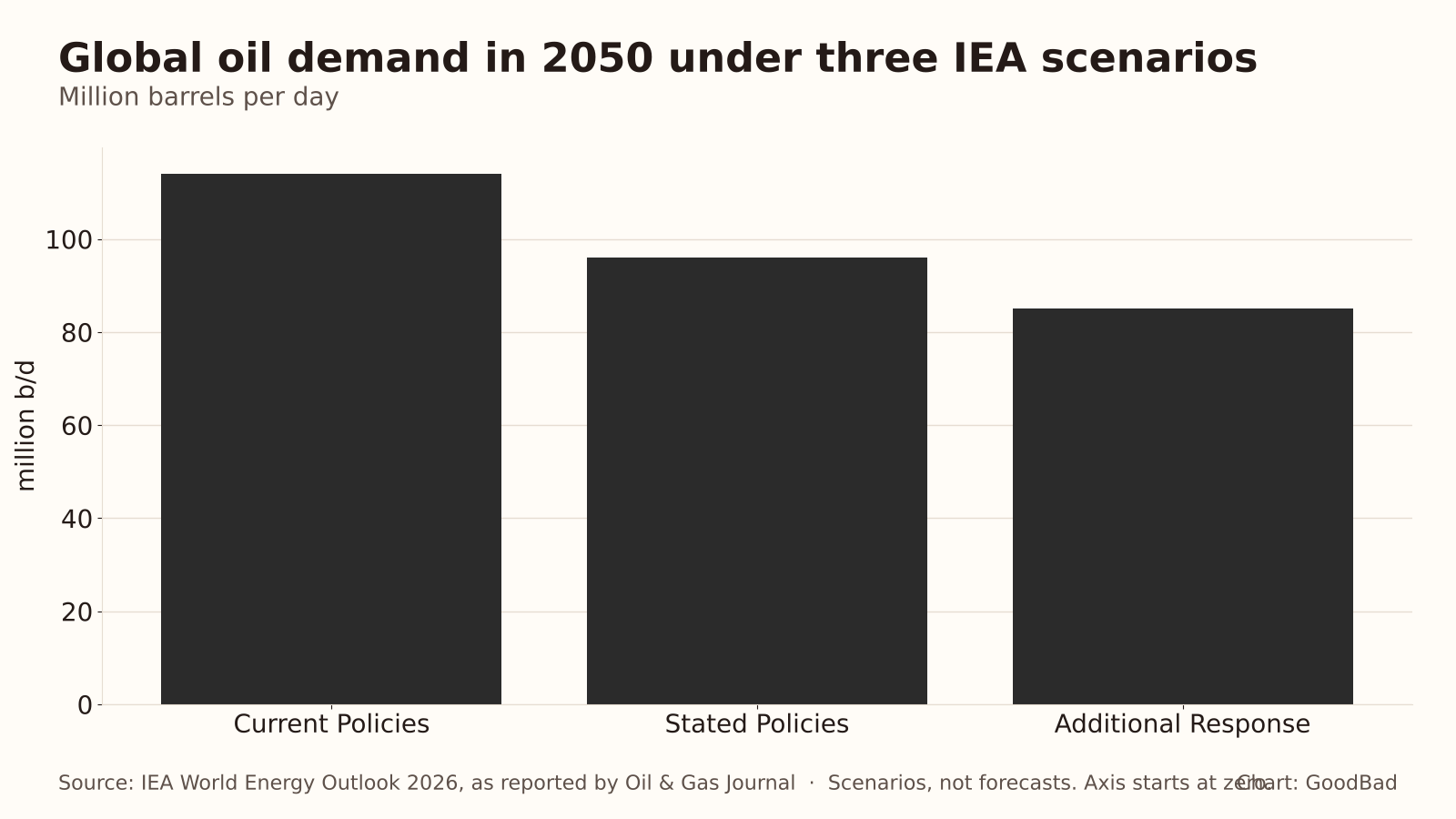 Chart: GoodBad. Data from the IEA World Energy Outlook 2026, as reported by Oil & Gas Journal.
In the fastest case, oil demand is more than 4 million barrels a day below the stated-policies path in 2035 and reaches 85 million in 2050. The IEA stresses that these are scenarios, not forecasts. Even in its fastest case, which adds measures governments are only considering, the world still needs new supply. About 9 million barrels a day of new oil projects and 500 billion cubic metres of new gas projects are required by 2035 to offset declining fields.
What the crisis already cost
The Hormuz disruption cost the world 2.8 billion barrels of oil and 60 billion cubic metres of gas, cumulatively. At its worst, global oil supply fell by 16.1 million barrels a day, according to the same account. Diesel passed $200 a barrel. IEA members released 400 million barrels of emergency stocks on 11 March.
Demand fell because people could not afford fuel. The IEA expects oil demand to drop about 2.7 million barrels a day in 2026, the first annual fall since 2020, and gas demand to fall about 1.5%. The agency attributes the weaker consumption to higher prices, not to a planned transition.
What would change the outcome
The agency is explicit that duration matters, and that the longer the crisis lasts the deeper its effects. A faster electrification path exists. Climate Home News reports that 25 countries, most of them in Asia, have announced new electrification policies since February. China’s electrification rate rises from 32% last year to 43% by 2035 in the report.
Nothing in the sources says that data centre emissions will fall without new policy. The agency’s own wording is that they are set to rise. Whether 25 electrification policies, a 35% electricity-share target before COP31 and new grids can offset a 70% rise from one fast-growing industry is the question the outlook leaves open.