Bad news
COP31 Draft Drops Every Mention of Fossil Fuels as Talks Near Friday Deadline
Negotiators published a COP31 draft with no reference to moving away from coal, oil and gas, with finance, adaptation and just transition talks unresolved. The text keeps a 35% electricity target and an electrification package.

Read the good side of this story
COP31 Draft Keeps Electrification Goal as Package Spans 150 Countries and the EU
Climate negotiators in Antalya removed every reference to moving away from fossil fuels from the latest draft of the COP31 deal. The slimmed-down text was published on Thursday, a day before the summit’s scheduled close, Reuters reports. Monday’s first draft had contained two references to fossil fuels and limiting their use, a topic that divides countries every year.
UN News says the new cover decision drops explicit language on transitioning away from coal, oil and gas. It emphasises clean energy and electrification instead, and keeps Turkey’s proposed target of 35% electricity in global final energy use by 2035. It also acknowledges that warming will overshoot the 1.5 degree goal.
What Monday’s draft said
Reuters says Monday’s opening draft acknowledged that warming could exceed the 1.5 degree threshold countries have tried to preserve. It spoke of the need for deep, rapid and sustained cuts in greenhouse gas emissions, and it encouraged efforts to scale up technologies that remove carbon from the air. The reporting does not say whether those lines survive in Thursday’s text, so readers should check the full draft.
The fossil fuel references were the part most countries fought over. Their removal means the cover decision now names the target, 1.5 degrees, and the tool, electrification, but not the fuels that cause the warming.
The gaps behind the text
Finance, adaptation and just transition negotiations all remain unresolved as the Friday deadline approaches, UN News reports. The draft reaffirms the goal of tripling adaptation funding by 2035 but leaves out how to calculate the increase. Without a baseline, the number cannot be checked.
The numbers already point the wrong way. UN Climate Change’s new yearbook says adaptation finance fell from $81.5 billion in 2022 to $64.1 billion in 2024. It also finds that only 44 of 96 climate-action indicators are moving the right way, while 19 show no progress and 33 lack enough data to judge.
| Adaptation finance | Amount |
|---|---|
| 2022 | $81.5 billion |
| 2024 | $64.1 billion |
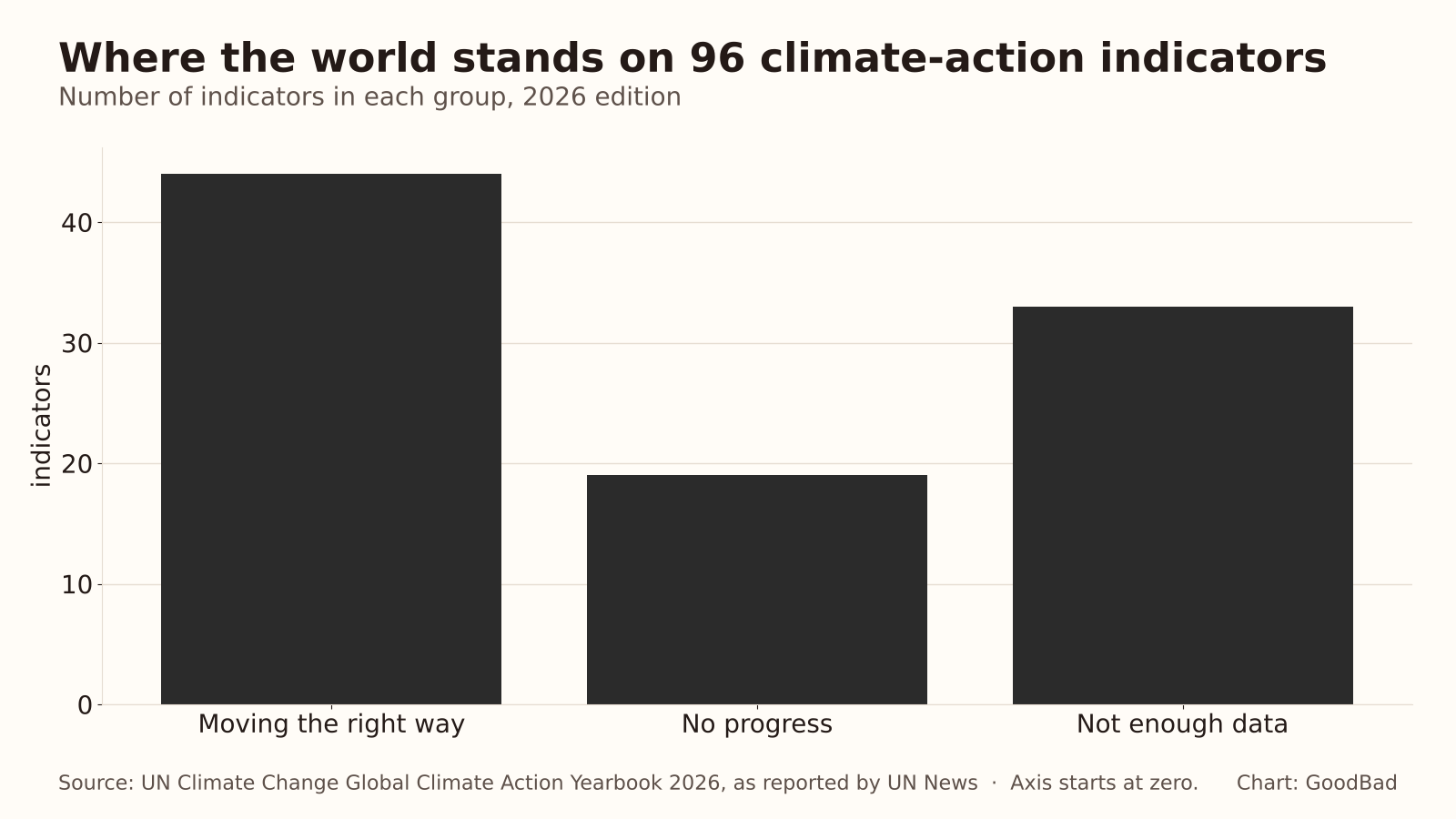 Chart: GoodBad. Data from the UN Climate Change Global Climate Action Yearbook 2026, as reported by UN News.
The yearbook adds that energy efficiency gains are well below what is needed. Renewable energy capacity did grow 17% between 2024 and 2025. The presidency’s electrification package covers more than 150 countries plus the EU. It lists at least $156 billion in annual investment plans for grids, renewables and storage.
What the energy shock adds
The talks are running against a backdrop of fuel stress. Climate Home News reports that the International Energy Agency’s new outlook counts 25 countries, mostly in Asia, with new electrification policies since February. The same report, according to AP, says energy security fears reinforce the case for keeping coal as a backup. Our report on the IEA outlook covers that finding.
Electricity makes up roughly 21% of global final energy use today, AP says, and Turkey wants 35% by 2035. Before the talks opened, the United Nations said the world is dangerously close to missing its 1.5 degree goal.
Who is objecting
Activists spent the morning outside the venue with missing-cat posters for a character named Ambition, a campaign UN News says began at COP29. Behind the joke is a serious demand, according to the report: governments must agree how to move away from coal, oil and gas while protecting workers and communities.
Teresa Anderson of ActionAid International told journalists that announcements in the cover decision cannot cover up the fact that negotiations are struggling. She argued that developing countries are still asked to do more without adequate financial support. Ministers from vulnerable countries said little progress had come from a Wednesday evening exchange called by the COP31 president, Murat Kurum. Some other ministers described the same session as constructive. UN climate chief Simon Stiell said at the electrification event that vulnerable developing countries need affordable finance and technology, and that workers and communities must be supported through the change.
Australia’s Chris Bowen, who leads the negotiations alongside Turkey, defended the text. He said COP31 would be the first summit to acknowledge that the world will fail to hold warming to 1.5 degrees. The draft asks that any overshoot be kept as small and short as possible, and he said the summit should be remembered for rejecting that outcome.
No guarantee of an ending
Australia had said Monday’s opening draft was always intended to be broad and then narrowed down, Reuters notes. The latest text is expected to be revised further before it can be agreed by the nearly 200 countries taking part. In recent years, talks have regularly overrun the scheduled close by more than 24 hours.
Electrification is not fossil-free by default. UN documents on the table do not say that the extra electricity must come from renewables, which means coal and gas plants could supply it at first. The sources do not say what would restore the fossil fuel language, or whether it would survive a final text. Bowen said negotiators would keep working through the night, and that he would not leave the rooms of Antalya without a consensus. Whether the text that emerges restores any fossil fuel wording is the first thing to check.