Good news
ATP Lifts Pay Floors for 250 Players in a $350 Million Plan From 2028
Men’s tennis approved a plan to lift total player compensation above $350 million a year from 2028, with minimums of $1.1 million for the top 100, $450,000 for the top 175 and $250,000 for the top 250.

Read the bad side of this story
ATP’s $350 Million Pay Plan Leaves Doubles Undecided and Starts Only in 2028

Players ranked down to 250 in the world will have a guaranteed living from 2028 if the ATP’s new pay plan works as designed. The men’s tour approved measures on Friday in Turin that are meant to lift total player compensation to more than $350 million a year, according to Reuters, carried by CNA. The top 100 earners are projected to make at least $1.1 million, the top 175 at least $450,000 and the top 250 at least $250,000.
The plan comes with open items. A decision on doubles is still to come, and the 2028 calendar has not been announced. Those are covered below, because they decide how much of the headline reaches players.
Where the money comes from
The ATP, which governs men’s tennis, counts $350 million as everything players earn on tour except the four Grand Slams: on-site prize money, tournament-level profit sharing and central funds. Its chairman, Andrea Gaudenzi, set out the proposals in an open letter on 15 October, and the ATP says the plan is the next phase of its OneVision strategy. With Grand Slam prize money added, Reuters says, total player compensation passes half a billion dollars.
More than $100 million a year of that is central money from the ATP itself. It has three parts: a $50 million bonus pool, a $25 million year-end rankings bonus and $26 million for player pensions.
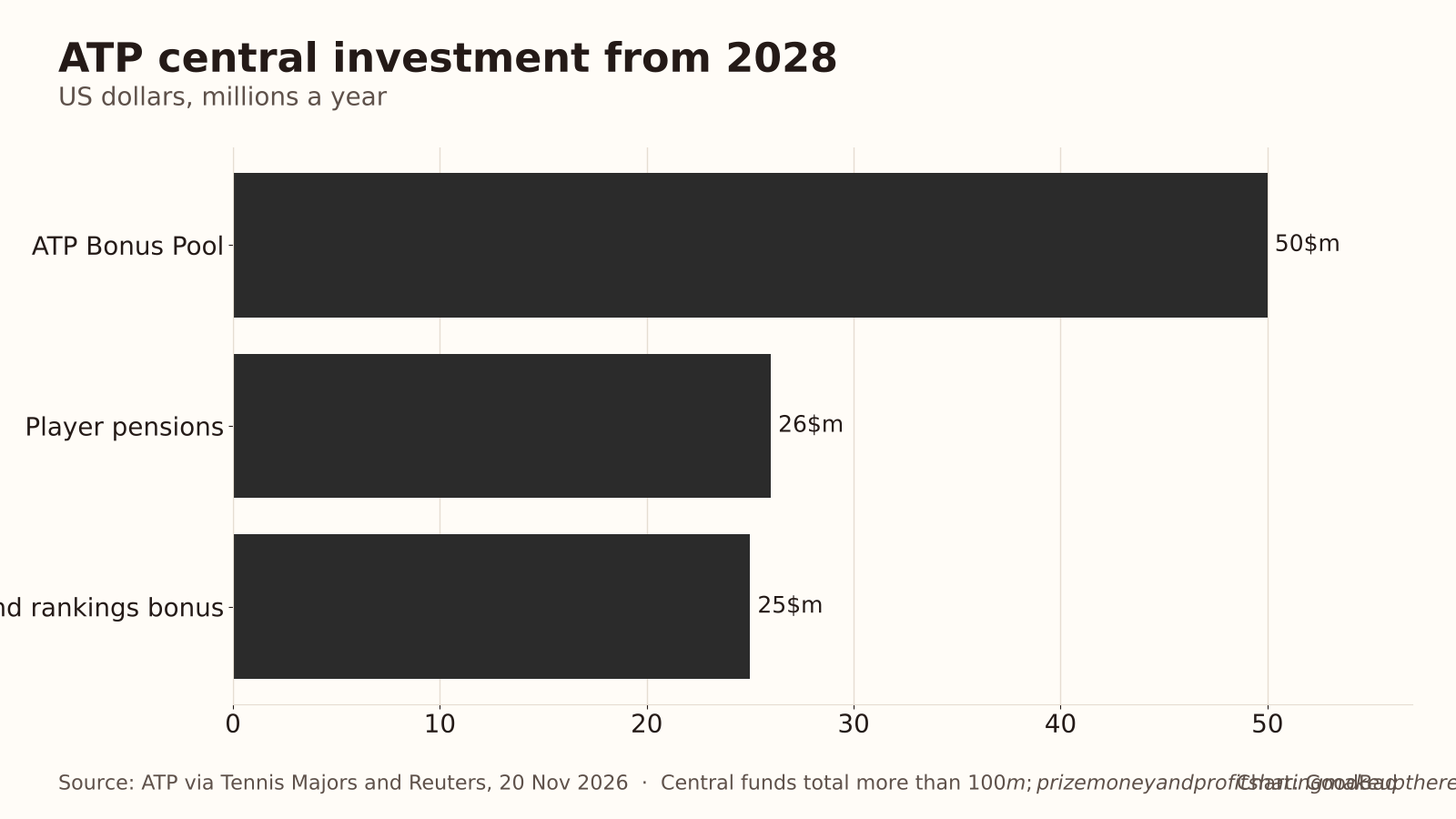 Chart: GoodBad. Data from the ATP via Reuters, 20 November 2026.
What changes for players
The bonus pool more than doubles. It rises to $50 million, and top-30 players are eligible for payments at each mandatory Masters 1000 event, Reuters reports. The old rule that a player had to compete in five of those events before earning anything has been removed, so a player now earns from the first event they play.
The pension money matters differently. It is a payment for after a career ends, and at $26 million it is about a quarter of the central total. The year-end rankings bonus adds $25 million on top of what players win in matches. The sources we have read do not set out the eligibility rules for either, so how it is split is an open question.
The floors are the headline. On those minimums, the top 100 alone would earn at least $110 million between them, by our arithmetic. The top 175 would earn at least $143.75 million, and the top 250 at least $162.5 million, on the figures the ATP projects.
Who this helps
For the top 100, the minimum is a large figure, and it sits within the range of the sport’s best-known names. For players ranked 175 to 250, $250,000 a year is a different kind of change. The sources do not say how many players now earn less than those floors, so the size of the gain for any one player cannot yet be stated.
The plan also changes how the bonus is earned. Because players no longer need to commit to five Masters 1000 events to qualify, a player who has a good run at one of them takes home money from it. That is a more direct link between results and income.
How the $350 million adds up
The three central items total $101 million, by our arithmetic, which is about 29% of the $350 million. The other $249 million or so is on-site prize money and tournament-level profit sharing, the two items that grow when tournaments earn more. With Grand Slam prize money included, Reuters puts the total above $500 million, so the four Slams account for roughly $150 million or more by subtraction.
That split matters because central money is the part the ATP controls directly. Prize money and profit sharing depend on tournaments, so the plan combines money the tour can promise with money it hopes tournaments will generate.
What is still open
Two decisions sit outside this announcement. The ATP put off a decision on proposals for doubles until later this year. Reuters had reported that the plans included smaller doubles draws and shifting prize money to singles qualifying and early-round payouts. The ATP says a decision is expected by the end of 2026.
The 2028 calendar, built around dedicated weeks for each tournament category, is expected to be announced early next year. The ATP says reallocated prize money would stay inside total player compensation, so the $350 million is meant to hold whichever way doubles is decided.
What to watch
Three dates matter. The doubles decision is due before the end of 2026. The 2028 calendar follows in early 2027. And the first season under the new floors is 2028, a little over a year away. Players who plan their finances around a projection should note the wording: the ATP calls these figures projected, not guaranteed.
The ATP’s plan is also a test of how much of a tour’s money can be moved down the rankings without cutting into the top. The direction, though, is clear and clearly good for the tour’s middle. More money is going to more players, with a pension attached, and a bonus that starts from the first big event a player enters.