Bad news
ATP’s $350 Million Pay Plan Leaves Doubles Undecided and Starts Only in 2028
Men’s tennis approved a $350 million pay plan on Friday, but it starts in 2028, rests on projections, and the ATP put off its decision on doubles, where Reuters says prize money could shift to singles.

Read the good side of this story
ATP Lifts Pay Floors for 250 Players in a $350 Million Plan From 2028

Men’s tennis has promised its players more than $350 million a year, but not until 2028, and not yet for everyone. The ATP approved the pay plan on Friday in Turin and put off a decision on doubles, which Reuters describes as controversial, until later this year, according to Reuters, carried by CNA. The figures are projections. The calendar that the plan depends on has not been announced.
The minimums sound large. The top 100 earners are projected to make at least $1.1 million, the top 175 at least $450,000 and the top 250 at least $250,000. Every one of those numbers is from 2028, a year after next.
The doubles question
Doubles is the unresolved part. Reuters had reported that proposals for doubles included smaller draws and shifting prize money to singles qualifying and early-round payouts. The ATP says a decision is expected by the end of 2026 and that any reallocated money would remain within player compensation, according to its open letter of 15 October.
Within the $350 million, then, some players may gain at the expense of others. Singles qualifiers and early-round losers could be paid more. Doubles specialists, whose events would get smaller draws under those proposals, would be paid less or play fewer matches. The sources do not give figures for what any doubles player would lose.
Who gets the central money
More than $100 million a year is central money: a $50 million bonus pool, a $25 million year-end rankings bonus and $26 million for player pensions. Reuters says the bonus pool more than doubles and is paid to the top 30 players at each mandatory Masters 1000 event. The five-event minimum for earning from it has been removed.
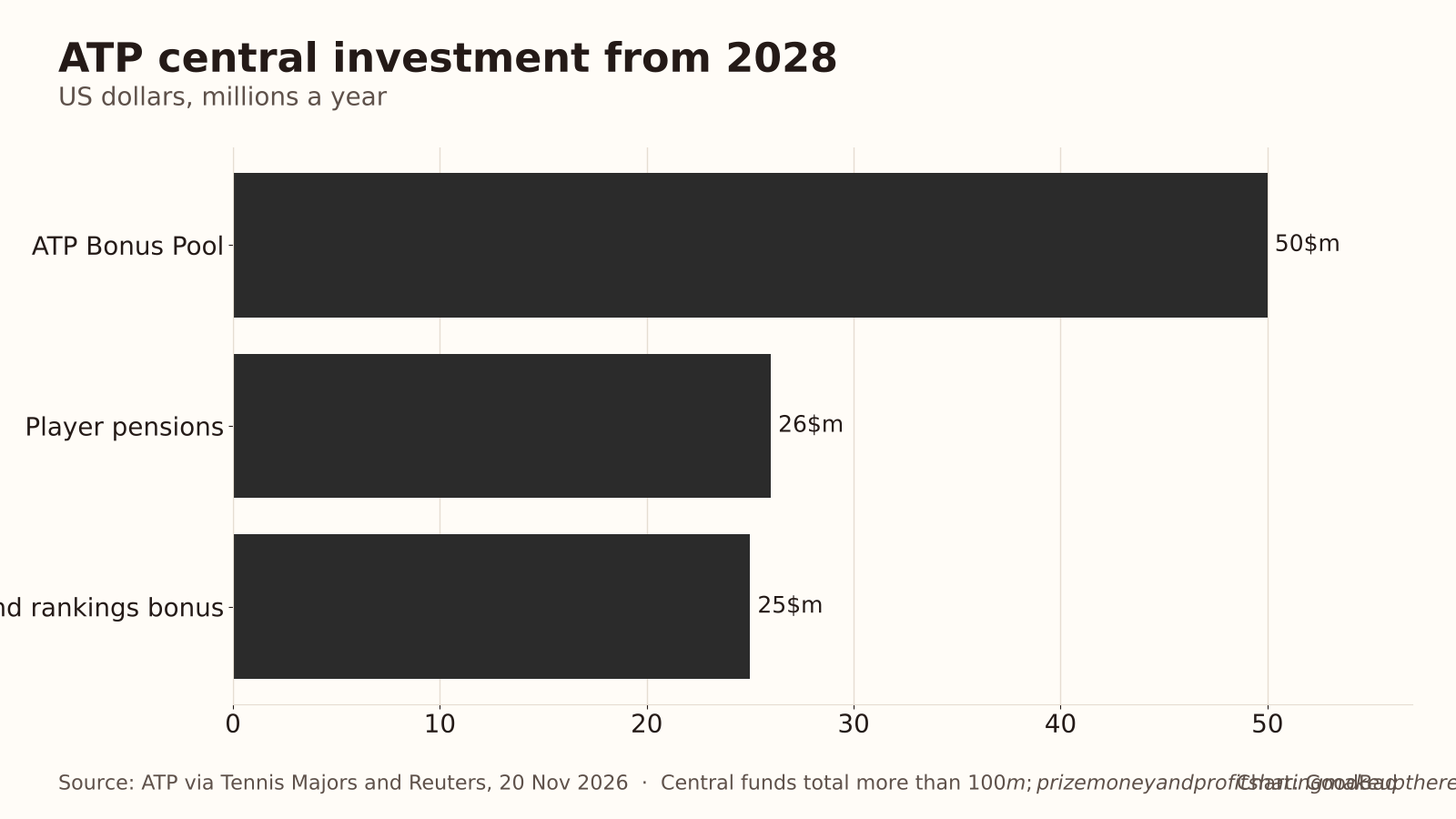 Chart: GoodBad. Data from the ATP via Reuters, 20 November 2026.
The biggest single item therefore goes to players already at the top of the rankings. A top-30 cut-off means that a player ranked 31st or lower earns nothing from the $50 million, however many Masters events they enter. That is 220 of the 250 players the headline numbers cover, on the plan as described.
What the floors mean
On the ATP’s projected minimums, the top 100 alone would earn at least $110 million, by our arithmetic. The top 175 would earn at least $143.75 million, and the top 250 at least $162.5 million. A player ranked 250th who earns the minimum would collect $250,000 before travel, coaching and tax.
The sources here do not say how many players currently earn less than the new floors, so the size of the change for any player is unknown.
How the $350 million adds up
The three central items total $101 million, by our arithmetic, which is about 29% of the $350 million. The other $249 million or so is on-site prize money and tournament-level profit sharing. Those two depend on what tournaments earn, so only the central part is money the ATP itself puts up.
That makes the headline softer than it looks. Roughly seven dollars in every ten is a projection of what tournaments will pay, and the doubles proposals show that the ATP is still deciding how that money is divided.
What the plan leaves out
The $350 million excludes the four Grand Slams, the ATP says. Money from those events is set by their own organisers. Reuters adds that with Grand Slam prize money, total player compensation passes half a billion dollars. The ATP does not control how that is shared. By subtraction the four Slams account for roughly $150 million or more of that total, so over a quarter of the bigger figure sits outside the ATP’s reach.
Players below 250 are not covered by the stated minimums at all. The sources do not describe pay or pension rules for them. Nor do they say whether the $26 million pension fund pays out for every player who retires, or only for those with enough years in the top ranks.
What to watch
The doubles decision is due before the end of 2026. The 2028 calendar is expected early next year. Until both are settled, the $350 million is a projection resting on two open questions, and players cannot plan around it.
For tennis, the plan is real money. For a player ranked 300th, or a doubles specialist waiting to learn what the draw sizes will be, it is still a promise with a date attached.
Questions the sources leave open
The reports do not say who sits on the body that will decide the doubles proposals beyond the ATP’s governing bodies, or how players were consulted. They do not give the amount that doubles players earn now, or how many of the 250 ranked players are doubles specialists. They do not say whether the floors are guaranteed payments or projected outcomes if tournaments perform as hoped; the ATP’s own wording is projected.
Those gaps matter because a floor is only a floor if someone is obliged to pay it. Until the ATP spells out which of the $350 million is promised and which is forecast, players are being asked to take the larger figure on trust.