Bad news
US Wages Still Lag Prices as Long Jobless Spells Reach a Five-Year High
A 165,000-job October did not close the gap: pay rose 3.1% against inflation of 3.7%, the broad jobless rate rose to 7.9%, and the average spell without work reached 27.1 weeks, the longest since 2021.

Read the good side of this story
US Employers Add 165,000 Jobs in October, Nearly Triple the Forecast

Average hourly pay in the United States rose 3.1% over the year to October. Consumer prices rose 3.7% over the year to September, the latest month the Bureau of Labor Statistics (BLS) has published. A worker on the average wage is therefore still falling behind, even in a month when the jobs figure beat every forecast.
The BLS jobs report showed 165,000 jobs added in October and unemployment at 4.1%. The same release contains the numbers that the headline leaves out. Pay and price figures come from different months because October prices have not yet been published, so the gap may move, but it has not closed.
The pay gap
Average hourly earnings reached $38.00, up 0.4% on the month and 3.1% on the year. The BLS consumer price release of 14 October put inflation at 3.7% for September, with prices up 0.6% in that month alone. The Commerce Department’s preferred gauge, the PCE index, stood at 3.6% for September, as we reported last week.
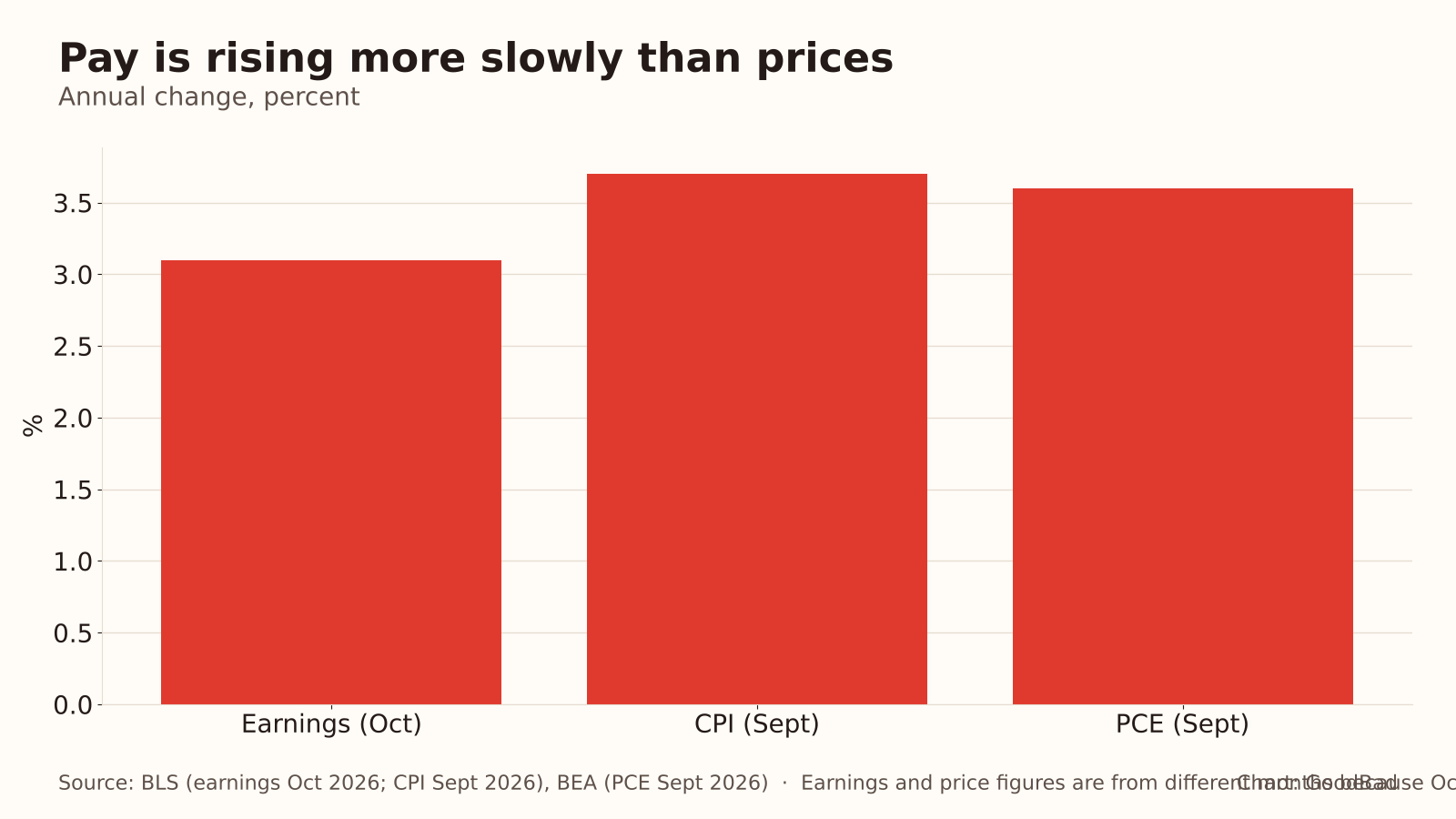 Chart: GoodBad. Data from the US Bureau of Labor Statistics (earnings, October 2026; CPI, September 2026) and the Bureau of Economic Analysis (PCE, September 2026).
Heather Long of Navy Federal Credit Union wrote on X that inflation has now erased wage gains for seven straight months, NBC News reported. Nothing in the October pay figure breaks that run unless prices ease. NBC adds that producer prices are rising faster than consumer prices, which can foreshadow more pressure on shop shelves.
Out of work for longer
Underneath the 4.1% headline rate, the picture for people who lose a job is harder. The average duration of unemployment rose by 2.3 weeks to 27.1 weeks, the longest since September 2021, CNBC reported. The number of people out of work for more than 27 weeks rose to 1.96 million, the most since December 2021.
The broader measure of unemployment, which includes discouraged workers and part-timers who want full-time work, rose by 0.3 points to 7.9%. The BLS counts 7.1 million people as unemployed. Employers are hiring, but those who have been without work for half a year are not being pulled back in at the same pace.
A market that barely turns over
Diane Swonk of KPMG told NBC that low turnover is the core problem, with fewer people entering the labour force. NBC reads the low jobless rate as partly a sign of stagnation, since few people quit and few are hired into new roles. Immigration cuts and demographic change have also shrunk the labour force, according to CNBC.
Housing is a weak spot. NBC counts home building and specialty contracting down by more than 15,000 jobs, as high mortgage rates hold back sales. Artificial intelligence has not yet produced much hiring, NBC says, despite the investment boom around it.
The rate rise to come
The strong report raises the chance that borrowing costs go up. CNBC says traders put the odds of a quarter-point rise at the Federal Reserve’s meeting on 8 and 9 December at 76.8%, according to CME FedWatch. For households with a variable-rate loan or a mortgage to refinance, that adds to a bill that wages already fail to cover.
The jobs numbers themselves are better than expected. The BLS revised August up to 186,000 and September up to 60,000, and the 165,000 gain compares with a forecast of 59,000 from Dow Jones economists. Professional and business services added 70,000 jobs and health care added 42,000, as the good-side telling sets out.
What comes next is arithmetic. If prices ease in the October release, due in the coming weeks, the pay gap narrows. If they keep rising at the September pace, a rate rise in December would arrive before pay has caught up.