Good news
US Employers Add 165,000 Jobs in October, Nearly Triple the Forecast
The US added 165,000 jobs in October against a forecast of 59,000, and unemployment fell to 4.1%. Earlier months were revised up by 84,000, and hiring spread beyond health care, though pay still trails prices.

Read the bad side of this story
US Wages Still Lag Prices as Long Jobless Spells Reach a Five-Year High

American employers hired far more people in October than anyone expected. The Bureau of Labor Statistics (BLS) reported on Friday that payrolls rose by 165,000, compared with an average monthly gain of 48,000 over the previous twelve months. Economists surveyed by Dow Jones had forecast 59,000, CNBC reported, so the real number came in at almost three times the guess.
The unemployment rate fell to 4.1%, with 7.1 million people out of work, below the 4.2% forecast. The labour force grew by 421,000 and the participation rate edged up to 61.9%. More people looked for work and more of them found it, which is the healthy way for a jobless rate to fall.
Earlier months got better too
The BLS also revised its earlier estimates upward. August now shows 186,000 jobs, up 53,000 from the first count, and September shows 60,000, up 31,000. Together the two months are 84,000 jobs stronger than first reported. September had looked like a stall at 29,000, and it now looks like a slow month rather than a stop.
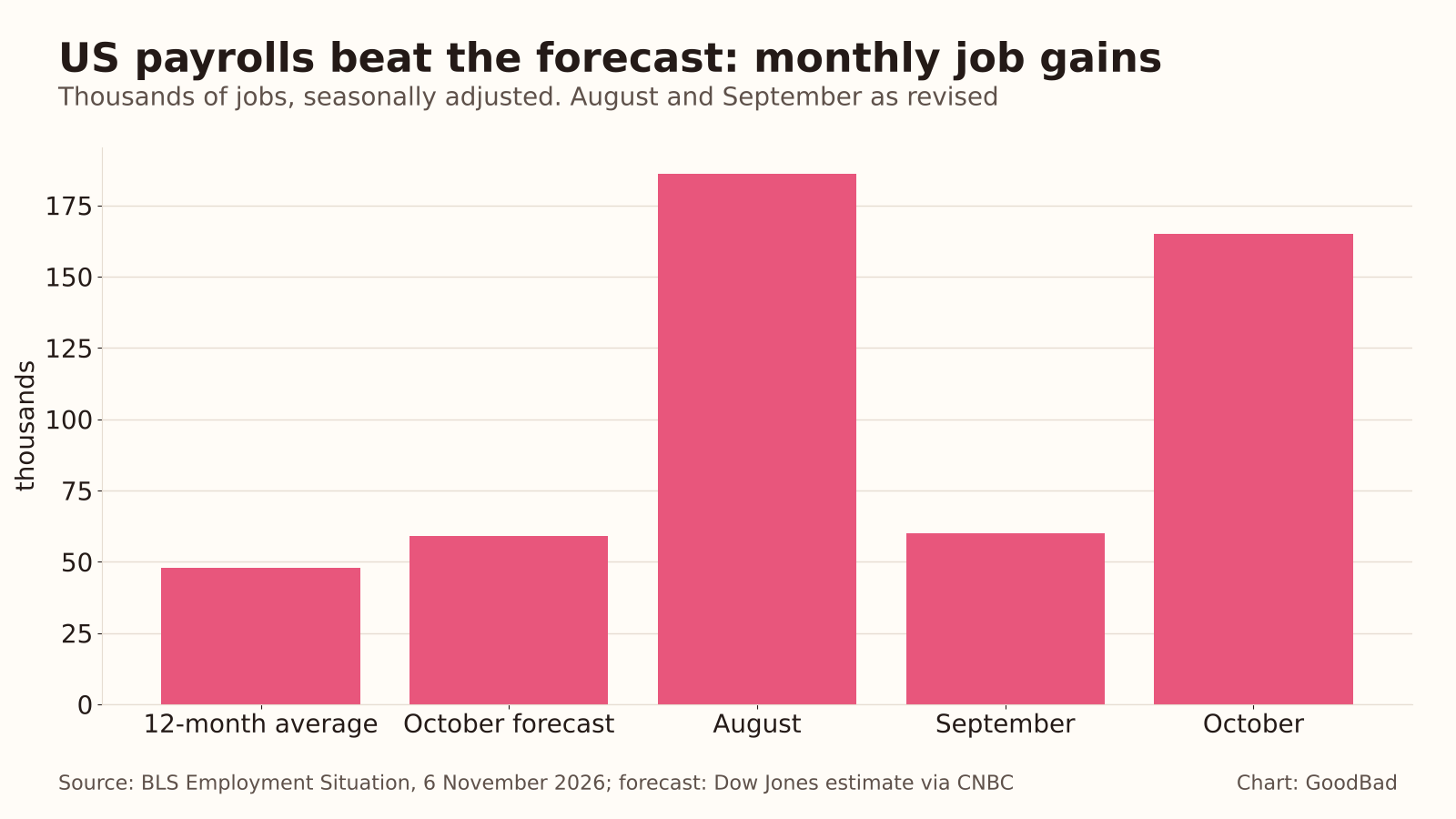 Chart: GoodBad. Data from the US Bureau of Labor Statistics, 6 November 2026, and a Dow Jones forecast reported by CNBC.
Navy Federal Credit Union economist Heather Long told NBC News that the labour market is on much firmer ground than a year ago. CNBC adds her estimate that the economy created barely 10,000 jobs a month through 2025, mostly in health care. Against that base, 165,000 is a different kind of month.
Who is hiring
The gains were broad. Professional and business services added 70,000 jobs, and health care added 42,000, which is above its monthly average of the past year. Transportation and warehousing added 25,000, and manufacturing added 19,000. NBC notes that factories have now added more than 100,000 jobs since their low in December 2025, led by computer and electronics, machinery and primary metals.
Two smaller signs point the same way. General merchandise retailers added more than 18,000 jobs, which NBC reads as early holiday hiring. Nonresidential construction rose by nearly 3,000, possibly because of data centre building. The BLS reported no sector with a notable loss, though NBC counts home building and specialty contractors down by more than 15,000 as high mortgage rates bite.
What it means for pay
Wages rose 0.4% in the month to an average of $38.00 an hour, and 3.1% over the year. Economists had expected 0.3% and 2.9%, according to CNBC. The average workweek held at 34.4 hours, so the gain is not a product of longer shifts.
The honest caveat is prices. The BLS put consumer price inflation at 3.7% for September, in its release of 14 October, which is above 3.1%. Paychecks are therefore still losing ground to prices, although the gap is a little narrower than the earnings forecast implied. The September CPI and October earnings cover different months, so the comparison will tighten or widen when October prices are published.
What happens next
A strong report cuts both ways for borrowers. CNBC says traders now put the odds of a quarter-point rise in interest rates at the Federal Reserve’s meeting on 8 and 9 December at 76.8%, according to the CME FedWatch tool. Higher rates would make mortgages and car loans dearer, which is the cost of an economy that is hiring faster than expected.
The report is a counterweight to the worry of the past month, when a sharp fall in technology shares revived talk of a slowdown. Seema Shah of Principal Asset Management told CNBC it is a strong rebuttal to fears of a meaningful slowdown, and she pointed to broad job creation. Dan North of Allianz Trade called it a good report from a labour market that looks stable rather than exciting.
Some strain remains underneath. The broader unemployment measure, which counts discouraged workers and part-timers who want full-time hours, rose by 0.3 points to 7.9%. The average jobless spell lengthened by 2.3 weeks to 27.1 weeks, the longest since September 2021, and 1.96 million people have been out of work for more than 27 weeks. Those numbers are on the other side of this story and we cover them in the companion piece.
The next jobs report is due in early December, before the Fed meets. If hiring holds near 165,000, it would be a third strong month out of four.