Bad news
Exported Clean Tech Trims 1% of Global CO2 as Levels Hit Record
China’s solar, battery, wind, and EV exports should avoid about 450 million tonnes of CO2 abroad in 2026. That is 1.2% of a 38.6 billion tonne world total, from the country that emits the most, in a year when atmospheric CO2 set another record.

Read the good side of this story
China’s Clean-Tech Exports Now Avoid as Much CO2 as Brazil Emits
Start with the atmosphere. The World Meteorological Organization reported on 27 October that the global average concentration of carbon dioxide reached 426.8 parts per million in 2025, a record and 153% of the 1750 level. Methane and nitrous oxide also set records. Two days later, an analysis for Carbon Brief estimated that China’s clean-technology exports will avoid about 450 million tonnes of CO2 a year abroad in 2026. Both things are true, and the second is much smaller than the first.
The world emitted 38.6 billion tonnes of fossil CO2 in 2024, according to the Global Carbon Budget. China emitted 12.3 billion of them, more than any other country. The 450 million tonnes its exports are projected to avoid elsewhere is 1.2% of the global figure, or nearly 2% of emissions outside China, and roughly Brazil’s 483 million tonnes. It is a real saving. It does not offset the exporter.
What the model assumes
The 450 million tonne figure is a projection, not a measurement. Its author, Lauri Myllyvirta of the Centre for Research on Energy and Clean Air (CREA), extends January to September shipments across a full year. The model assumes every exported panel and turbine displaces the destination grid’s average mix, and every EV replaces a combustion car. Lifetimes are set at 20 years for solar and wind, 10 for vehicles and batteries, and five for electric two-wheelers. Independent experts told the Associated Press that the scale matched China’s export volumes but that they could not validate the underlying data.
The manufacturing bill is counted but not small. Making the goods exported in 2025 released about 170 million tonnes of CO2 inside China, against 370 million tonnes avoided abroad that year. The analysis puts the payback at about six months. Over their assumed lives, the 2026 exports would avoid about 8,400 million tonnes net, up from 5,000 million for 2024 exports and 6,800 million for 2025. That lifetime total is about the 8,097 million tonnes the United States and India emitted together in 2024, and it accrues over two decades.
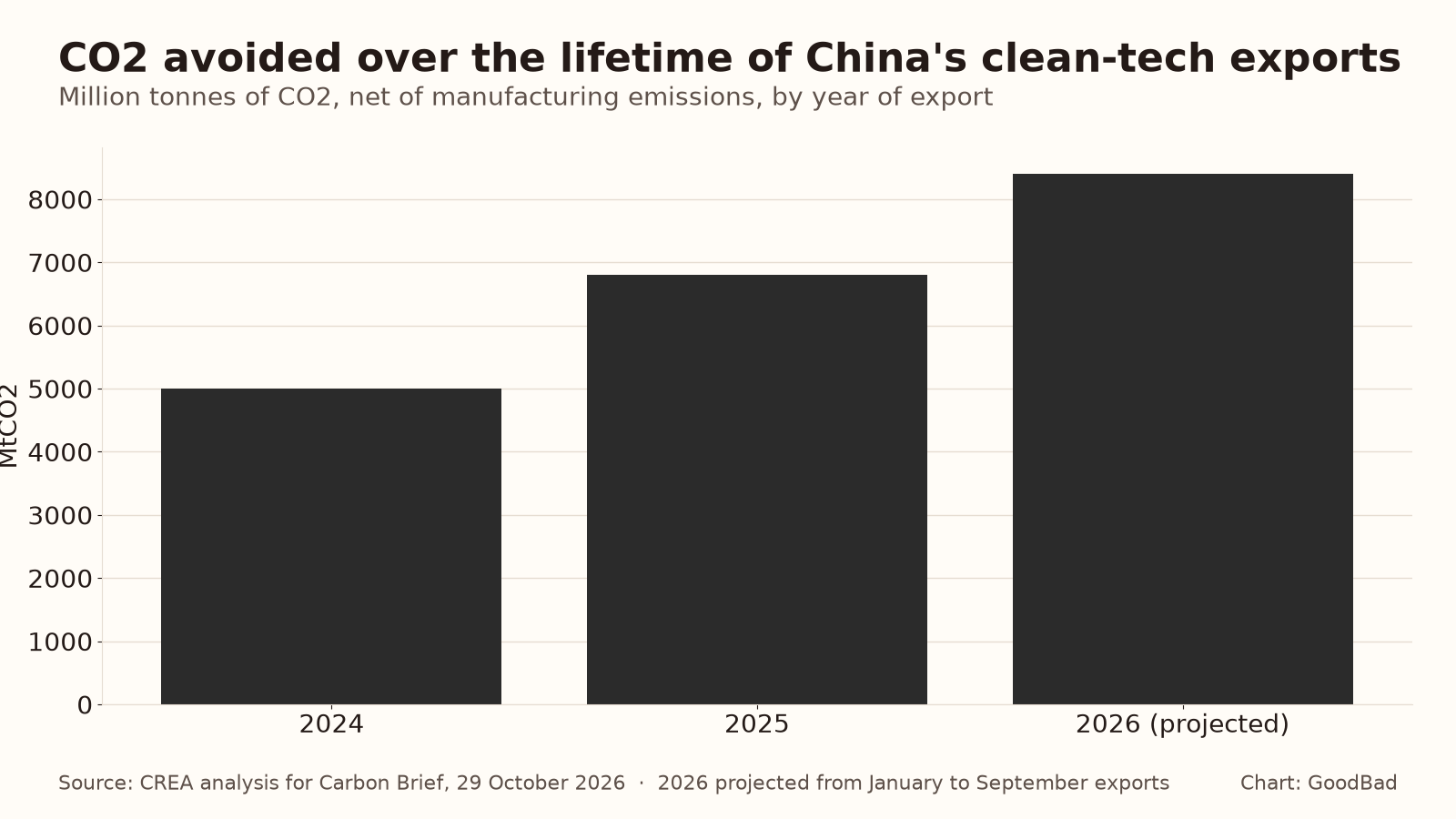 Chart: GoodBad. Data from CREA analysis for Carbon Brief, 29 October 2026.
Who is buying, and why
Three quarters of the avoided emissions land in the Global South: 73% in 2025 and 76% in the first nine months of 2026, with South and South-east Asia alone at 52% this year. India is the largest destination, then the United States, Thailand, Saudi Arabia, South Africa, and Australia. Avoided emissions rose 36% in 2025 and 26% year on year in the first nine months of 2026. The buyers are often the countries with the least room to absorb another shock.
The shock is the reason for the surge. AP reports that the Iran war disrupted the Strait of Hormuz, through which about a fifth of the world’s oil and gas normally passes. Import-dependent Asian economies faced higher power and fuel bills and turned to rooftop solar and EVs. Chinese clean-energy exports to South-east Asia rose nearly 160% in the year to September, by Ember’s count. Electric-vehicle exports rose 61% in the first three quarters of 2026, wind turbines 45%, batteries 39%, and solar equipment 22%. Growth bought by an energy crisis is not the same as growth from policy, and no source yet says how much of it outlasts the war.
The promises not kept
Trade policy is pulling against the saving. United States tariffs on Chinese clean tech rose sharply in June 2025. Shipments to the US still grew about 12% in 2026. A gigawatt of solar installed there avoids about three times the CO2 of one in the EU, because American grids are more carbon-intensive and sunnier. China’s 2021 pledge to stop building coal plants abroad still has gaps, the analysis notes, particularly captive coal plants attached to industrial projects in Indonesia. China-linked power projects overseas remain marginal next to equipment sales: 8.4 GW of China-linked solar entered operation abroad in 2025, against 436 GW of solar exported.
What would move the number is not in doubt. The same researcher’s analysis of 2024 exports found them trimming about 1% of emissions outside China, and two years later the share is nearly 2%, so the trend is real. At home, China’s own solar and storage installations fell in 2026 after a record 2025. The atmosphere responds to total emissions, and those were 38.6 billion tonnes in 2024 and rising. COP31 opens in Antalya on 9 November. The question for delegates is not whether China can sell the equipment, but whether the countries buying it, and China itself, retire the coal and oil it is meant to replace.