Good news
China’s Clean-Tech Exports Now Avoid as Much CO2 as Brazil Emits
Solar panels, batteries, wind turbines, and electric vehicles shipped from China in 2026 are on course to avoid about 450 million tonnes of CO2 a year abroad, roughly Brazil’s annual total, with three quarters of the benefit landing in the Global South.

Read the bad side of this story
Exported Clean Tech Trims 1% of Global CO2 as Levels Hit Record
Clean-energy equipment leaving Chinese ports this year will avoid about 450 million tonnes of carbon dioxide a year in the countries that install it. That is the finding of an analysis published by Carbon Brief on 29 October. That is close to Brazil’s entire fossil-fuel output, which the Global Carbon Budget put at 483 million tonnes in 2024. The estimate comes from Lauri Myllyvirta of the Centre for Research on Energy and Clean Air (CREA), who projected a full year from January to September shipments. It counts only emissions avoided outside China and subtracts the CO2 released in making the goods.
The number is moving fast. Avoided emissions rose 36% in 2025 and a further 26% year on year in the first nine months of 2026, the analysis says. In 2024, the same researcher estimated that China’s exports were trimming about 1% of emissions outside its borders. The 2026 figure is nearly 2%.
What is being shipped
Every category grew. Exports of electric vehicles rose 61% in the first three quarters of 2026 compared with a year earlier, wind turbines 45%, batteries 39%, and solar equipment 22%. The Associated Press reported the same figures on 29 October. In 2025 alone, China shipped 436 GW of solar panels and intermediates, 305 GWh of batteries, 8 GW of wind turbines, 2.2m battery-electric cars, and 36m electric two-wheelers. The wind and solar kit sold in 2025 will generate about 720 TWh a year; the 2026 total is projected at 800 TWh, the output of roughly 100 coal plants.
Over their working lives, the goods exported in 2026 are expected to avoid about 8,400 million tonnes of CO2 after manufacturing emissions are deducted. That compares with 8,097 million tonnes emitted by the United States and India together in 2024, per the Global Carbon Budget. The lifetime figure was 5,000 million tonnes for 2024 exports and 6,800 million for 2025.
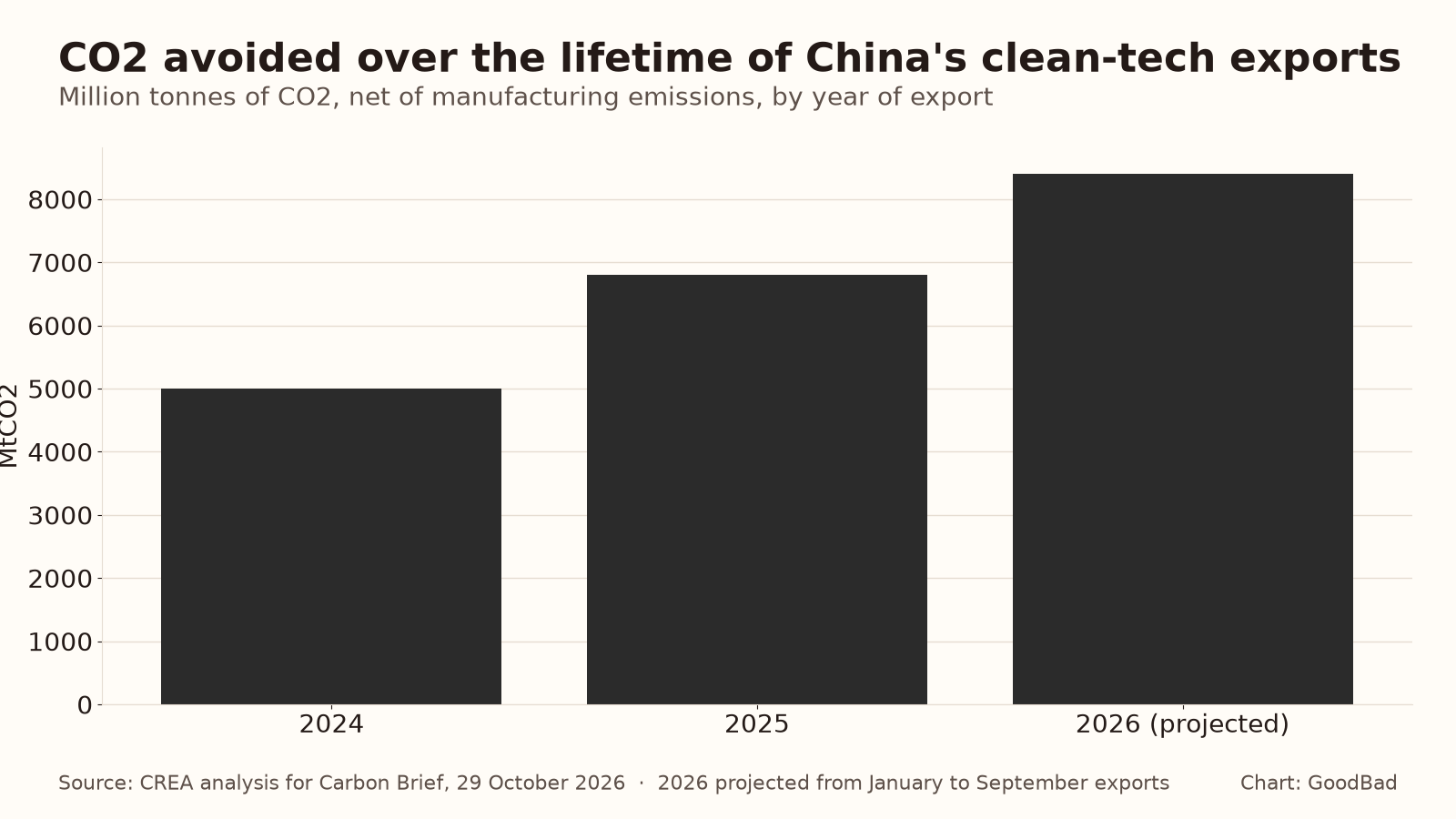 Chart: GoodBad. Data from CREA analysis for Carbon Brief, 29 October 2026.
Who gains most
Three quarters of the benefit lands in poorer countries. The Global South accounted for 73% of lifetime avoided emissions in 2025 and 76% in the first nine months of 2026, with South and South-east Asia alone taking 52% this year. India is the largest single destination, followed by the United States, Thailand, Saudi Arabia, South Africa, and Australia. Solar does the most work where grids burn the most coal, which is why a gigawatt installed in the United States avoids about three times the CO2 of one in the EU.
The demand has a hard cause. AP reports that the Iran war disrupted shipping through the Strait of Hormuz, which normally carries about a fifth of the world’s oil and gas. Import-dependent Asian economies faced higher power and fuel bills and turned to rooftop solar and EVs. Chinese clean-energy exports to South-east Asia rose nearly 160% in the year to September, by Ember’s count. The Philippines became the second-largest market for Chinese solar in the first quarter of 2026, and Indonesia has pledged 100 GW of solar by 2029.
The caveats and the arithmetic
The estimate is a model, not a measurement. It assumes exported panels and turbines displace the local grid mix and that each EV replaces a combustion car. Products are assumed to last 20 years for solar and wind, 10 for vehicles and batteries, and five for two-wheelers. Independent experts told AP the scale was plausible but that they could not check the underlying data. Making the 2025 exports emitted about 170 million tonnes of CO2 inside China, against 370 million avoided abroad that year, so the goods repay their carbon in about six months.
It is also not yet enough. The World Meteorological Organization reported on 27 October that the global average CO2 concentration reached a record 426.8 parts per million in 2025, 153% of the 1750 level. China itself emitted 12.3 billion tonnes in 2024, the most of any country, and 450 million tonnes is about 1.2% of the 38.6 billion tonnes the world released that year. United States tariffs on Chinese clean tech rose sharply in June 2025; exports there still grew about 12% in 2026. Gaps remain in China’s 2021 pledge to stop building coal plants abroad, notably captive plants tied to industrial sites in Indonesia. China-linked solar projects overseas added only 8.4 GW in 2025, against 436 GW exported.
The next test is whether the curve keeps bending. China’s own solar and storage installations fell in 2026 after a record 2025, so exports may outweigh domestic deployment for the first time. COP31 opens in Antalya on 9 November with electrification on the agenda, and the full-year export data will show whether the 450 million tonne projection held.