Bad news
Pancreatic Cancer Pill Priced Near $63,000 a Month Has Only 61 First-Line Patients
Daraxonrasib shrank tumors in 60.7% of 61 patients in an early first-line trial, but tumors vanished in only 8.2%, no phase 3 result exists yet, and a Canadian patient pays about US$63,000 a month for the approved version.

Read the good side of this story
Daraxonrasib Plus Chemotherapy Shrinks Pancreatic Tumors in 61% of Patients
Daraxonrasib shrank or cleared tumors in 60.7% of people with metastatic pancreatic cancer in a trial of 61 patients. That trial is small and early, and the approved version of the pill is very expensive. In 8.2%, the cancer was no longer detectable after a typical follow-up of 18 months, the Independent reports. That leaves roughly 92% of patients whose scans still showed cancer.
The combination with chemotherapy is not approved for first treatment anywhere. Pancreatic Cancer UK called this a small, initial study.
The limits of 61 patients
The data come from a phase 1/2 trial presented at a conference of the European Organisation for Research and Treatment of Cancer. Patients with newly diagnosed metastatic disease received daraxonrasib with gemcitabine and nab-paclitaxel. Tumors shrank or vanished in 60.7%, the cancer stopped growing in 90.2%, and 76.6% were alive after a year.
The Independent sets the one-year figure against roughly 40 to 45% for chemotherapy alone. That is a comparison with typical rates, not with a control group in this trial. Median time before tumors returned or began growing was 12.8 months, which also means that for at least half of patients the cancer came back or grew within about a year.
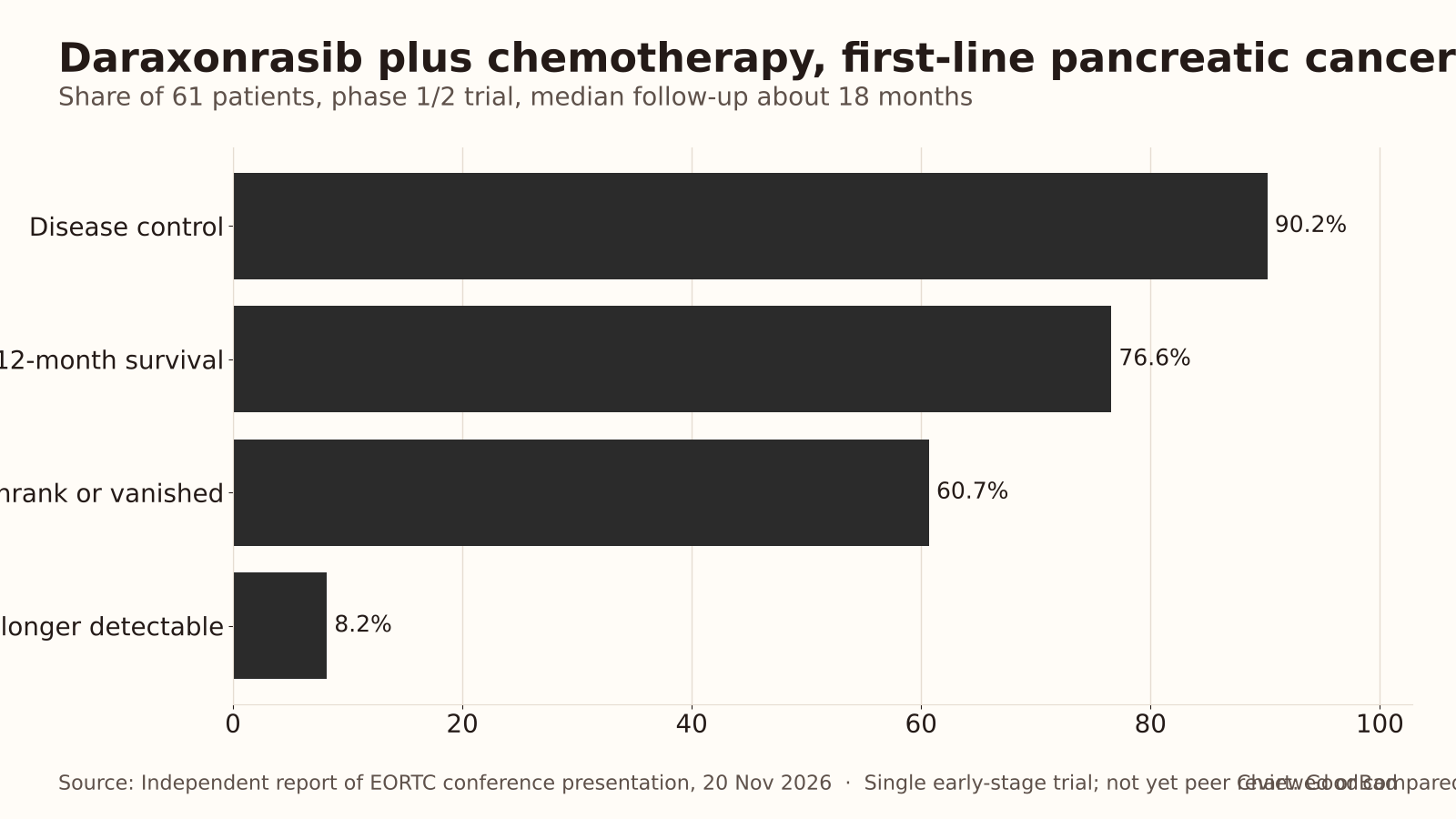 Chart: GoodBad. Data from the Independent’s report of the trial presentation, 20 November 2026.
Dr Wungki Park of Memorial Sloan Kettering Cancer Center, who presented the results, said longer-term survival data would come as the trial progresses. He also said cancer often develops resistance to drug treatment. Fewer than 5% of patients stopped the treatment, the Independent says.
What the pill already costs
The approved single-drug version shows what access looks like. The company says the US Food and Drug Administration approved it in August. In a release, it adds that the European Commission authorised it on 16 November for adults who have had at least one earlier therapy. CBC reports that one Vancouver patient imports it from the United States at about US$63,000 a month, roughly C$90,000, because Canada has not approved it.
More than two dozen cancer specialists told CBC that rising prices are pushing public health systems towards a breaking point. Dr Christopher Booth of Queen’s University, writing in The Lancet Oncology, argues that the benchmark price will push up the cost of later drugs. The company, for its part, says the price supports innovation, CBC reports.
The European authorisation does not apply in the UK or Switzerland, which run separate approvals. Revolution Medicines says patient access in the EU will depend on national pricing and reimbursement, so timing will vary by country.
Side effects of the approved version
The company’s safety information for the approved pill lists skin toxicity in 86% of pancreatic cancer patients in clinical trials, with 10% at grade 3, which is severe. Stomatitis, meaning mouth ulcers and inflammation, occurred in 57%, with 9% at grade 3. Those figures come from the single-drug trials, not the new combination study.
The Independent reports that fewer than 5% of patients stopped treatment in the combination trial, which suggests side effects were manageable. The combination trial’s detailed safety data are not in the sources available here, and that is a gap.
Who is not covered
The gap between a trial result and a prescription is where patients wait.
Pancreatic cancer kills quickly. In the UK, according to the Independent, more than 11,000 people are diagnosed each year and more than 10,000 die. Revolution Medicines says about 147,000 people are diagnosed in Europe annually, around 80% after the disease has spread, with five-year survival below 10%.
None of those patients can get the first-line combination outside a trial. The Independent reports that the final phase 3 study in the United States has enough patients, though some sites in Europe may have space. Michelle Mitchell, chief executive of Cancer Research UK, said more trials are needed before it can be assessed for use on the NHS. Pancreatic Cancer UK urged the UK government to build a rapid pathway to patients.
What would change the picture
Three things will decide whether this is a breakthrough or a promising signal. A randomised phase 3 result would show whether the first-line combination beats standard treatment. Longer follow-up would show how many cancers that vanished on scans stay gone. National pricing decisions would show who can afford to be treated.
Until then, the evidence is 61 patients. It is encouraging, as the charities say, and it is not yet a standard of care. The approved drug exists, and many of the people who need it cannot reach it at the price being asked.
One comparison puts the scale in view. About 147,000 people a year are diagnosed in Europe, and the trial enrolled 61. The pill that did shrink tumors in most of them is, for most patients worldwide, either unapproved for first-line use, unreimbursed or unaffordable at the price quoted. Dr Booth and his co-authors argue in The Lancet Oncology that high launch prices of this kind tend to rise further, not fall. That is a claim about prices generally, and it is the reason the cost is part of the story and not a footnote.