Good news
Daraxonrasib Plus Chemotherapy Shrinks Pancreatic Tumors in 61% of Patients
In an early trial of 61 people with metastatic pancreatic cancer, adding daraxonrasib to chemotherapy shrank or cleared tumors in 60.7%. Tumors were no longer detectable in 8.2%, and 76.6% were alive at one year.

Read the bad side of this story
Pancreatic Cancer Pill Priced Near $63,000 a Month Has Only 61 First-Line Patients
Tumors shrank or disappeared in 60.7% of people with metastatic pancreatic cancer who took the pill daraxonrasib alongside standard chemotherapy, according to results from a phase 1/2 trial of 61 patients. In 8.2%, the cancer was no longer detectable on scans after a typical follow-up of 18 months. The Independent reports that the data were presented at a conference of the European Organisation for Research and Treatment of Cancer.
These are early results from a small study that has not yet been through a randomised phase 3 trial, and they should be read that way. They still stand out in a disease where half of patients die within three months of diagnosis, a figure given by the charity Pancreatic Cancer UK.
What the trial found
Patients in the study had newly diagnosed metastatic disease and received daraxonrasib with the chemotherapy drugs gemcitabine and nab-paclitaxel. Beyond the 60.7% whose tumors shrank or vanished, the cancer stopped growing in 90.2%, a measure called disease control. Median time before tumors returned or began growing again was 12.8 months across the whole group.
One year on, 76.6% of patients were alive. The Independent sets that against roughly 40 to 45% for patients given chemotherapy alone. That comparison is with typical rates, not with a control group in this trial, so it is a signal and not proof.
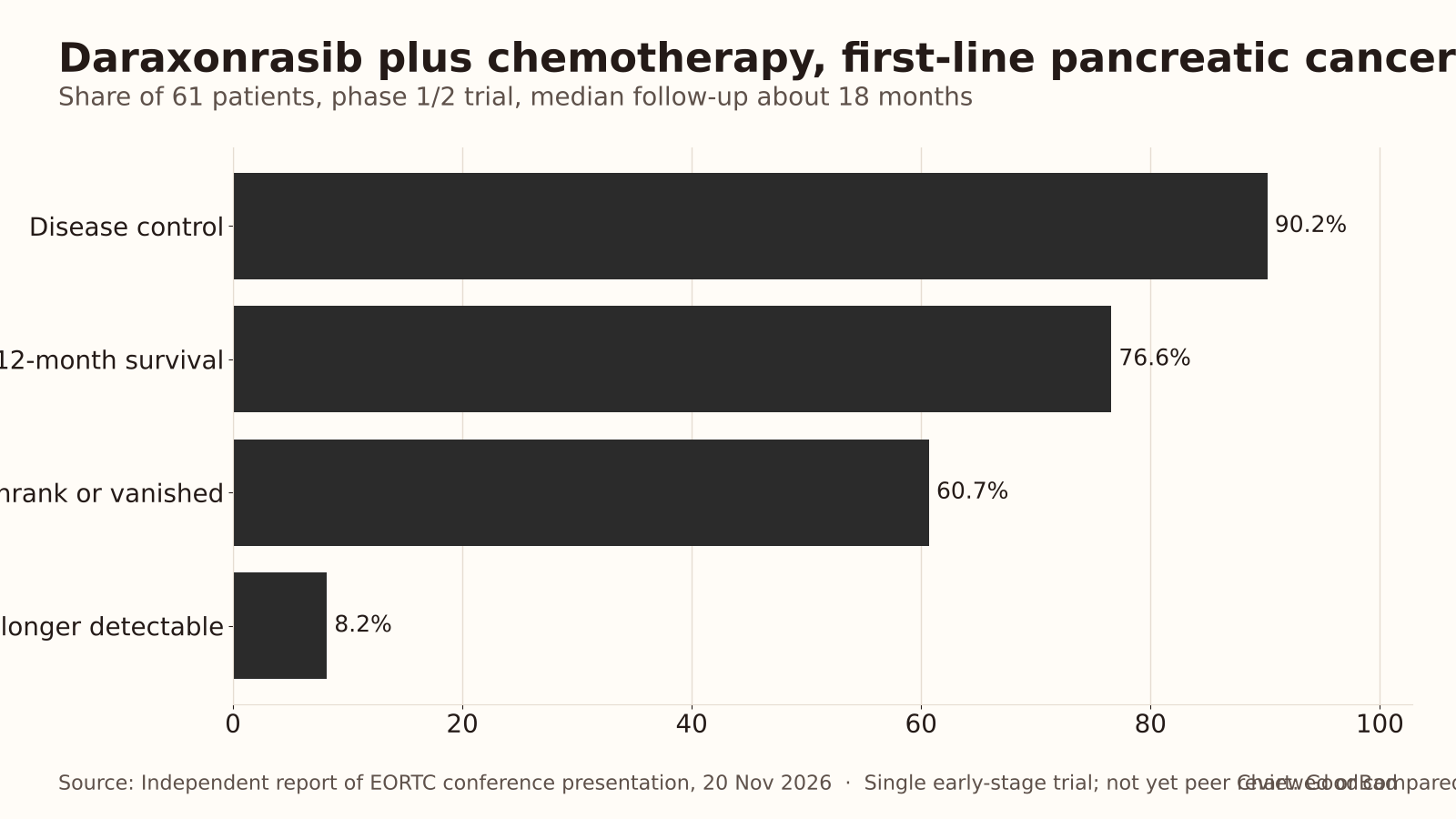 Chart: GoodBad. Data from the Independent’s report of the trial presentation, 20 November 2026.
Fewer than 5% of patients stopped treatment, which doctors regard as low, the Independent says. Dr Wungki Park, an oncologist at Memorial Sloan Kettering Cancer Center who presented the findings, called the results a very large step and said he had never seen such responses.
How the drug works
More than nine in ten pancreatic tumors carry a mutated KRAS gene, a member of the RAS family of growth switches that tells cancer cells to keep growing. Daraxonrasib is a tablet that locks onto RAS proteins and shuts that signal off, the Independent explains. Revolution Medicines, the drug’s developer, describes it as an oral RAS(ON) multi-selective inhibitor.
The drug is already on the market for people whose cancer has progressed. The company says the US Food and Drug Administration approved it in August. In a release, it adds that the European Commission authorised it on 16 November as a single treatment for adults who have had at least one earlier therapy. Both approvals rest on an earlier phase 3 trial called RASolute 302, which the company says met all its main goals. The new data move the same drug to the first treatment a patient receives, in combination.
Who this could reach
Pancreatic cancer is hard to catch early. Revolution Medicines says about 147,000 people are diagnosed in Europe each year, roughly 80% after the disease has spread, and five-year survival is below 10%. In the UK, the Independent reports, more than 11,000 people are diagnosed annually and more than 10,000 die.
For now, the first-line combination is not an approved treatment anywhere. The Independent reports that the final phase 3 study in the United States has enough patients, though some sites in Europe may still have space. Patients who want to take part would need to ask their oncologist about trial places.
What it costs and how it compares
The approved version of the drug has a high price. CBC reports that a Canadian patient importing it pays about US$63,000 a month, roughly C$90,000, because it is not yet approved in Canada. The European Commission’s approval does not apply in the UK or Switzerland, according to the company, and national pricing and reimbursement decisions will set when EU patients get access.
Context matters on the benefit side too. The charities that treat this as hopeful also ask for caution. Pancreatic Cancer UK’s head of research, Dr Madina Kara, called this a small, initial study and said the results were encouraging. Michelle Mitchell, chief executive of Cancer Research UK, called it the biggest leap forward in decades for pancreatic cancer patients. She added that more trials are needed before it can be assessed for use on the NHS.
What happens next
Three things will show whether the results hold. The phase 3 trial of the first-line combination will compare it against standard treatment in a randomised design. Longer follow-up will show how many of the cancers that disappeared on scans stay away, and Dr Park told reporters that resistance often develops and that the combination is meant to delay it. Regulators in the US, Europe and the UK will then decide on first-line use.
Until then, the practical line for patients and families is simple. The approved single-drug version is available to people whose cancer has progressed after treatment, and a first-line combination is being tested. The early numbers justify the trial, and a trial is how they will be tested.
One further point of scale: the 61 patients in this study are a tiny fraction of the roughly 147,000 people diagnosed in Europe each year. A phase 3 trial enrolls many more, and it is the one that regulators will weigh. Pancreatic Cancer UK also called on the UK government to invest in pancreatic research and clinical trials, so that more patients can take part in studies and any proven treatment reaches them quickly.