Bad news
Ebola Has Killed 5,198 in Congo as Contact Tracing Falls Short of Target
WHO counts 10,668 confirmed cases and 5,198 deaths to 3 November, with transmission active in 51 of 67 health zones. Only 86 percent of contacts are seen daily, against a 95 percent threshold, and no vaccine is approved.

Read the good side of this story
Ebola Vaccine Trial Enrolls in Congo as Kenya and Nigeria Add No Cases
Almost half the people confirmed with Ebola in Congo have died. The World Health Organization (WHO) reports 10,668 confirmed cases and 5,198 deaths as of 3 November in its update of 6 November, a crude fatality ratio of 48.7 percent. Since the previous update on 23 October the count has risen by 964 confirmed cases and 511 deaths. This follows our earlier report on the 5,000-death mark.
WHO calls it the largest Ebola outbreak ever recorded in Congo, whatever the virus species, and says transmission is sustained and high. Active transmission continues in 51 of the 67 affected health zones across eight provinces. A new province, Nord-Ubangi, now has cases, and the Yakoma health zone there reported three confirmed cases most recently.
Deaths at home, not in clinics
Of the 512 deaths reported since 21 October, 335 happened in communities and 177 in treatment centres. WHO says this points to trouble detecting cases early and getting people to care in time, and it singles out young children. Deaths outside clinics matter because bodies handled without protection are a route of infection.
Contact tracing is the main tool left, and it is missing its target. An average of 86 percent of contacts were seen daily over the previous 14 days, below the 95 percent WHO requires. Only three provinces met the line: Bas-Uélé, Nord-Ubangi and Sud-Ubangi. Tshopo reached 71 percent, Nord Kivu 82 percent and Haut-Uélé 85 percent.
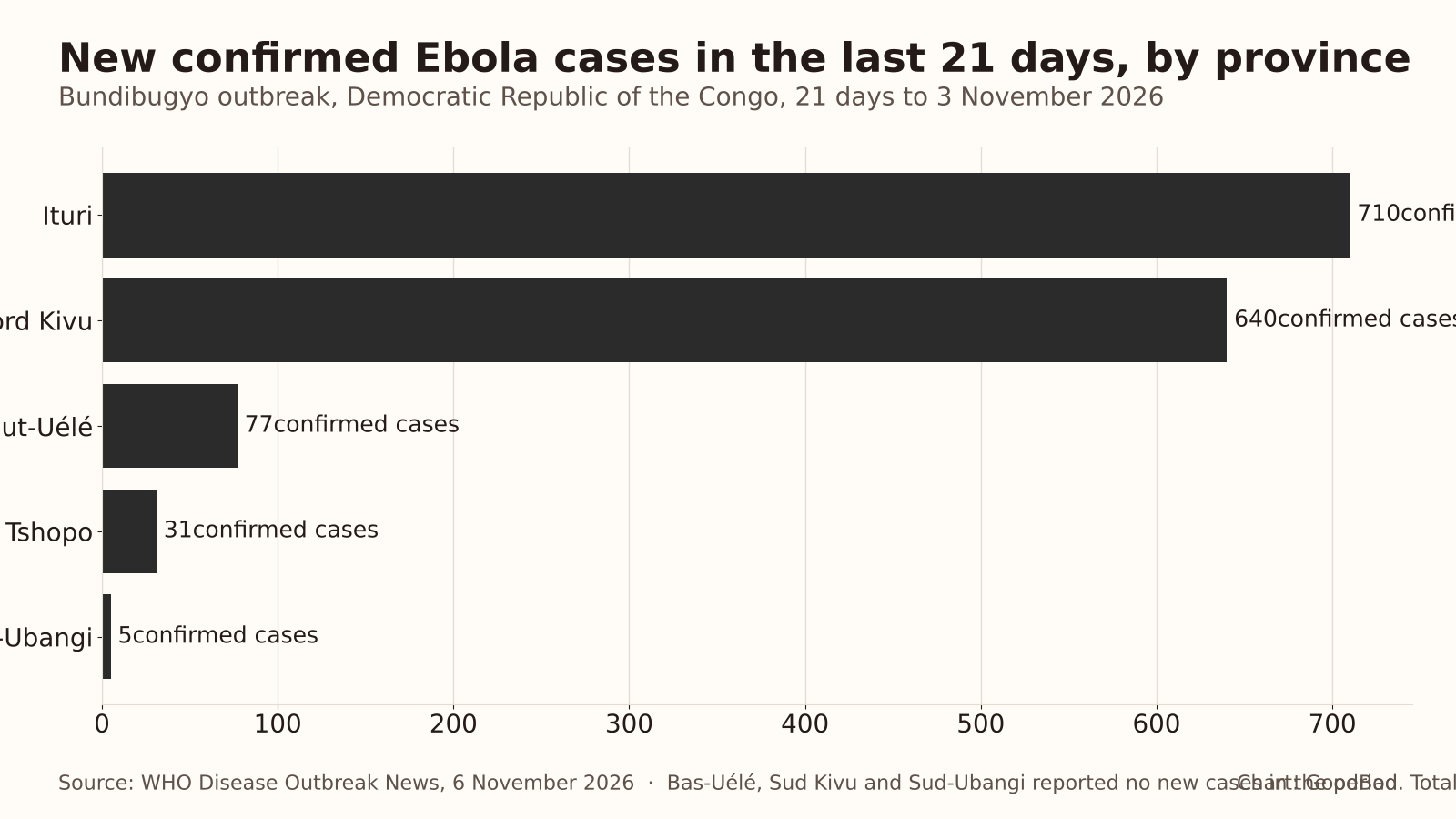 Chart: GoodBad. Data from WHO Disease Outbreak News, 6 November 2026.
Where the burden falls
Ituri has 7,485 confirmed cases and 3,532 deaths, and Nord Kivu has 2,593 cases and 1,422 deaths, the highest provincial fatality ratio at 54.8 percent. In the last 21 days WHO counted 1,463 new cases, 710 in Ituri and 640 in Nord Kivu. Beni, Bunia and Mandima had the most cases and deaths.
The virus has also left Congo. Kenya has nine confirmed cases and two deaths, a cluster linked to one imported case that included four health and care workers. Two patients there are still in treatment. On 5 November the United Kingdom reported the medical evacuation of a health and care worker to London, and Switzerland has also evacuated a confirmed case. WHO is revising its risk assessment; its August version rated Congo very high and neighbouring countries high.
No vaccine yet
No vaccine or specific treatment is approved for the Bundibugyo strain. The Tumaini trial launched on 23 October, and two more candidates will join once national approvals come through, with no date for results. Researchers quoted by DW say the virus was known from outbreaks in 2007 and 2012, and Torsten Feldt of Düsseldorf’s University Hospital calls the lost time a missed opportunity.
What would change the outcome, on WHO’s account, is faster detection and tracing. It says contact follow-up must be strengthened, particularly in the provinces below the 95 percent line. It also advises against travel and trade restrictions, so the response rests on teams reaching contacts, not on closed borders.