Bad news
Children’s Wegovy Is Unproven Past Two Years as WHO Advises Against Drugs Under 10
A trial of 167 children found weekly semaglutide cut BMI, but it was funded by Novo Nordisk and tracked two years. WHO advises against obesity drugs for children under 10, and the drug is unapproved under 12 in the US.

Read the good side of this story
Semaglutide Cuts BMI 13.5% in Children Aged 6 to 11 in Phase 3 Trial

A new trial gives the first randomised evidence that semaglutide, sold as Wegovy, lowers weight in children aged 6 to 11. It also leaves most of the hard questions open. The drug is not approved in the US for children under 12, the trial was funded by Novo Nordisk, and the longest follow-up is two years plus a seven-week break. The World Health Organization advised on 7 October against obesity drugs for children aged 0 to 9.
The STEP Young results were presented on 16 November at ObesityWeek and published in the New England Journal of Medicine. They involved 167 children with obesity, randomly assigned two to one to semaglutide or a placebo, both with lifestyle counselling. At 68 weeks, BMI fell 13.5 percent on the drug and rose 2.7 percent on placebo, Novo’s release says. In 38 percent of children on the drug, BMI dropped below the obesity threshold, against 2 percent on placebo. About 79 percent moved down at least one BMI category, against 23 percent on placebo, so the drug does work on average.
What the trial cannot say
The study is registered as NCT05726227, and the paper states that Novo Nordisk funded it. Funding by the maker is normal for drug trials and does not make the data wrong, but it means the first long-term answers will also come from the company. Independent follow-up has not been announced in the release or the abstract.
The headline result is real, but its limits are plain in the numbers. The trial had 112 children on the drug and 55 on placebo. That is enough to detect an average effect and too small to detect rare harms. Adverse events occurred in 96 percent of children on semaglutide and 93 percent on placebo, according to the paper’s abstract, and stomach problems were more common on the drug. One child stopped treatment because of them.
The benefit also shrank in absolute terms. By week 104, BMI was 9.4 percent below baseline on semaglutide, against 13.5 percent at week 68, while placebo children’s BMI had risen 8.4 percent. Novo says the week 104 figures were not adjusted for multiple comparisons and cannot be used for firm inferences. The abstract does not report what happened to BMI after the seven-week washout, and the release does not either.
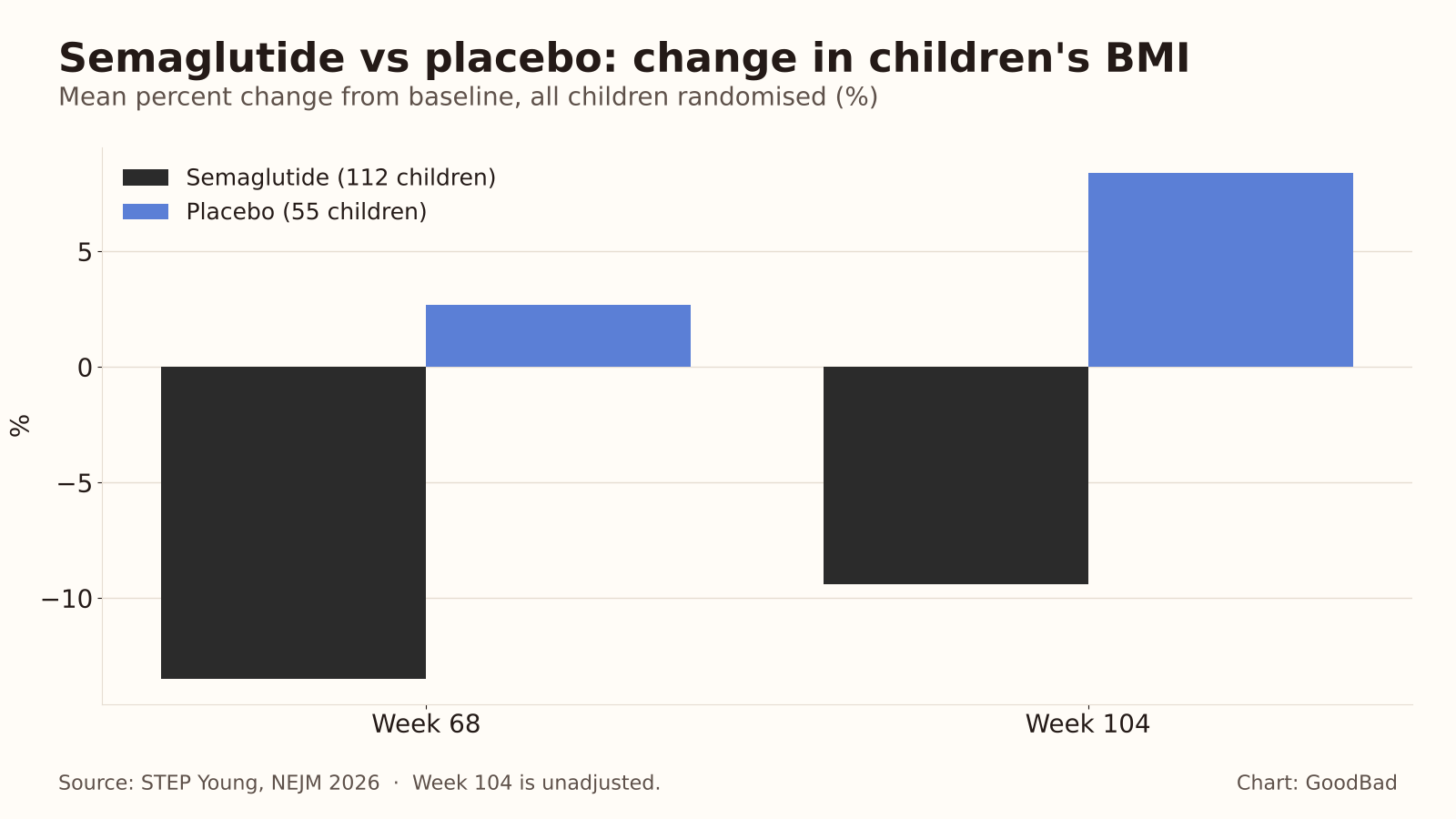 Chart: GoodBad. Data from the STEP Young trial, New England Journal of Medicine, 2026. Week 104 results are not adjusted for multiple comparisons.
Safety and the label
Novo says the safety profile matched its earlier paediatric and adult trials, with no unexpected concerns and none for growth or pubertal development. That is the company’s own summary. The drug carries a boxed warning for possible thyroid tumours, including cancer, and must not be used by anyone with a personal or family history of medullary thyroid carcinoma. In children under 12 it is investigational in the US, and Novo says there is no guarantee it will become available for that use.
The company’s own idealised figure is larger than the one that counts every child. If every child had taken the drug as directed, BMI would have fallen 17.4 percent. Counting all children, as the primary analysis does, the fall was 13.5 percent. Both are in the release, and the second is the cautious one.
What WHO says
The WHO’s first global guidelines on child and adolescent obesity put structured diet, activity and behaviour support first. They do not recommend drugs, surgery or devices for children aged 0 to 9. For ages 10 to 19, approved medicines may be considered only after a supervised lifestyle programme has not worked. The trial enrolled children aged 6 to under 12, so for the 6 to 9-year-olds in it, the use tested is one WHO does not recommend.
Who it will not reach yet
For a family weighing this, the numbers translate into a plain list of unknowns. The sources give no price, no date for approval, and no data on what happens when the drug is stopped. They do give a boxed warning, a high rate of adverse events in both arms, and a guideline from the world’s main health body that puts lifestyle support first. A parent would also want to know whether weight lost at this age stays off, and the trial was not designed to answer that.
Obesity in young people is common and rising. WHO counted 170 million people aged 5 to 19 with obesity in 2024, including 70 million aged 5 to 9. Prevalence in that age group has quadrupled since 1990, from 2 percent to 8 percent. Nothing in the trial sources says what the drug would cost children, or whether health systems would cover it. Neither Novo’s release nor the abstract gives a price.
Most of the children in the trial had severe obesity, with more than 85 percent in class II or III. The results speak for that group. They say little about children with milder obesity.
What would change the picture
Three things would settle the open questions: BMI data years after treatment stops, a long follow-up of growth and development, and a regulatory decision with a stated price. Novo has not said in its release when it will seek approval for younger children. Until then, the finding is that the drug works in a funded trial, for two years, in children with severe obesity, and WHO currently advises against drug treatment for those under 10.