Good news
Semaglutide Cuts BMI 13.5% in Children Aged 6 to 11 in Phase 3 Trial
In a phase 3 trial of 167 children with obesity, weekly semaglutide cut BMI by 13.5 percent at 68 weeks while placebo rose 2.7 percent. The results appear in the New England Journal of Medicine.

Read the bad side of this story
Children’s Wegovy Is Unproven Past Two Years as WHO Advises Against Drugs Under 10

Children as young as six lost a meaningful amount of excess weight in a phase 3 trial of weekly semaglutide, the drug sold as Wegovy. In the STEP Young trial, 167 children aged 6 to under 12 with obesity were randomly assigned two to one to the drug or a placebo, and both groups also got lifestyle counselling. At 68 weeks the children on semaglutide had cut their body-mass index (BMI) by 13.5 percent on average, while the placebo group’s rose 2.7 percent. Novo Nordisk, which makes the drug and funded the trial, presented the results on 16 November at ObesityWeek, and the New England Journal of Medicine published them the same day.
The gap between the groups was 16.2 percentage points, with a 95 percent confidence interval of 12.9 to 19.4. This is the “treatment regimen” result, which counts every child whether or not they stayed on the drug. If every child had taken the drug as directed, Novo’s release says BMI would have fallen 17.4 percent against a 2.2 percent rise on placebo. That second figure is an idealised estimate, so the first is the safer headline.
Who it helped
The children were not mildly overweight. More than 85 percent had class II or III severe obesity at the start, the release says, meaning a BMI of at least 35 or 40. Among those on semaglutide, 79 percent moved down at least one BMI category at week 68, against 23 percent on placebo. In 38 percent of children on the drug, BMI fell below the threshold for obesity, defined as the 95th percentile for age and sex. On placebo, 2 percent crossed that line.
Novo says the drug also improved several cardiometabolic markers, and that no safety concerns appeared for growth or pubertal development. Dr Ania Jastreboff of the Yale School of Medicine commented in the release. She said effective treatment “may shift a child’s trajectory back towards one of improving weight related health.” Her comment is an expert’s reading of the data, and Novo chose to publish it.
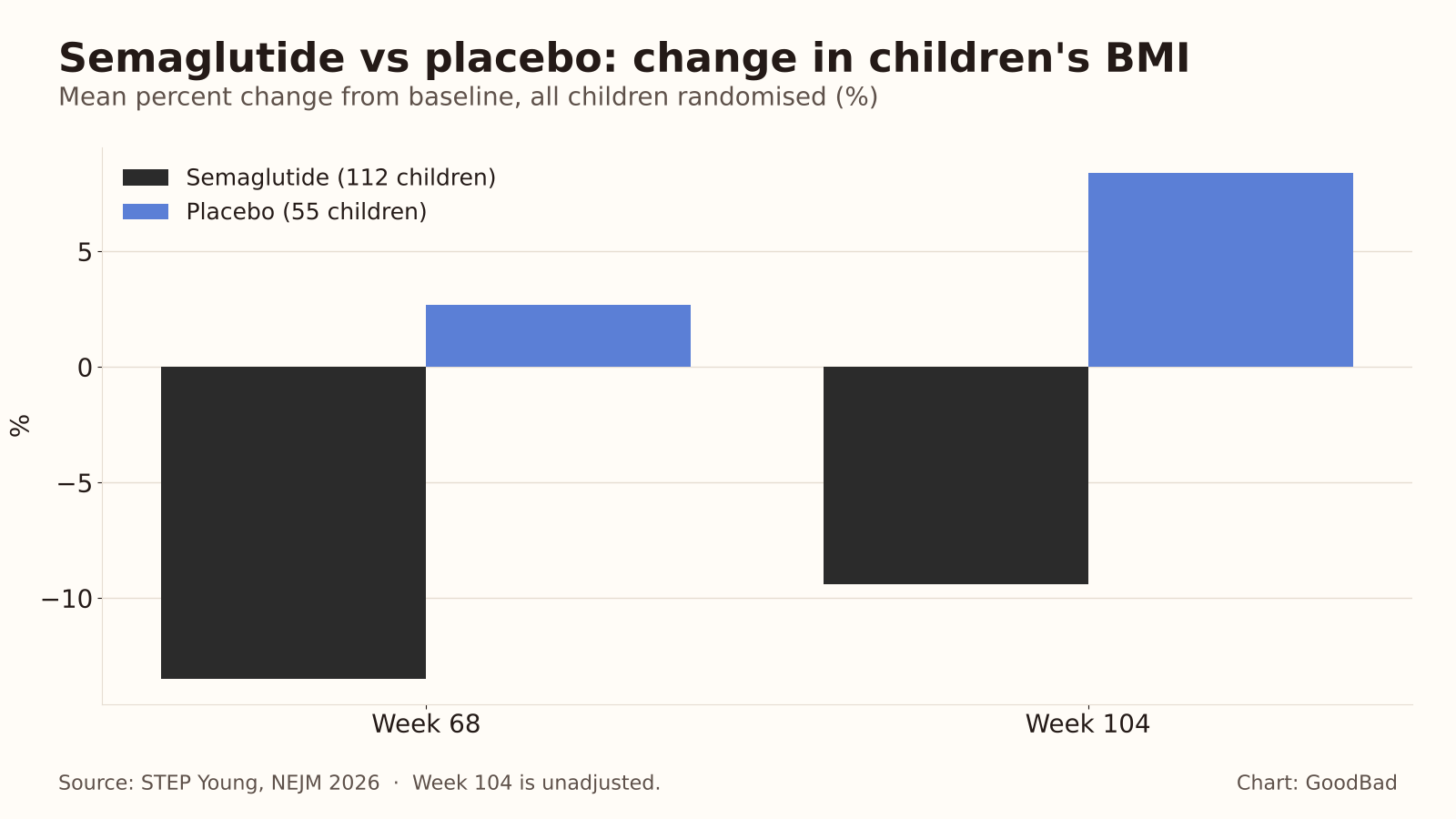 Chart: GoodBad. Data from the STEP Young trial, New England Journal of Medicine, 2026. Week 104 results are not adjusted for multiple comparisons.
What two years showed
The trial ran for 104 weeks, followed by a seven-week washout with no drug. At week 104 the semaglutide group’s BMI was still 9.4 percent below baseline, while the placebo group’s had risen 8.4 percent, a difference of 17.8 percentage points. The drug’s benefit narrowed in absolute terms but the gap between the groups held. Novo cautions that the week 104 numbers were not adjusted for multiple comparisons and should not be used to draw firm conclusions.
For parents the practical question is what happens when the drug stops. The paper’s abstract does not report BMI after the washout, and Novo’s release does not either, so that answer is not yet in the published material.
Side effects and limits
Novo says the safety picture in children matched its earlier paediatric and adult trials with no unexpected concerns. That is the company’s summary of its own trial.
Adverse events were common in both groups, at 96 percent on semaglutide and 93 percent on placebo. Stomach problems were the most frequent and were more common on the drug, but they led to discontinuation in only one child, according to the paper’s abstract. The drug carries a boxed warning for possible thyroid tumours, including cancer, and should not be used by anyone with a personal or family history of medullary thyroid carcinoma.
Three limits matter. The trial was funded by Novo Nordisk. It enrolled 167 children, which is enough to show an effect but small for rare harms. And the drug is not approved in the US for children under 12, so a family cannot yet get it for this use on the label.
Where this sits with WHO advice
The results arrive five weeks after the World Health Organization issued its first global guidelines on child and adolescent obesity. WHO says the foundation of care is structured diet, activity and behaviour support, and it does not recommend drugs, surgery or devices for children aged 0 to 9. For ages 10 to 19, it says approved medicines may be considered only after a supervised lifestyle programme has not worked.
The need is large. WHO counted 170 million people aged 5 to 19 living with obesity in 2024, including 70 million aged 5 to 9. It says prevalence in that age group has quadrupled since 1990, from 2 percent to 8 percent. A treatment that works in young children, even if it is a second step, speaks to the group the guidelines leave with the fewest options.
What happens next
Novo has not said in its release when it will ask regulators to approve the drug for younger children. Until it does, STEP Young is evidence for doctors and guideline writers, not a prescription. The next useful data will be long-term: BMI years after treatment, and whether growth stays on track. For now, a randomised trial has shown that in children as young as six with severe obesity, semaglutide plus lifestyle support moved weight further than lifestyle support alone.