Good news
Euro Area Grows Twice as Fast as Forecast in Third Quarter
Eurostat’s first estimate puts euro area growth at 0.4% for July to September, double the 0.2% economists expected, with Spain and the Netherlands out in front. France shrank and prices are still rising, so the ECB left rates alone.

Read the bad side of this story
France Shrinks as Euro Area Growth Slows and Prices Climb

The euro area grew by 0.4% between July and September, according to Eurostat’s preliminary flash estimate published on 30 October. Economists polled by Reuters had pencilled in 0.2%, CNBC reported, so the bloc produced twice the growth expected of it. Output is now 1.3% higher than a year earlier. The wider European Union did slightly better, at 0.5% on the quarter and 1.5% on the year.
Who did the growing
Spain and the Netherlands each expanded by 0.6% on the quarter, and Estonia matched them. Spain has grown by at least 0.6% in every quarter of 2026 so far. Its output is 2.7% higher than a year ago, the fastest annual rate of any large economy in Eurostat’s table, and the Netherlands is 2.1% up on the year. CNBC attributes Spain’s run to productivity gains, tourism, domestic demand, and a comparatively strong fiscal position. It also notes that a snap election has been called for next month after protests over living costs and housing.
Germany, the bloc’s largest economy, managed 0.2%, slower than the 0.3% of the previous quarter but still a fourth consecutive quarter of growth. Italy was flat. France contracted by 0.1%, and it is the only economy in the table that is smaller than a year ago. Ireland posted 5.5%, a figure Eurostat labels experimental and likely to be revised, which is why it is left out of the chart below.
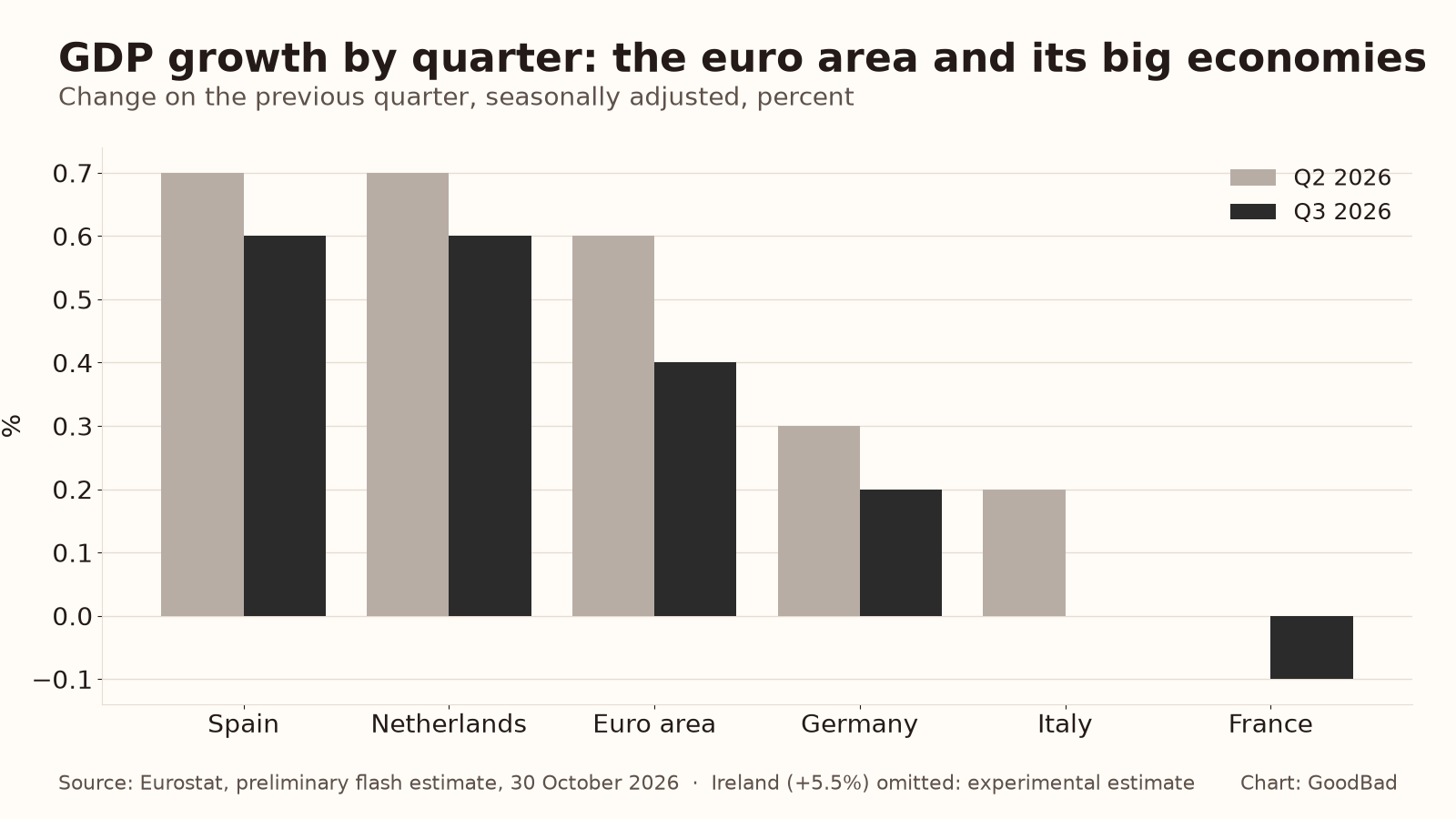 Chart: GoodBad. Data from Eurostat, preliminary flash estimate, 30 October 2026.
How the quarter compares
The 0.4% follows 0.6% in the second quarter and a flat first quarter, so growth has cooled since the spring without stalling. It is double the 0.2% recorded in the final quarter of 2025. Eurostat’s estimate draws on data from 19 member states covering 96% of euro area output. The numbers can change on 13 November, when the second estimate is due, and again in December and January.
For France the picture is weaker. INSEE’s quarterly series, updated on 30 October, shows the French economy at minus 0.2% in the first quarter, flat in the second, and minus 0.1% in the third. CNBC links the slide to investors pulling back from French debt during a political fight over the budget deficit, and to nationwide unrest in October over living costs. The CGT union said about 800,000 people protested across the country, 250,000 of them in Paris.
Growth despite dearer energy
The quarter was delivered with energy prices climbing. Euro area inflation was 3.8% in September, up from 3.2% in August, with energy 18.8% dearer than a year earlier, according to Eurostat’s inflation flash of 2 October. Services inflation was 3.2% and food 1.4%, so the pressure is concentrated in one place rather than spread through the whole basket.
October’s national figures, published on 30 October and reported by Euronews, were mixed. German inflation eased to 2.8% from 3.3%, helped by a fuel tax cut in force from 1 October to the end of the year, and German core inflation slipped to 2.1%. Italy rose to 5.4% from 4.2% and France to 3.4% from 3.1%, while Spain held at 4.9%. Pantheon Macroeconomics now expects the euro area figure, due next week, to reach 4%.
What the ECB did with it
The European Central Bank kept its deposit rate at 2.5% on 29 October, having raised it from 2.0% in June and again in September, its key rates table shows. Euronews reports that the bank judged underlying inflation broadly stable, saw no material wage response yet, and declined to commit to a rate path. For anyone on a variable-rate loan, a hold means an unchanged payment until at least the December meeting.
Part of the tightening has happened without the ECB lifting a finger. French ten-year yields passed 5% in the week before the meeting, the first time since 2002. Euronews cites ING’s estimate that the rise in yields since September equals a 25 basis point hike in Germany and closer to 50 in France. Markets price one more increase this year, CNBC says. Christine Lagarde will leave the presidency on 7 February 2027, about nine months early, with no successor named.
The next tests arrive quickly: the October inflation flash next week, Eurostat’s revised growth estimate on 13 November, and the ECB’s December meeting. A 0.4% quarter with energy at these prices is a better starting point for all three than the 0.2% that was forecast.