Bad news
France Shrinks as Euro Area Growth Slows and Prices Climb
France’s economy contracted by 0.1% in the third quarter while its borrowing costs passed 5% and October inflation reached its highest since early 2024. The euro area as a whole slowed to 0.4%, still ahead of forecasts.

Read the good side of this story
Euro Area Grows Twice as Fast as Forecast in Third Quarter

France’s economy shrank by 0.1% in the third quarter, according to INSEE’s quarterly series updated on 30 October, after a flat second quarter and a 0.2% fall in the first. It is the only economy in Eurostat’s flash table that is smaller than a year ago, down 0.1%. In the same week, French ten-year borrowing costs rose above 5% for the first time since 2002, Euronews reports.
The bill lands on French households
The people paying for this are not abstract. French inflation rose to 3.4% in October from 3.1% in September, Euronews reports from INSEE’s preliminary figures, and on the harmonised measure it reached 3.8%, the highest since January 2024. Energy prices were 24.1% higher than a year earlier, the fourth month in a row that the rate accelerated. Claus Vistesen of Pantheon Macroeconomics expects the harmonised rate to pass 4% by November.
Borrowing is dearer too, without the central bank doing anything. Euronews cites ING’s estimate that the rise in yields since September has done the work of a 25 basis point rate hike in Germany and closer to 50 in France. The spread over German debt stood at about 155 basis points on 29 October, and Moody’s kept France at Aa3 with a negative outlook. CNBC links the pullback from French debt to a political struggle over cutting the budget deficit, and reports that October’s nationwide unrest over living costs turned violent at times. The CGT union said about 800,000 people protested, 250,000 of them in Paris.
A slower quarter for the bloc
The euro area as a whole grew by 0.4% in the third quarter, down from 0.6% in the second, and the European Union slowed to 0.5% from 0.7%. That still beat the 0.2% economists polled by Reuters had expected, CNBC notes, and output is 1.3% above a year earlier. But the slowdown reaches the core: Germany slipped to 0.2% from 0.3%, Italy to zero from 0.2%, and Lithuania contracted by 1.0%. Spain and the Netherlands grew 0.6% each, and Spain has a snap election next month after protests over living costs and housing.
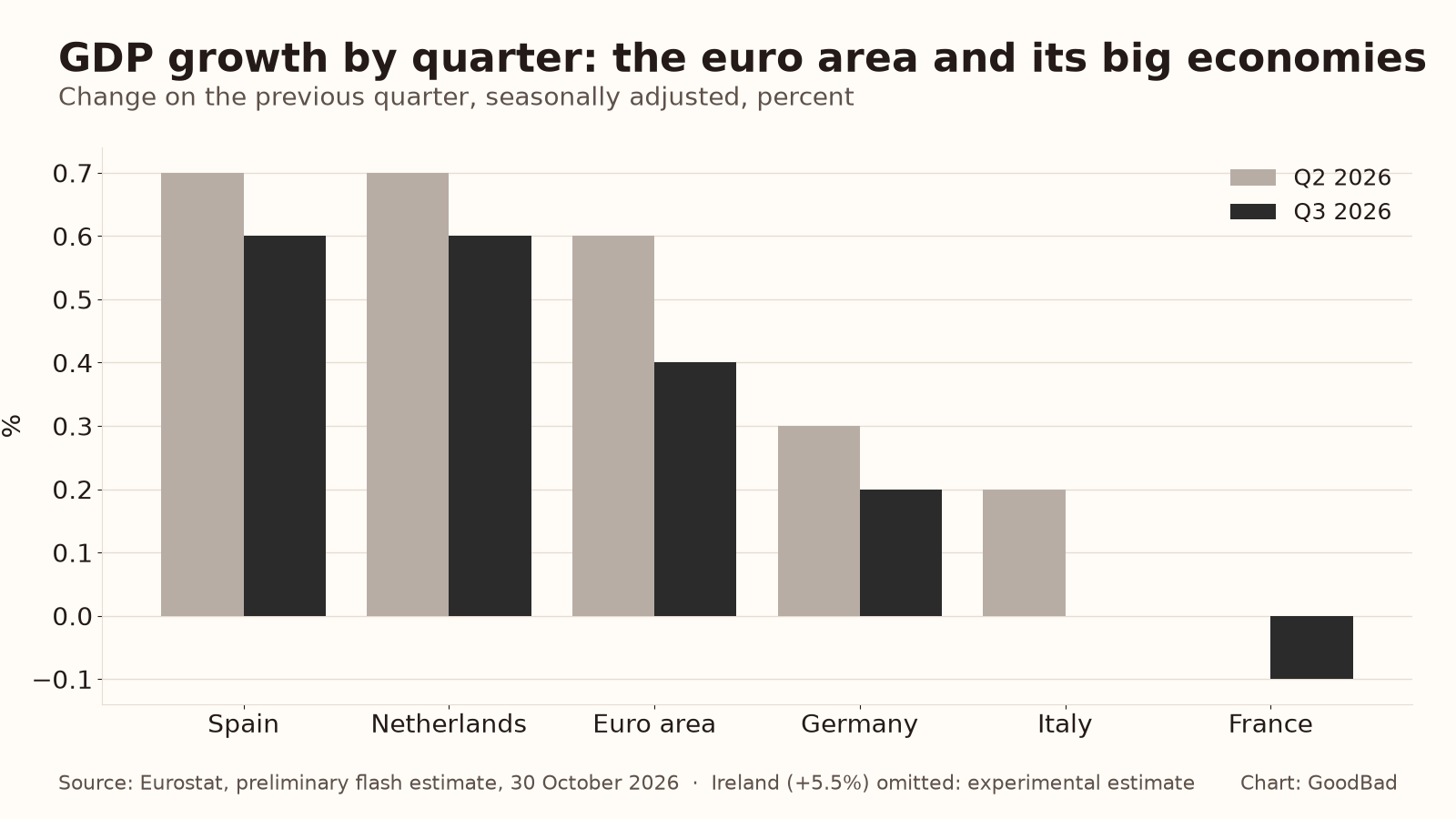 Chart: GoodBad. Data from Eurostat, preliminary flash estimate, 30 October 2026.
Two caveats sit in Eurostat’s footnotes. Ireland’s 5.5% is an experimental estimate that the agency expects to revise, and it is excluded from the chart for that reason. The whole release rests on data from 19 member states covering 96% of euro area output, and every figure can move on 13 November, in December, and again in January.
Prices rising faster than forecast
Euro area inflation was 3.8% in September, up from 3.2% in August, according to Eurostat’s flash estimate of 2 October. Energy was 18.8% dearer than a year earlier, services 3.2%, and food 1.4%. The ECB’s target is 2%.
October’s national readings point higher still. Italy jumped to 5.4% from 4.2%, against the 4.6% economists expected, with energy up 31.4% on the year, Euronews reports. Spain held at 4.9%. Germany eased to 2.8% from 3.3%, but only because a fuel tax cut took effect on 1 October, and it expires at the end of the year. Pantheon Macroeconomics raised its forecast for the euro area figure, due next week, to 4%.
A central bank on hold, and changing hands
The European Central Bank kept its deposit rate at 2.5% on 29 October. Its key rates table shows the rate at 2.0% as recently as June, lifted to 2.25% that month and to 2.5% in September. Euronews reports that the bank said energy prices pose upside risks to inflation and downside risks to growth. It added that financing conditions had tightened since September and that it is not committing to a rate path. Markets price one more increase this year, CNBC says, which would be the third in six months for anyone on a variable-rate loan.
The bank will make that decision while preparing to lose its president. Christine Lagarde leaves on 7 February 2027, about nine months before her term ends, and no successor has been named. Euronews says reports have linked the timing to France’s presidential election in April 2027, and that two more Executive Board seats open in the first half of next year.
So the sequence for a French household runs like this: output falling in the first and third quarters, prices rising for four months, and borrowing costs at a 24-year high. A rate rise may follow in December. The euro area’s better-than-forecast quarter is real, and it does not reach them.