 Good news
Amazon Clearing Falls 42% to the Lowest Level Since Records Began
Brazil cleared 3,335 square kilometres of Amazon forest in the year to July, 42% less than a year earlier and the lowest figure since satellite monitoring began in 1988. A new Nature study shows the forest’s carbon balance has further to go.

Read the bad side of this story
Amazon Is a Net Carbon Source Even After Clearing Hit a Record Low
Brazil’s Amazon lost 3,335 square kilometres of forest to clearing in the 12 months to July 2026, about 42% less than the year before. It is the lowest figure since the national satellite programme PRODES started counting in 1988, AFP reported. The previous low was 4,571 square kilometres in 2011 to 2012, and annual losses peaked at nearly 30,000 in the mid-1990s.
Clearing has now fallen every year since 2022 and is down 71.2% over four years. During Jair Bolsonaro’s 2019 to 2022 term the Amazon lost about 11,600 square kilometres a year, according to the same report. The latest year’s loss is less than a third of that average.
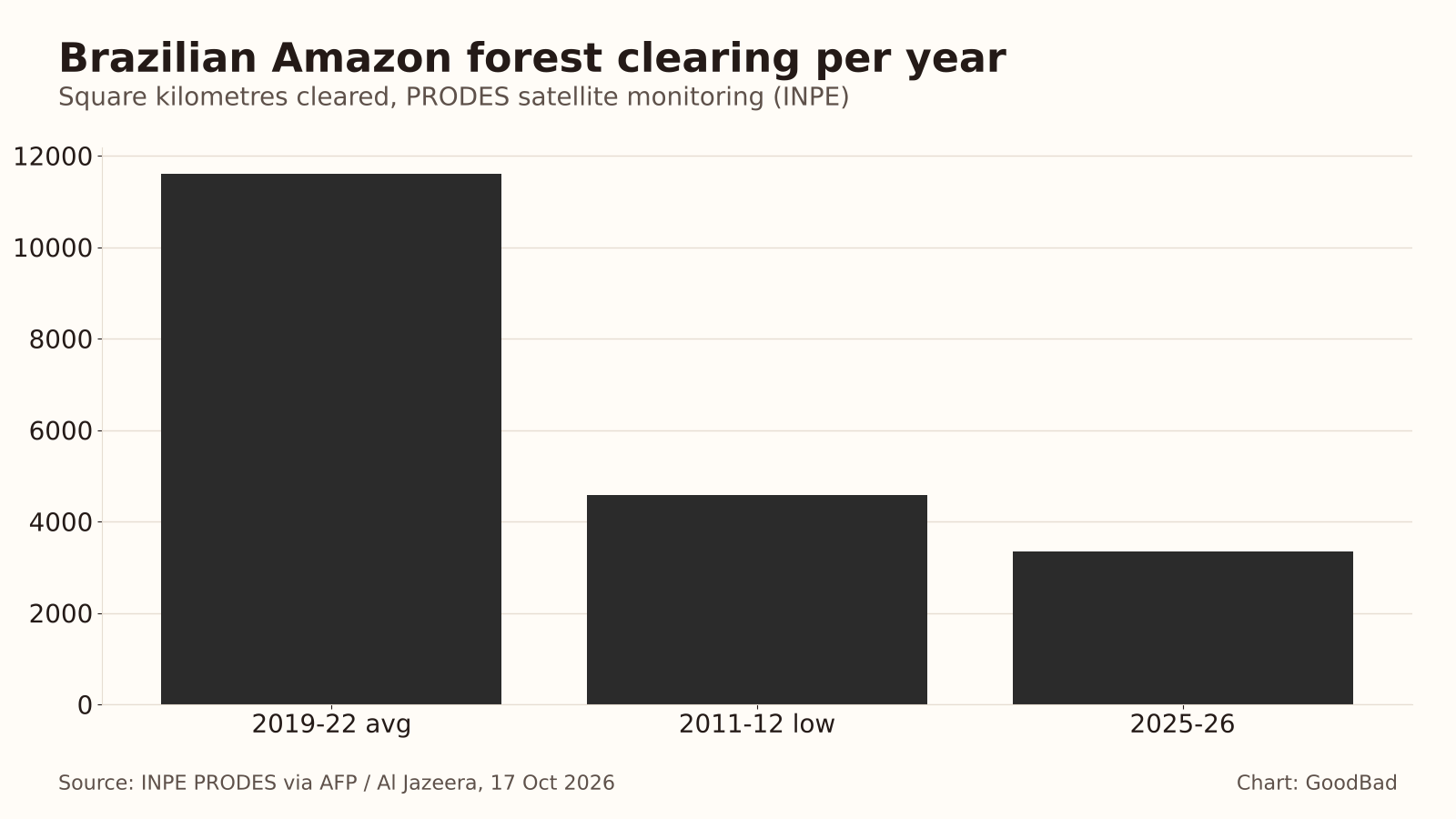 Chart: GoodBad. Data from INPE’s PRODES monitoring, as reported by AFP and Al Jazeera, 17 October 2026. The 2019 to 2022 figure is an average.
What changed
AFP attributes the drop to greater monitoring and stiffer penalties for illegal logging. PRODES measures from August to July because cloud cover is lower in those months. Environment Minister Joao Paulo Capobianco called the result “absolutely stratospheric”. Marcio Astrini of Observatorio do Clima called it “a historic achievement”. President Lula has set a goal of zero illegal deforestation by 2030.
The figures came out eight days before the 25 October presidential run-off between Lula and Senator Flavio Bolsonaro, the former president’s eldest son. AFP reports that Flavio Bolsonaro also pledged to end illegal deforestation, by 2029, and to focus enforcement on organised crime. On the numbers, both candidates were promising to hold a line that the satellites now show already moved a long way.
The Cerrado savanna, which sits south of the Amazon, also had a record low: 5,517 square kilometres cleared, down about 24% and the lowest since its records began in 2001.
The carbon picture is still catching up
The forest’s carbon books look less cheerful for now, and the evidence is recent. A study in Nature, led by Luciana Gatti of Brazil’s National Institute for Space Research, used 15 years of airborne measurements to show that the Amazon is a net source of carbon. In wet years with little clearing or fire it was still a small net source, the University of Kansas reports. In 2024, a year of drought, fire and high clearing, emissions were the highest in the dataset.
The authors conclude that human land-use change, not climate alone, is the dominant control, with climate modulating the effect. The study does not confirm a tipping point, and the authors say satellites often cannot see the tropics clearly because of cloud cover.
So what does the record low buy? On the study’s own logic, less clearing and less burning are the levers that move the balance, and clearing is the one the new figures show moving. The two datasets measure different things: PRODES counts area cleared in a year, while the Nature paper tracks the forest’s carbon flow over 15 years. Neither says when the balance might turn.
What to watch
The next test is whether the fall holds. Brazil’s goal is zero illegal deforestation by 2030. Fire is the second test, since the clearing figure does not measure it and the Nature study links the worst year in its record to drought, fire and high clearing together. The three year types in the paper suggest that low clearing and a wet year is the combination that comes closest to carbon balance.