Bad news
China’s Car Sales Fall for a 12th Month as Electric Sales Drop 17%
China’s passenger car sales fell 28.1% in September and new-energy vehicle retail sales fell 17%. The record 67% electric share reflects combustion sales falling faster, while exports of the surplus rose 164%.

Read the good side of this story
Electric and Hybrid Cars Hit a Record 67% of China’s New Car Sales
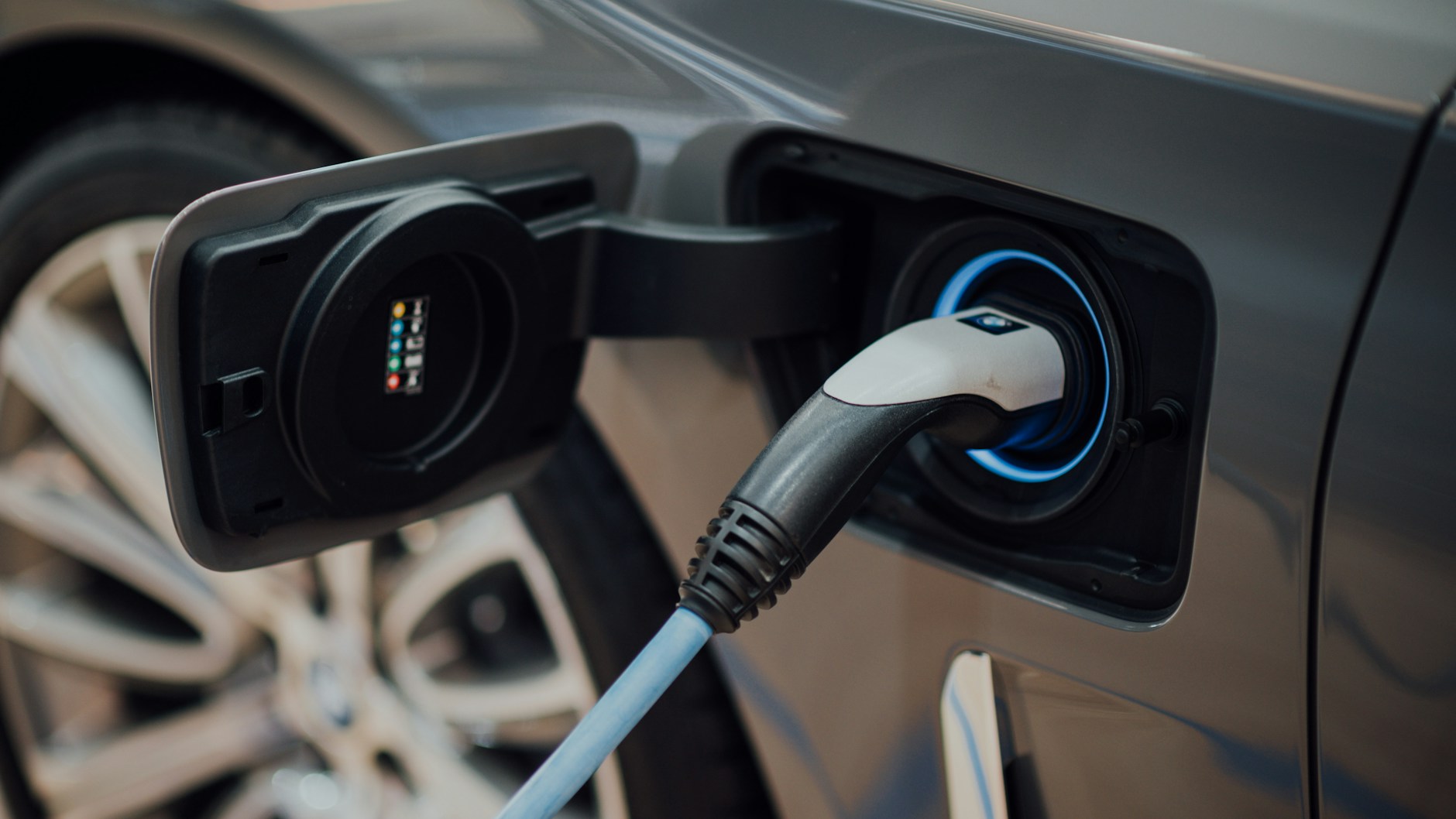
China’s car market shrank again in September, and electric cars shrank with it. Reuters reports that passenger vehicle sales fell 28.1% from a year earlier to 1.63 million units, the twelfth straight monthly decline, according to the China Passenger Car Association (CPCA). The widely quoted record is a share, not a volume: new-energy vehicles (NEVs), meaning battery-electric and plug-in hybrid cars, were 67% of sales.
A bigger share of a smaller market
Carbon Brief reports that domestic NEV retail sales fell 17% in September to 1.084 million, from 1.296 million a year earlier. That was a ninth monthly drop, and sales are down 13% for the year to date. Battery-electric sales fell 8.5% in September and plug-in hybrids 36%. Combustion-engine sales fell faster, by 43%, which is what lifted the NEV share. Combustion-car sales have fallen every year since peaking in 2017, so the shift is long-running, but 2026 has made it abrupt.
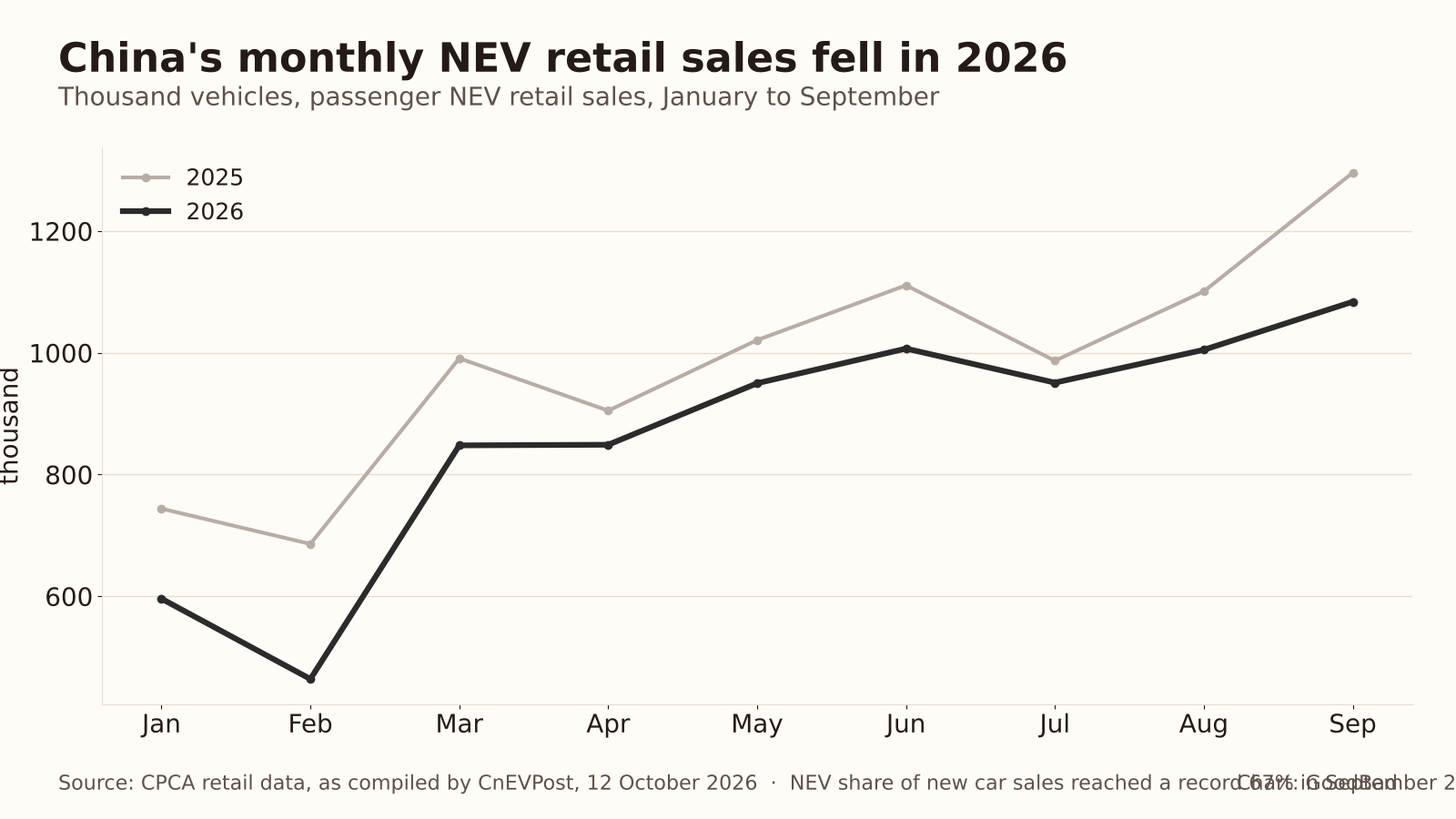 Chart: GoodBad. Data from CPCA retail data, as compiled by CnEVPost, 12 October 2026.
The CPCA’s Cui Dongshu attributed the September fall to a high comparison base from 2025, changes to trade-in policies and holiday disruption, Carbon Brief reports. Consultancy Wood Mackenzie points to demand pulled forward into 2025 by the end of subsidies and to tighter financing. The share was only 39% in January, after a purchase-tax exemption ended in December 2025.
The September numbers
| Measure, September 2026 | Result | Source |
|---|---|---|
| NEV share of new car sales | 67% (record) | CPCA, via Carbon Brief |
| NEV domestic retail sales | 1.084 million, down 17% (September 2025: 1.296 million) | CPCA, via Carbon Brief and CnEVPost |
| Combustion-engine sales | Down 43% | CPCA, via Carbon Brief |
| NEV exports | 558,000, up 164% | CPCA, via Carbon Brief |
| All passenger vehicle sales | 1.63 million, down 28.1% | CPCA, via Reuters |
Who carries the cost is the car industry itself. Carbon Brief describes weaker domestic demand and cut-throat industrial competition, which squeeze margins at the same moment that trade barriers abroad multiply. Nothing in the sources consulted says which carmakers are most exposed, or how many jobs depend on the export push.
The surplus goes abroad
With home demand weak, carmakers are selling overseas. The CPCA says NEV exports rose 164% to 558,000 in September, and Reuters says total car exports rose 73.2% to 923,000. The CPCA calls exports a core priority for some carmakers, Carbon Brief reports, amid cut-throat domestic competition.
That is causing friction. The European Union has placed tariffs on Chinese EV imports and recently agreed plans to cut hybrid imports, and Mexico and Turkey have also imposed tariffs, according to Carbon Brief. Beijing is cutting VAT export rebates, and analysts differ on whether that will push export prices up.
What the oil saving is, and is not
The oil figures need care, because the sources give only estimates, and they come from different analysts using different methods.
Part of the reason for the shift is the Hormuz crisis. China’s oil imports fell 15% in January to September, equivalent to 470 million barrels, because conflict tightened supply and raised prices. Ember analyst Euan Graham estimates that EVs displaced 143 million barrels, a fraction of that fall. An estimate given to the Brookings Institution and cited by Carbon Brief puts EVs at 12% of the drop in China’s oil use.
AlixPartners’ Zhang Yichao does not see much further room for NEV share to grow and expects it to stay below 80%. The share has also started to slow, Carbon Brief notes, as growth in NEV share decelerates. For now, the milestone comes with falling volumes, a squeezed domestic industry and a surplus pushed into markets that are raising barriers.