Good news
Electric and Hybrid Cars Hit a Record 67% of China’s New Car Sales
Battery-electric and plug-in hybrid cars made up two of every three new cars sold in China in September, up from 6% in 2020, and an analyst estimates the fleet has displaced 143 million barrels of oil since the Hormuz crisis began.

Read the bad side of this story
China’s Car Sales Fall for a 12th Month as Electric Sales Drop 17%
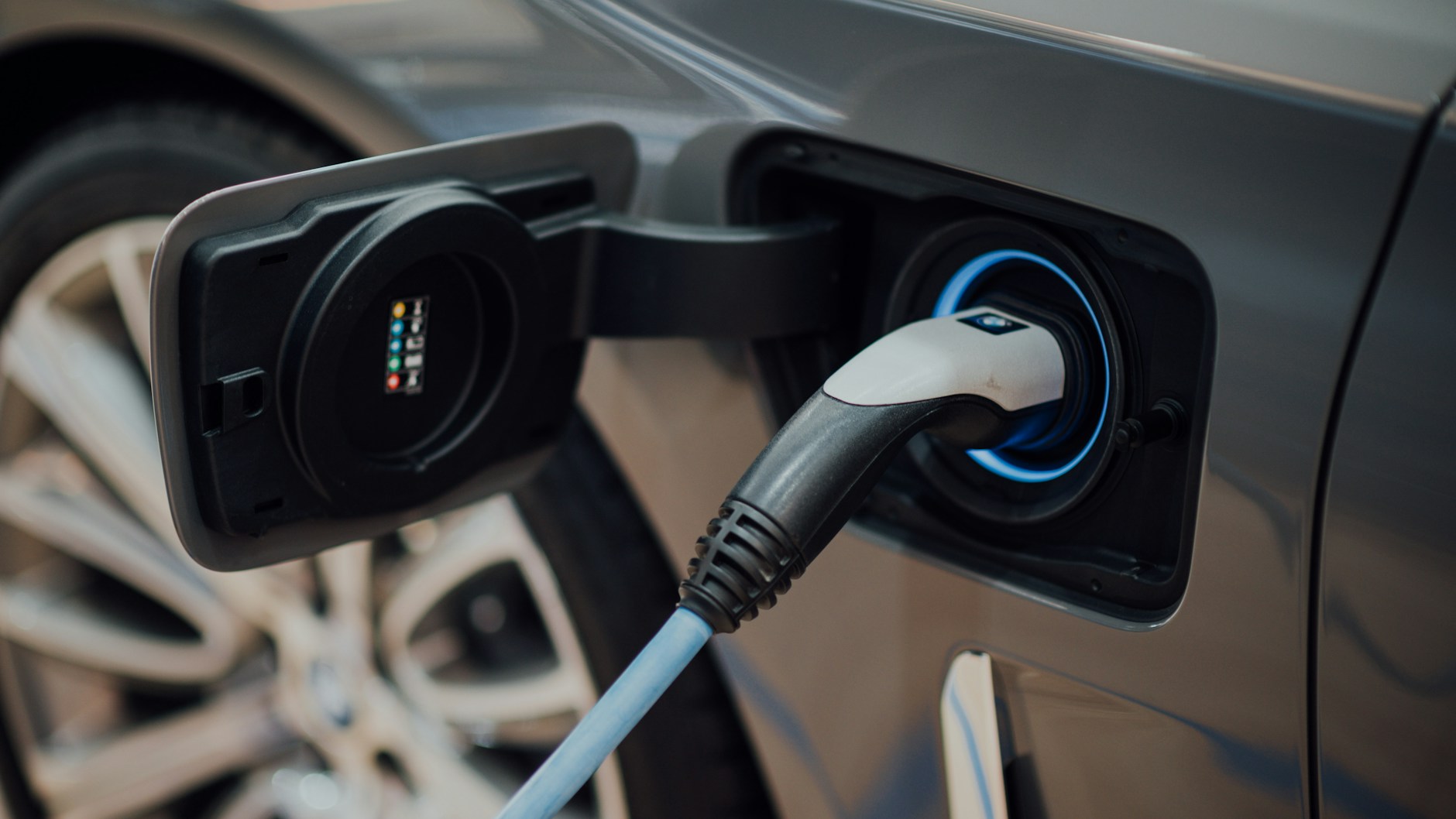
For the first time, two of every three new cars sold in China were electric or plug-in hybrid. New-energy vehicles (NEVs) took a record 67% of September sales, Carbon Brief reports, citing data from the China Passenger Car Association (CPCA). In 2020 the share was 6%. For 2026 so far it is 58%.
Why the share jumped
Petrol got more expensive. The Hormuz crisis tightened oil supply, and CPCA secretary-general Cui Dongshu cited higher petrol prices as a reason combustion-car sales were weak in September, according to Carbon Brief. Fuel-only car sales are down 31% in the first nine months of 2026, while battery-electric sales are down only 4%.
The share also recovered from a low. It stood at 39% in January, after a purchase-tax exemption that had lasted more than a decade ended in December 2025. Analyst Zhang Yichao of AlixPartners told Carbon Brief that government trade-in policies and a strong pipeline of new models helped NEVs hold up better than combustion cars.
What it means for oil
China’s oil imports fell 15% in January to September compared with 2025, equivalent to 470 million barrels, Carbon Brief reports. Euan Graham, a senior energy analyst at the think tank Ember, estimates that China’s passenger NEV fleet has displaced 143 million barrels of oil since the Hormuz crisis began. Another analyst’s estimate, passed to the Brookings Institution and cited by Carbon Brief, puts EVs at 12% of the fall in China’s oil use.
Erica Downs of Columbia University’s Center on Global Energy Policy says the disruption is reinforcing China’s electrification of road transport. She says it vindicates an early bet that was partly driven by worries about oil supply security.
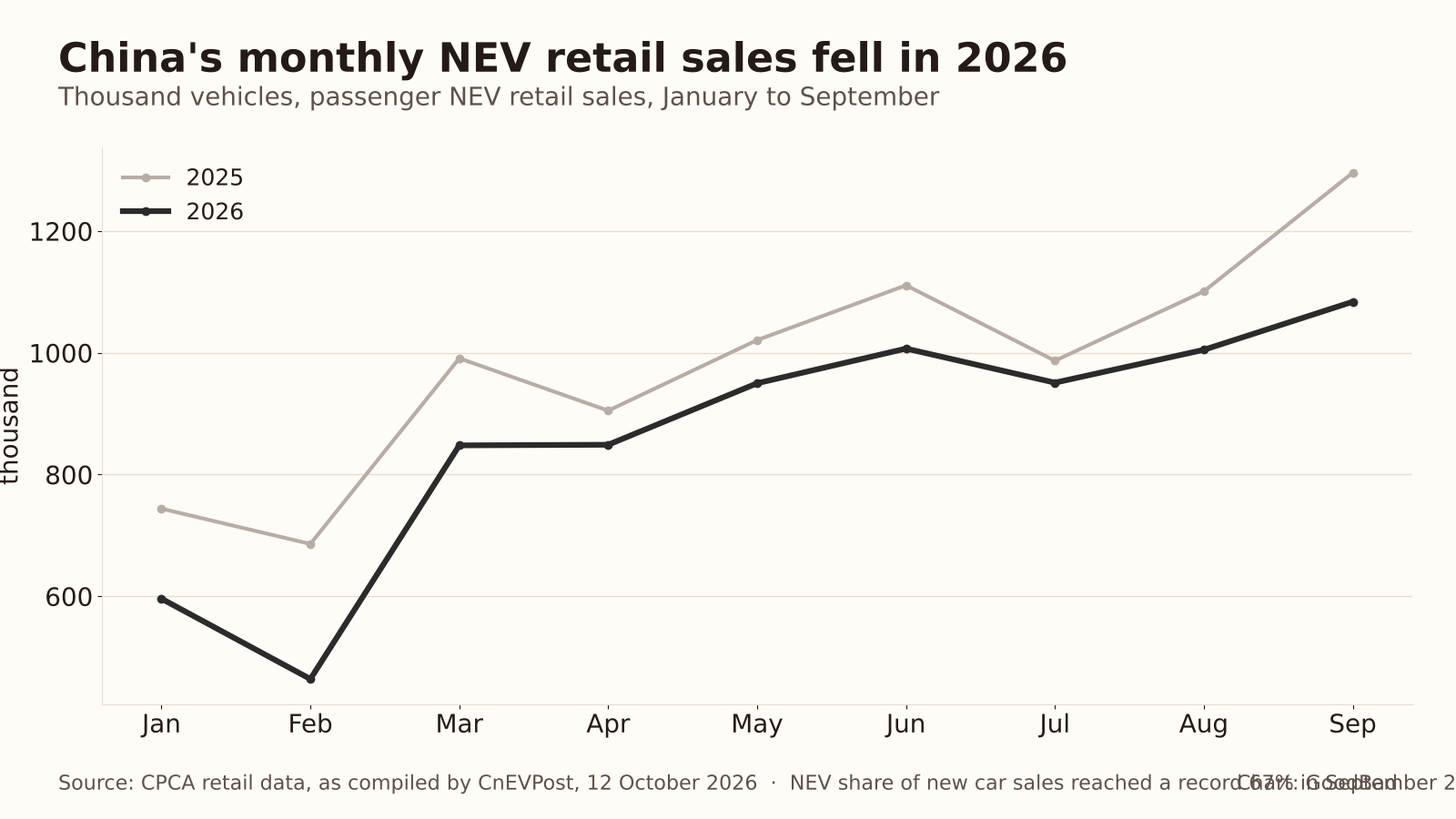 Chart: GoodBad. Data from CPCA retail data, as compiled by CnEVPost, 12 October 2026.
The September numbers
| Measure, September 2026 | Result | Source |
|---|---|---|
| NEV share of new car sales | 67% (record) | CPCA, via Carbon Brief |
| NEV domestic retail sales | 1.084 million, down 17% (September 2025: 1.296 million) | CPCA, via Carbon Brief and CnEVPost |
| Combustion-engine sales | Down 43% | CPCA, via Carbon Brief |
| NEV exports | 558,000, up 164% | CPCA, via Carbon Brief |
| All passenger vehicle sales | 1.63 million, down 28.1% | CPCA, via Reuters |
A caveat in the numbers
The record share is not a sales record, and the table above shows why. NEV retail sales were 1.084 million in September, below the 1.296 million of a year earlier, because the whole car market shrank faster. Reuters reports that passenger vehicle sales fell 28.1% year on year to 1.63 million units, the twelfth straight monthly decline.
Electric cars are also leaving China in larger numbers. The CPCA says NEV exports rose 164% from a year earlier to 558,000 in September, as Carbon Brief reports, and Reuters says total car exports rose 73.2% to 923,000. So more of China’s electric output now serves buyers abroad.
What the sources do not say
The sources do not say how much of the oil displacement is permanent. The 143 million barrel figure is one analyst’s estimate, given to Carbon Brief, and the Brookings figure comes from an unnamed analyst. Both are best read as orders of magnitude, not audited totals.
How far can it go?
Zhang does not see much more room for growth in share, and expects it to stay below 80%, because some premium segments and uses will still need combustion engines. Even so, the long trend is clear and predates this year’s oil shock: combustion-car sales in China peaked in 2017 and have fallen since.
For drivers, the practical effect is a market where the electric option is now the default choice, not the alternative. For the climate, the key question is how long the share keeps rising once petrol prices settle.