Bad news
Ebola Is Still Out of Control in Congo at Six Months, 5,500 Dead
Africa CDC says the Congo outbreak is not under control: about 11,200 cases and 5,500 deaths, over 80 percent of new cases outside contact lists, and $1.3 billion of $2.9 billion pledged released. WHO reports slowing in some areas.

Read the good side of this story
Ebola Vaccine Trials Advance and 3,000 Recover as Congo Outbreak Passes Six Months
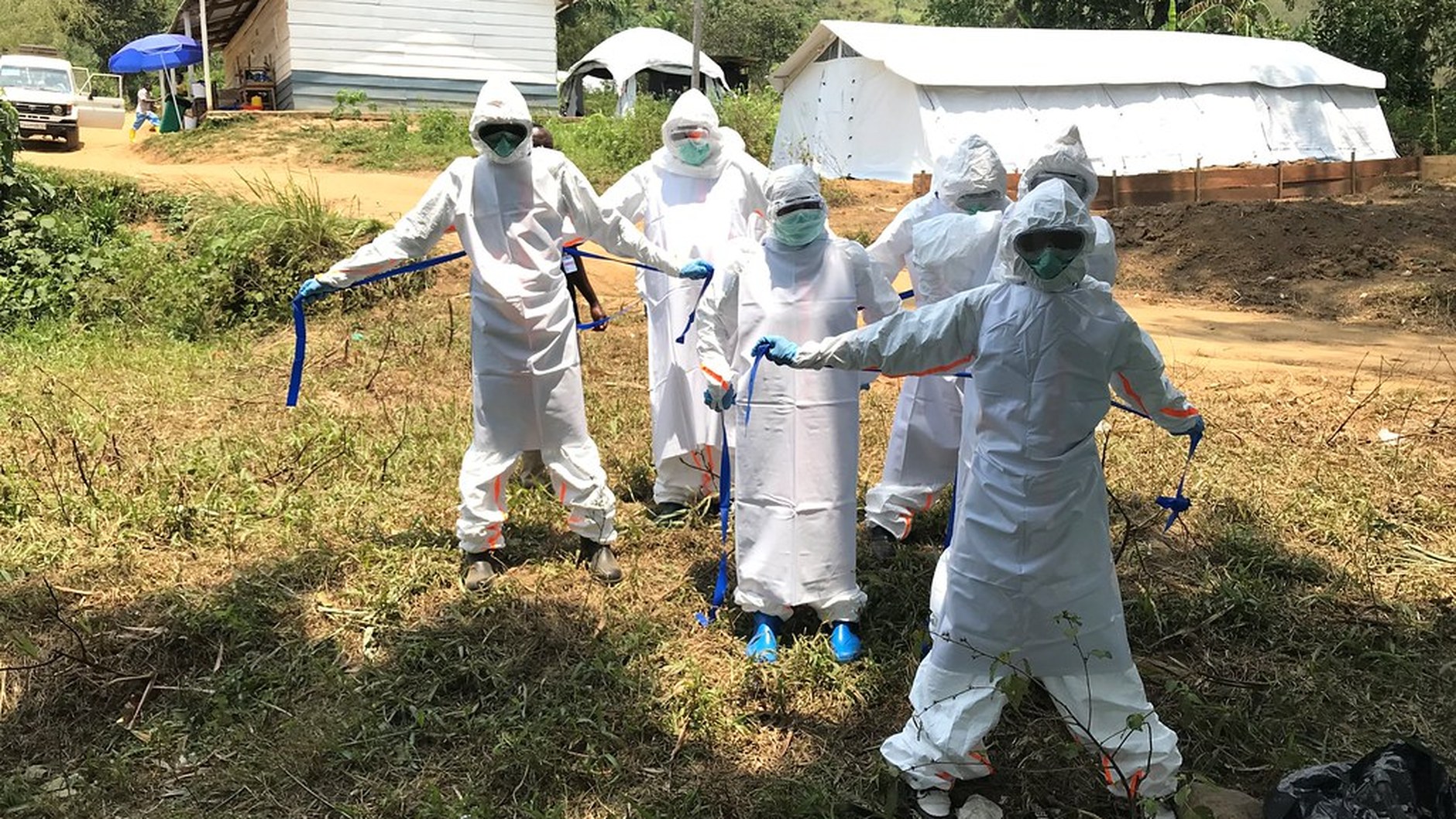
Six months after Congo declared its Bundibugyo Ebola outbreak on 15 May, Africa CDC says it is still not under control. Government data show more than 11,200 cases and 5,500 deaths, the agency’s director-general, Jean Kaseya, told Reuters, in a report carried by Al Jazeera. If it is not stopped now, he said, it would be the worst Ebola outbreak the world has had.
Cases the response cannot see
The core failure is detection. More than 80 percent of new cases emerge outside contact lists, Kaseya said, which means most infections are found only after people are sick and have already been in contact with others. He said more than 65 percent of deaths have occurred in the community, outside health centres. AP puts the community share at one-third of deaths, citing a different measure, in its account carried by PBS.
By the time the outbreak was announced in mid-May, 43 deaths had been recorded, which suggests the virus had circulated undetected for some time. It has since reached eight of Congo’s 26 provinces. Cases have been reported in East, Central and West Africa, the widest spread of any Ebola outbreak on the continent, Al Jazeera says. AP lists confirmed cases in Nigeria, Kenya and Uganda.
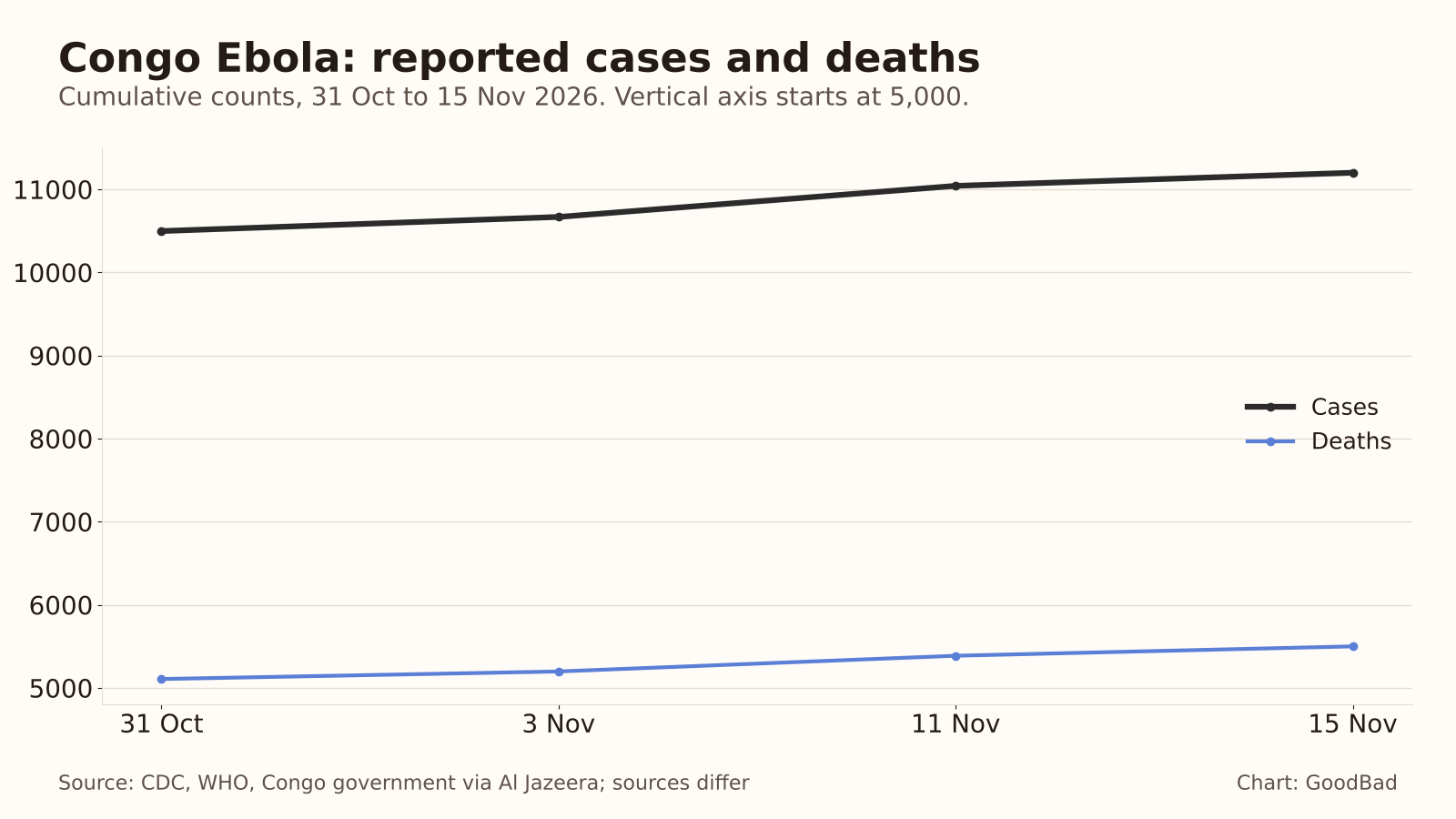 Chart: GoodBad. Data from CDC, WHO and the Congolese government via Al Jazeera, 31 October to 15 November 2026. The vertical axis starts at 5,000.
The counts keep climbing. The CDC reported 10,498 confirmed cases and 5,107 deaths on 31 October. The WHO counted 10,668 and 5,198 on 3 November. Congo’s government reported 11,042 and 5,387 on 11 November, and about 11,200 and 5,500 by 15 November. The sources use different counting rules, so the trend matters more than any single day.
This is the second-largest and second-deadliest Ebola outbreak on record, behind West Africa in 2014 to 2016, which infected more than 28,600 people and killed more than 11,000. AP says it is on track to pass that death toll. The Bundibugyo strain kills about half of those it infects, and no vaccine or treatment has been developed specifically for it.
Money, pay and conflict
Kaseya says only $1.3 billion of the $2.9 billion pledged by donors has been released. That leaves about $1.6 billion pledged but not yet released. He called the coordination between Congo and donors a collective failure. Last month Africa CDC raised concerns about more than $700 million in Ebola aid that remains unaccounted for, AP reports.
Health workers have repeatedly gone on strike over pay that is months overdue, sometimes leaving confirmed patients without treatment. Doctors Without Borders, known as MSF, describes a disconnect between the resources mobilised and what reaches patients, frontline workers and communities. Kaseya says Congo is digitising the payroll for workers who had not been paid for months.
The outbreak is concentrated in Ituri and North Kivu in the east, where armed conflict was already one of the world’s most severe humanitarian crises. Health workers have been attacked, some fatally, and so have health facilities, AP says.
The children
Children carry a heavy share. UNICEF says children made up 35 percent of deaths recorded through 4 November, and children under five made up 21 percent of all deaths. Nearly 72 percent of infected children in that age group have died. In plain terms, nearly three in four of the youngest infected children have died. AP notes that most affected children have not received specialised care, which contributes to the high death rate, and that children with existing conditions such as malnutrition are especially vulnerable.
What would change the outcome
Vaccines are the largest gap, and they are not close. WHO approved trials of two new vaccines earlier this month and expects results in early 2027, according to Al Jazeera. Doctors Without Borders says Congo asked for 500,000 doses of the existing Ervebo vaccine in August and received 70,000, as we reported in that access gap. WHO’s vaccine advisers meet on 17 November.
There is some progress. WHO’s director-general wrote on X that transmission is slowing in several early epicentres. WHO says at least 3,000 people have recovered and returned home. Kenya discharged its last patient on 11 November and began a 42-day countdown, our earlier report shows. Uganda was declared Ebola-free in August after about 20 cases. The Tumaini vaccine trial enrolled its first participants in Bunia in early November, according to WHO. Set against more than 5,500 deaths, that is a small share of the picture.
The response also has to work across borders. Kenya’s cluster reached nine confirmed cases and two deaths, and its own measures show the cost: visa suspensions and quarantines have hit workers, as our earlier report describes. Nigeria has reported an imported case. Every new country adds contacts to trace and borders where checks are needed, in a response that is already stretched.
AP quotes experts who say there is little chance of bringing the outbreak under control within the next year. Faster tracing, back pay for health workers, released funding and a working vaccine are the four things the sources point to. None of the sources says when any of them will arrive.