Good news
Ebola Vaccine Trials Advance and 3,000 Recover as Congo Outbreak Passes Six Months
WHO says transmission is slowing in several early epicentres, at least 3,000 people have recovered and two new vaccines are cleared for trials. Africa CDC says the outbreak, with about 11,200 cases and 5,500 deaths, is still not under control.

Read the bad side of this story
Ebola Is Still Out of Control in Congo at Six Months, 5,500 Dead
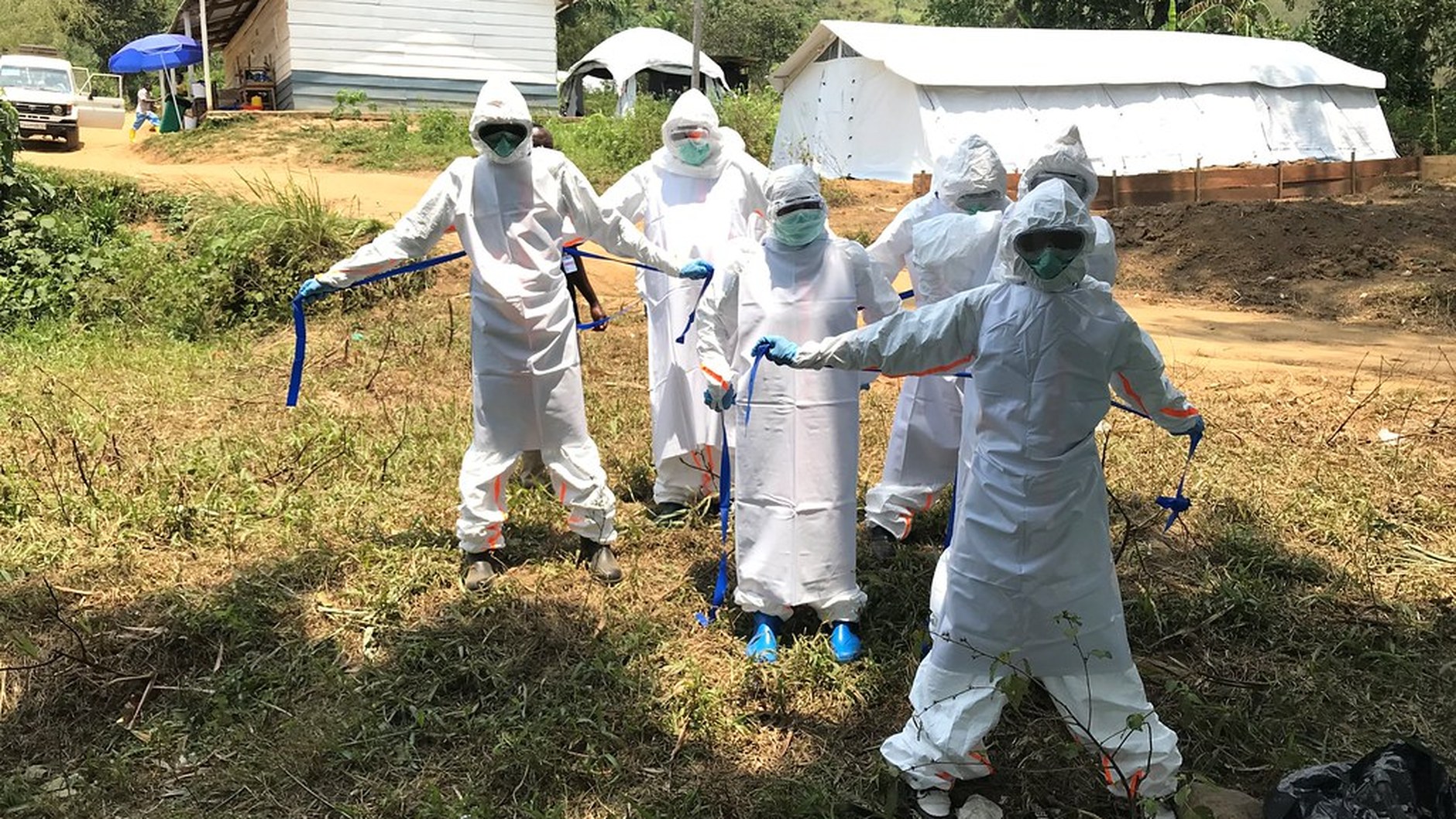
Six months after Congo declared its Bundibugyo Ebola outbreak on 15 May, the news from the response is mixed, and the good part is specific. The World Health Organization says transmission is slowing in several of the early epicentres, and at least 3,000 people have recovered and gone home. Two new vaccines have been cleared for trials, with results expected in early 2027, Al Jazeera reports from Reuters.
The same report carries the caution that goes with it. Africa CDC says the outbreak is still not under control. Government data show more than 11,200 cases and 5,500 deaths since the declaration, and the virus has been found in eight of Congo’s 26 provinces. By the time the outbreak was announced, 43 deaths had already been recorded, according to AP, which suggests the virus spread unnoticed for a while. Both things are true at once: the tools are arriving, and the epidemic is still large.
What is working
The recoveries are the clearest sign that care works when people reach it. WHO says at least 3,000 survivors have returned home. Its director-general, Tedros Adhanom Ghebreyesus, wrote on X that the Tumaini vaccine trial and the new candidates are advancing rapidly, according to Al Jazeera.
The vaccine news is concrete. Earlier this month WHO approved clinical trials of two new Ebola vaccines and said it expects results in early 2027. They are designed for the Bundibugyo strain, for which no vaccine or treatment has been developed. We described the two candidates and the Tumaini trial when WHO’s advisers recommended them on 4 November, and the WHO announcement has the detail.
Doses are the limiting factor for the vaccines that exist. The Tumaini trial enrolled its first participants in Bunia in early November, according to WHO. Doctors Without Borders says Congo asked for 500,000 doses of the Ervebo vaccine in August and has received 70,000, as we reported in our coverage of the access gap. WHO’s vaccine advisers meet on 17 November, the next decision point.
Containment elsewhere is also holding. Kenya discharged its last Ebola patient on 11 November and began a 42-day countdown to an Ebola-free declaration, as our earlier report set out. Uganda was declared Ebola-free in August.
The size of the task
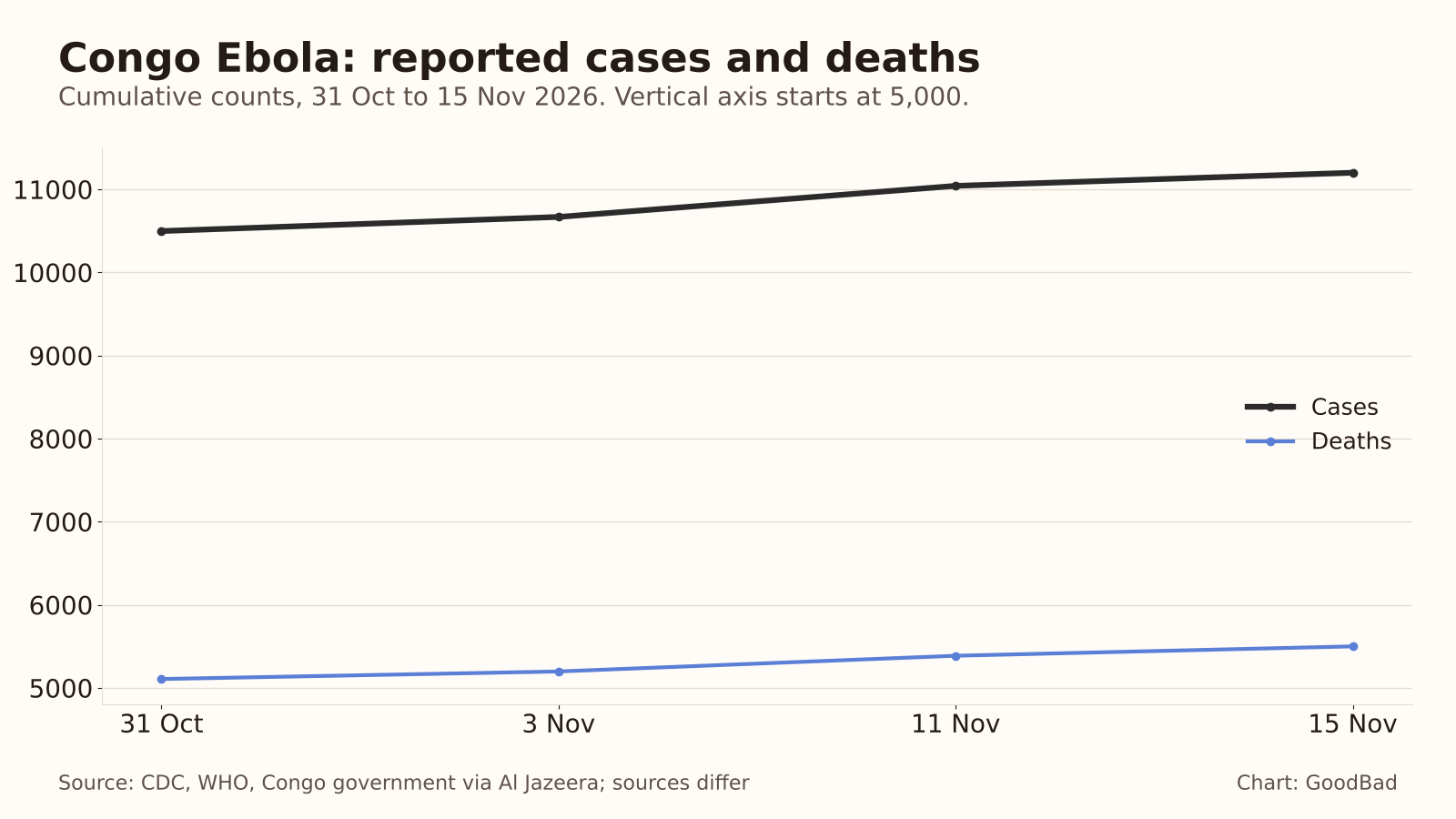 Chart: GoodBad. Data from CDC, WHO and the Congolese government via Al Jazeera, 31 October to 15 November 2026. The vertical axis starts at 5,000.
The count is still rising, though the weekly pace is modest next to the totals. The CDC reported 10,498 confirmed cases and 5,107 deaths on 31 October. The WHO counted 10,668 and 5,198 on 3 November. Congo’s government reported 11,042 and 5,387 on 11 November, and about 11,200 and 5,500 by 15 November. The sources use different counting rules, so the trend matters more than any single day.
It is the second-largest and second-deadliest Ebola outbreak on record, behind West Africa in 2014 to 2016, which infected more than 28,600 people and killed more than 11,000, Al Jazeera says. The Bundibugyo strain kills about half of those it infects. AP’s account, carried by PBS, says it is on track to pass the West African death toll.
What still has to go right
The weak point is finding cases. Africa CDC’s director-general, Jean Kaseya, told Reuters that more than 80 percent of new cases emerge outside contact lists. He said more than 65 percent of deaths happen in the community, outside health centres. AP puts the community share at one-third of deaths, citing a different measure. Either way, many infections are not being traced.
Contact lists matter because the response works by following the people a patient met. When more than four in five new cases are not on those lists, responders find them after they are sick rather than before. Closing that gap is the clearest way for the response to catch up with the virus. It depends on staffing, pay and access in a conflict zone as much as on new vaccines.
Money is the second gap. Kaseya says only $1.3 billion of the $2.9 billion pledged by donors has been released. AP reports that Africa CDC raised concerns last month about more than $700 million in aid that remains unaccounted for. Health workers have gone on strike over pay that is months overdue, and Kaseya says Congo is digitising the payroll for workers who had not been paid for months.
Children face the highest risk. UNICEF says children made up 35 percent of deaths recorded through 4 November, and children under five made up 21 percent of all deaths. Nearly 72 percent of infected children in that age group have died, according to AP.
What it means going forward
There is no timetable for control. AP quotes experts who say there is little chance of bringing the outbreak under control within the next year. Kaseya warned that if it is not stopped now, it would be the worst Ebola outbreak the world has had.
The next dates are practical ones. WHO expects vaccine results in early 2027, and Kenya’s countdown ends 42 days after 11 November. For readers outside the region, the sources report cases in Uganda, Kenya and Nigeria but do not describe a risk to other countries.