Bad news
Nearly Three Times the Dropouts as Lilly’s New Shot Beats Ozempic
Lilly’s retatrutide beat Ozempic on weight and blood sugar in an open-label trial of 1,298 people, but 7.9% on the top dose quit for side effects against 2.7% on Ozempic, and the price, the paper and the approval are all still missing.

Read the good side of this story
Retatrutide Doubles Ozempic’s Weight Loss in Head-to-Head Diabetes Trial
Of every 100 people given the highest dose of retatrutide in Eli Lilly’s new diabetes trial, about eight stopped taking it because of side effects. On Ozempic, the drug it was measured against, fewer than three did. Those figures sit low down in the company’s release of 28 October, beneath the headline that retatrutide more than doubled Ozempic’s weight loss. Both statements are true, and the second depends on who managed to stay the course.
TRANSCEND-T2D-2 was a phase 3 trial of 1,298 adults with type 2 diabetes that was not controlled on metformin, with or without an SGLT2 inhibitor. They were randomised 2:2:1 to weekly retatrutide at 9 mg, retatrutide at 12 mg, or semaglutide at 2 mg, the molecule sold as Ozempic, for 80 weeks. The trial was open-label, so patients and doctors knew who was on what. Both retatrutide doses lowered HbA1c by 2.2 percentage points from an average of 8.3%, against 1.8 points on Ozempic. Weight fell by 19.5% and 20.9% against 9.4%, or 20.1 kg and 21.5 kg against 9.5 kg from a starting average of 102.4 kg.
What the figures leave out
Those are company topline numbers, and no one outside Lilly has checked them. The release promises a presentation at a future medical meeting and a peer-reviewed paper, with no date for either. The weight and blood-sugar results use what Lilly calls an efficacy estimand. It assumes every participant stayed on the assigned drug for 80 weeks without adding another glucose-lowering medicine for more than 14 days. STAT noted that this describes people who stayed on treatment rather than everyone enrolled, and more people left the retatrutide arms than the Ozempic arm.
| Reported at 80 weeks | Retatrutide 9 mg | Retatrutide 12 mg | Ozempic 2 mg |
|---|---|---|---|
| Diarrhoea | 28.3% | 32.7% | 26.4% |
| Nausea | 21.2% | 23.8% | 21.3% |
| Vomiting | 10.2% | 15.0% | 13.2% |
| Dysesthesia | 4.8% | 6.5% | 2.7% |
| Stopped for side effects | 4.8% | 7.9% | 2.7% |
Dysesthesia is an abnormal skin sensation such as tingling or burning, and it was two to three times as common on retatrutide as on Ozempic. Lilly says most adverse events were mild to moderate and typically resolved during treatment. The release does not give figures for serious adverse events or deaths, and it reports improvements in cholesterol, triglycerides and blood pressure without saying how large they were. Those gaps are what a journal paper exists to fill.
A comparator the sponsor chose
Lilly picked Ozempic at 2 mg because, in its words, it is the highest approved dose for type 2 diabetes. That makes it a fair test of that product, not of the field. Retatrutide was not compared with tirzepatide, Lilly’s own Mounjaro, in this trial. A separate study, TRIUMPH-5, is doing that in people with obesity, with no results yet. Novo Nordisk told Reuters that Ozempic should not be judged on weight loss alone, because its highest doses have shown benefits for the heart, kidneys and liver. Retatrutide has no such outcome data yet; Reuters describes it as acting on the GLP-1, GIP and glucagon receptors, hence the nickname “triple-G”.
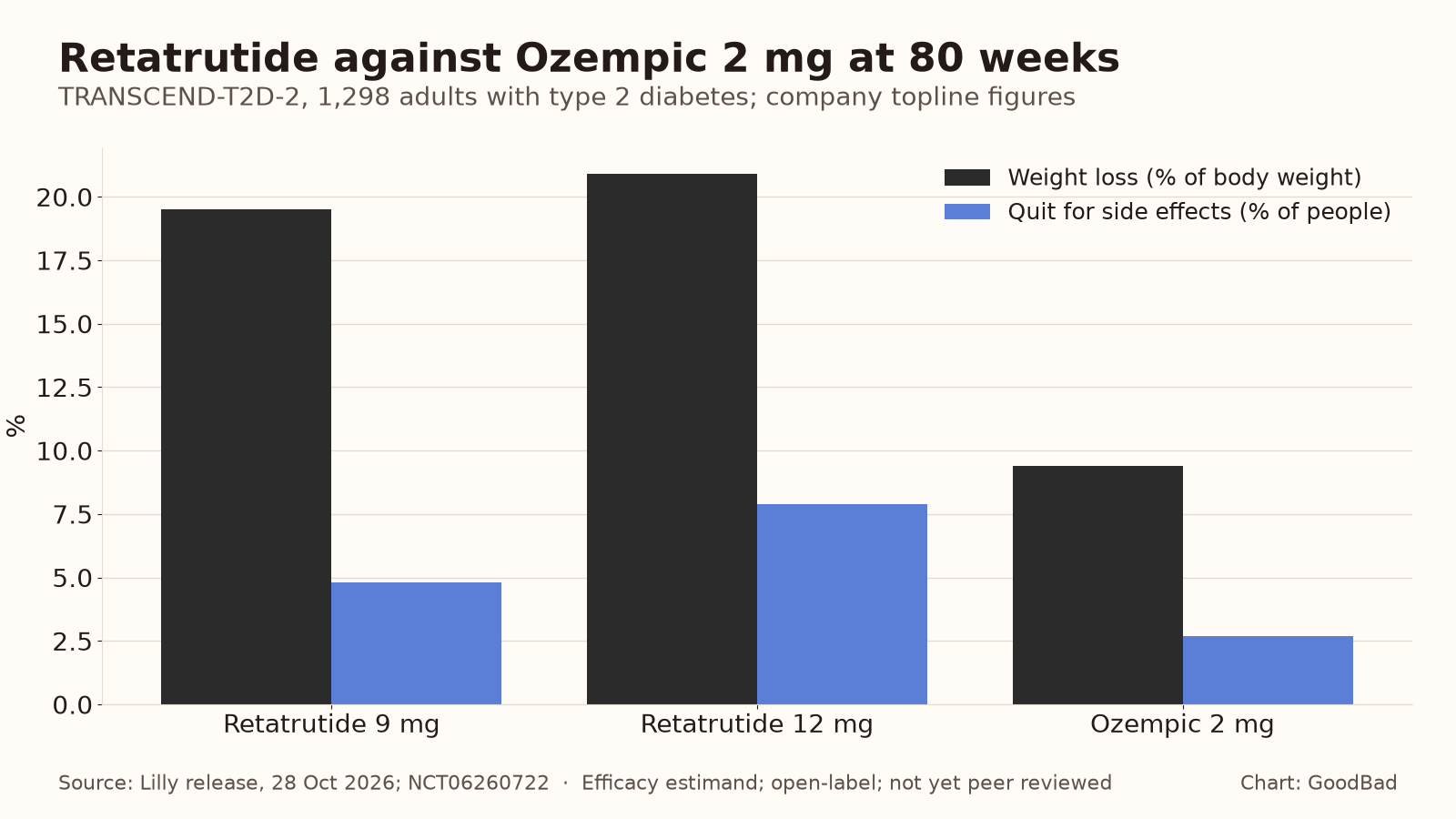 Chart: GoodBad. Data from Lilly’s news release of 28 October 2026 and trial NCT06260722.
Who pays, and who will not get it
Lilly has not named a price, and no source has one. For scale, the company reported $10.7 billion of Mounjaro sales in the third quarter of 2026, up 65% on a year earlier, and $5.35 billion of Zepbound, up 49%. Those are the prices and volumes the next drug will be launched into. The World Health Organization counts 830 million people living with diabetes in 2022, up from 200 million in 1990. It says 59% of adults over 30 with the disease were taking no medication at all that year.
The people in that 59% are concentrated in low- and middle-income countries, where WHO says prevalence has risen fastest and treatment coverage is lowest. The trial registry lists 77 sites, all in the United States, Canada, Mexico, Argentina and Puerto Rico. A weekly injection without a price, tested in five countries and territories of the Americas, is a long way from most of the people whose diabetes goes untreated.
What would change the picture
Four things would turn a company announcement into a result the rest of medicine can use. The first is the peer-reviewed paper, with serious adverse events and the figures for everyone randomised, not only those who stayed on the drug. The second is TRIUMPH-5, which will show whether retatrutide beats Lilly’s own tirzepatide or only Novo’s older molecule. The third is the 24-week extension in which about 650 participants stay on retatrutide, and the fourth is a price. Kenneth Custer, who runs Lilly’s cardiometabolic business, said retatrutide, “if approved, could shift the treatment paradigm”; Reuters reports the US filing is planned for next year, and the “if” still stands.