Good news
Retatrutide Doubles Ozempic’s Weight Loss in Head-to-Head Diabetes Trial
In a phase 3 trial of 1,298 adults with type 2 diabetes, Lilly’s three-hormone injection cut body weight by about a fifth and lowered blood sugar more than the highest approved dose of Ozempic, the company said on 28 October.

Read the bad side of this story
Nearly Three Times the Dropouts as Lilly’s New Shot Beats Ozempic
Eli Lilly’s experimental weekly injection retatrutide cut body weight by 19.5% to 20.9% over 80 weeks in adults with type 2 diabetes, against 9.4% for Novo Nordisk’s Ozempic at its highest approved dose. The company announced the topline results on 28 October from TRANSCEND-T2D-2, a phase 3 trial of 1,298 adults whose diabetes was not controlled on metformin, with or without an SGLT2 inhibitor. Both retatrutide doses lowered HbA1c, the standard measure of average blood sugar over about three months, by 2.2 percentage points from a starting average of 8.3%. Ozempic lowered it by 1.8 points.
The trial was randomised but open-label, so participants and their doctors knew which drug they were getting. People were assigned in a 2:2:1 ratio to weekly retatrutide at 9 mg, retatrutide at 12 mg, or semaglutide at 2 mg, the molecule sold as Ozempic. The figures come from Lilly’s own release and have not yet been through peer review. The company says the full results will go to a medical meeting and a journal, without naming a date. Reuters reported that Lilly plans to seek US approval next year.
How a third hormone changes the result
Ozempic imitates one gut hormone, GLP-1. Retatrutide, which Reuters notes is nicknamed “triple-G”, acts on the receptors for three hormones at once: GLP-1, GIP and glucagon. In kilograms the gap is plain. Participants started at an average of 102.4 kg and lost 20.1 kg on the lower dose and 21.5 kg on the higher one, against 9.5 kg on Ozempic. STAT pointed out that people with diabetes usually lose less weight on these drugs than people without it, which makes a loss of one fifth of body weight in this group stand out.
| At 80 weeks | Retatrutide 9 mg | Retatrutide 12 mg | Ozempic 2 mg |
|---|---|---|---|
| HbA1c change (points) | −2.2 | −2.2 | −1.8 |
| Weight change | −19.5% (20.1 kg) | −20.9% (21.5 kg) | −9.4% (9.5 kg) |
| Stopped for side effects | 4.8% | 7.9% | 2.7% |
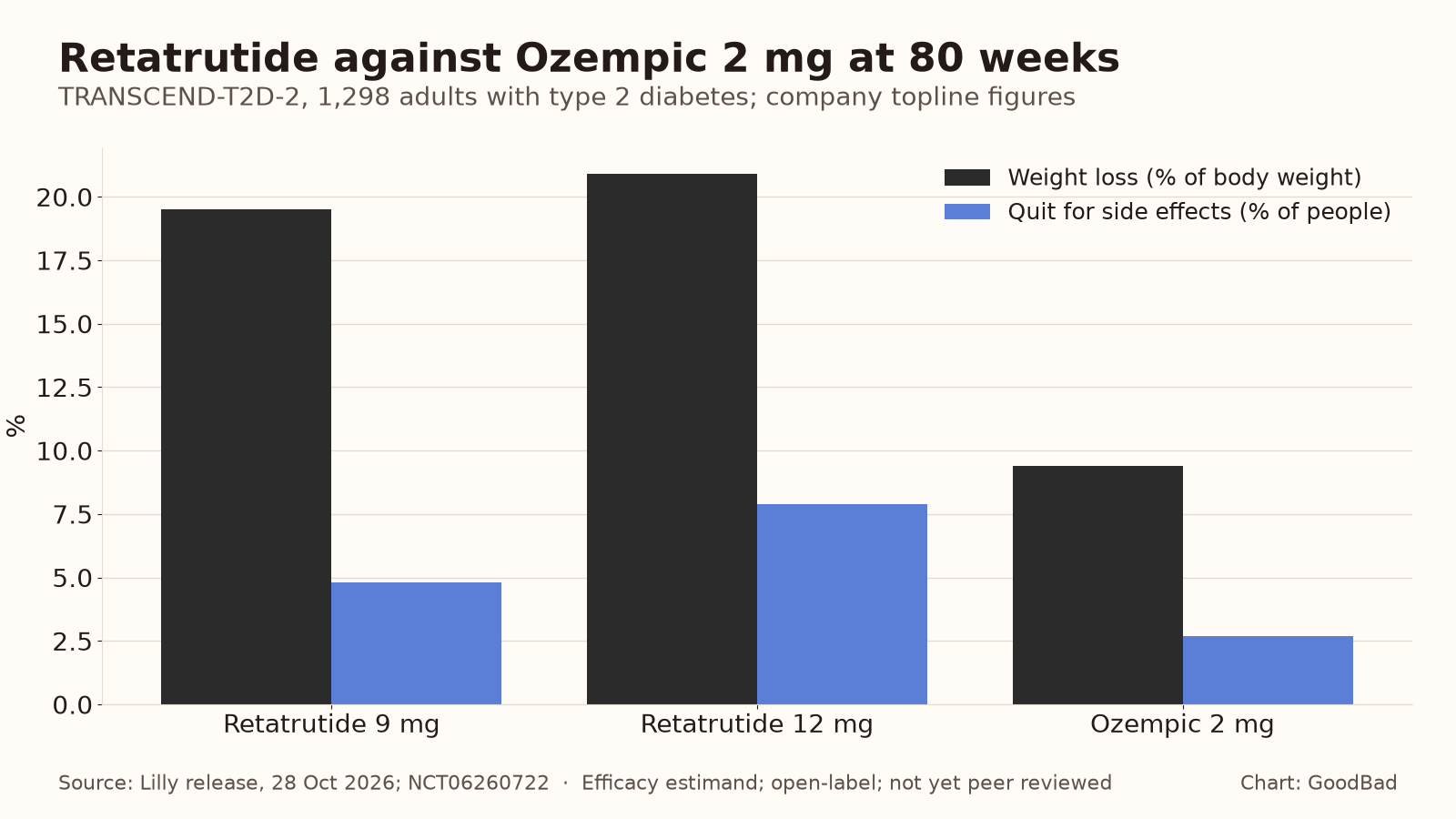 Chart: GoodBad. Data from Lilly’s news release of 28 October 2026 and trial NCT06260722.
Who it could reach
The scale of the need is the reason this matters beyond one company’s pipeline. The World Health Organization counts 830 million people living with diabetes in 2022, up from 200 million in 1990. It says 59% of adults over 30 with the disease were taking no medication for it that year. Prevalence has risen fastest, and treatment coverage is lowest, in low- and middle-income countries. A drug that lowers blood sugar and weight together addresses the two problems most people with type 2 diabetes carry at the same time.
Lilly has not said what retatrutide will cost, and no source has that answer yet. The same company reported $10.7 billion of Mounjaro sales in the third quarter of 2026 alone, up 65% on a year earlier, and $5.35 billion of Zepbound, up 49%. Those figures show both the demand and the price level this class of drugs commands.
The caveats, in order
More people on retatrutide stopped treatment because of side effects: 4.8% on 9 mg and 7.9% on 12 mg, against 2.7% on Ozempic. Diarrhoea affected 28.3% and 32.7% of the two retatrutide groups against 26.4% on Ozempic, and vomiting 10.2% and 15.0% against 13.2%. Dysesthesia, an abnormal skin sensation such as tingling or burning, was reported by 4.8% and 6.5% against 2.7%. Lilly says most events were mild to moderate and typically resolved during treatment.
The headline weight and HbA1c figures use what Lilly calls an efficacy estimand. It assumes everyone stayed on their assigned drug for the full 80 weeks without adding another glucose-lowering medicine for more than 14 days. STAT noted that these are results for people who stayed on treatment, not for everyone enrolled. Novo Nordisk told Reuters that Ozempic should not be judged on weight loss alone, since its highest doses have shown benefits for the heart, kidneys and liver. The trial registry lists 77 sites, all in the United States, Canada, Mexico, Argentina and Puerto Rico, so the participants were not drawn from the regions where diabetes is growing fastest.
What comes next
About 650 participants are staying on retatrutide for a further 24 weeks to track longer-term effects, Lilly says. A separate phase 3 trial, TRIUMPH-5, is testing retatrutide against tirzepatide, the molecule in Lilly’s own Mounjaro, in adults with obesity with or without type 2 diabetes. Kenneth Custer, who runs Lilly’s cardiometabolic business, said the drug, “if approved, could shift the treatment paradigm” for type 2 diabetes and obesity. The approval filing is due next year, and the peer-reviewed paper that would let outsiders check these numbers has no date yet.