Good news
Hubble Census of 37 Dwarf Galaxies Measures How Much Oxygen They Keep
Astronomers used Hubble to count the oxygen that stars have made in 37 nearby dwarf galaxies. The galaxies kept 4% to 25% of it, about 11% on average. The rest was probably blown out by supernova-driven winds.
This story runs on the good side only. The biggest stories of the day are told on both sides.
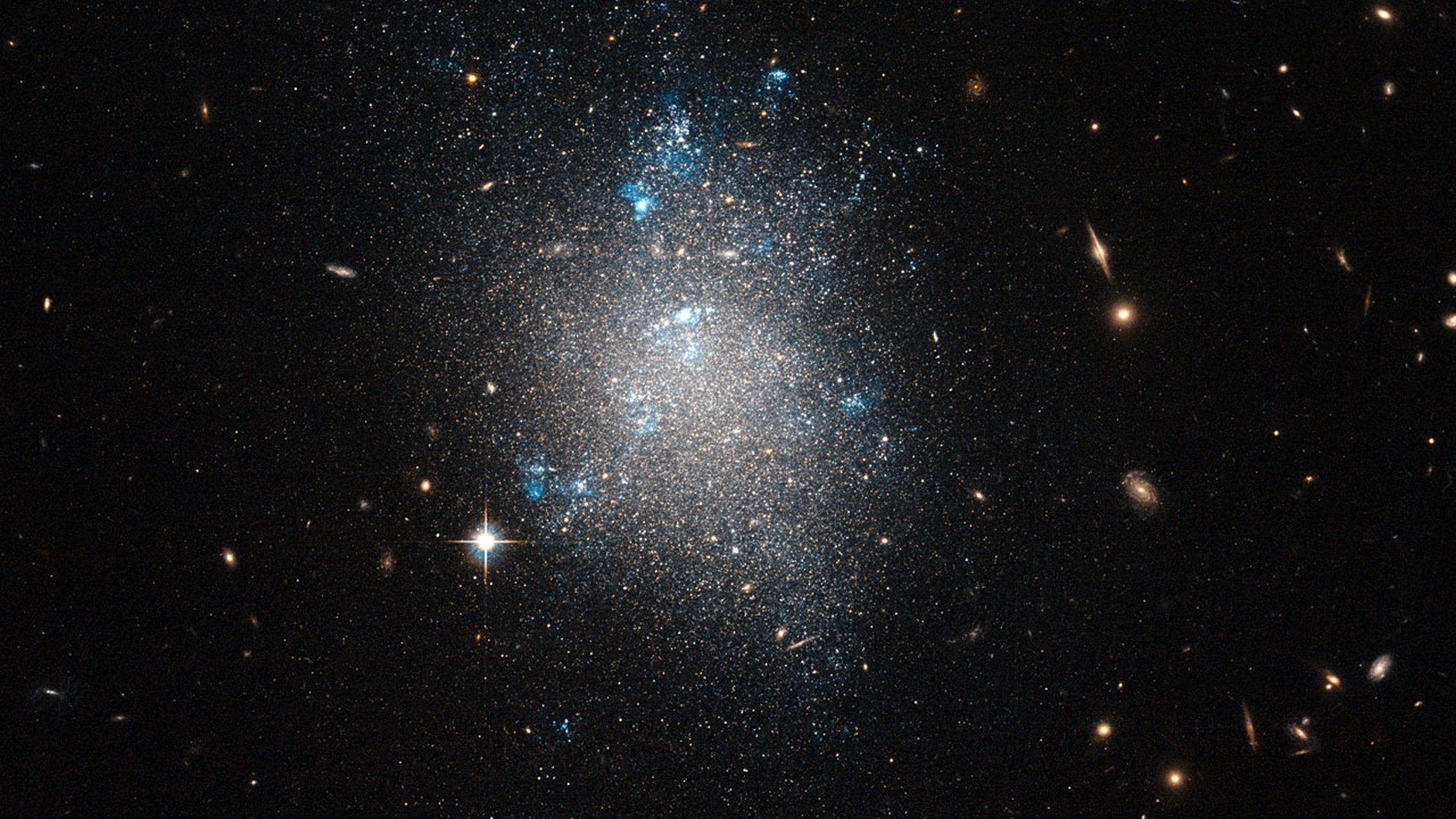
Small galaxies hold on to only about a tenth of the oxygen their own stars make, and a Hubble Space Telescope census has now measured how much. A team studied 37 dwarf galaxies within roughly 19.5 million light-years of Earth. They found the galaxies retained between 4% and 25% of the oxygen their stars produced, with a mean of about 11%, according to Sci.News. The result, announced by NASA on 2 November, was published in The Astrophysical Journal.
Why does oxygen matter?
Oxygen is the third most common element in the universe after hydrogen and helium. Stars make it, its production is well understood, and it is relatively easy to measure, which makes it a reliable tracer of how a galaxy’s material is distributed. NASA says the work is part of the GLOW project, Galaxies Losing Oxygen via Winds, funded by NASA and the National Science Foundation.
How was it counted?
The team used archival Hubble images that resolve individual stars in these nearby galaxies. From the stars they reconstructed each galaxy’s history of star formation, and from that they worked out how much oxygen should have been made. They then added up the oxygen actually present in each galaxy’s gas, stars and dust. For that they combined Hubble with data from the Spitzer Space Telescope, the Very Large Array and the Australian Telescope Compact Array. The galaxies range from a few thousand to several hundred million stars, with stellar masses from about 3 million to 3 billion times that of the Sun.
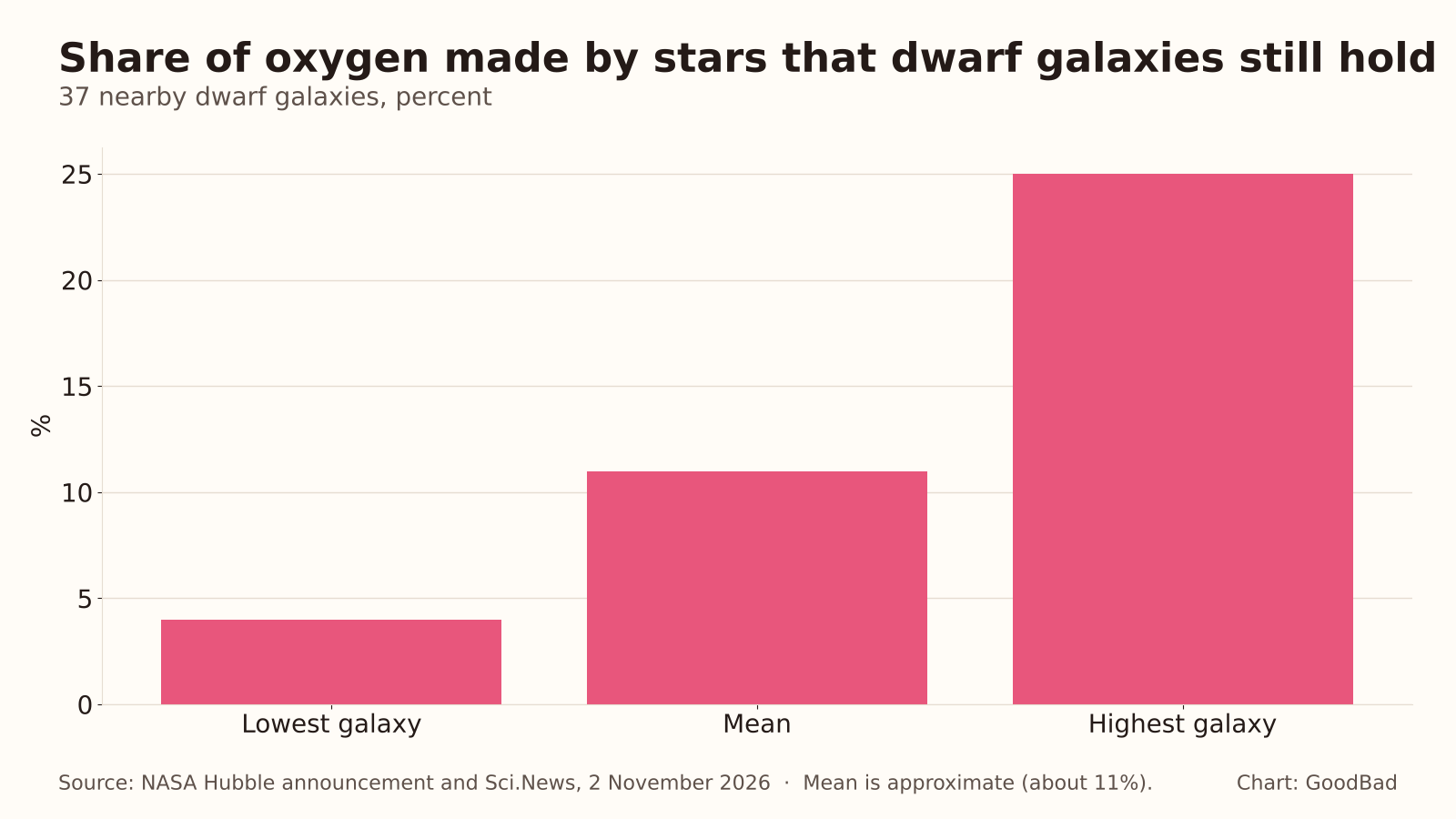 Chart: GoodBad. Data from NASA’s Hubble announcement and the study’s results as reported by Sci.News, 2 November 2026.
Where did it go?
Nearly all the oxygen the galaxies kept sits in gas, not in stars or dust. The team’s explanation for the rest is supernova-driven winds. Grace Telford of the University of Utah says the oxygen must once have been inside the galaxies, so it must have been pushed out by the energy of massive stars and supernova explosions. Galaxies more than 3.3 million light-years from a massive neighbour consistently kept less than 15%. Those in denser surroundings showed more scatter, including most of the highest values, which could mean oxygen is recycled back in or that they take in gas already enriched by neighbours.
The question is not closed. Earlier ultraviolet observations of a highly ionised form of oxygen account for roughly 1% to 7% of what the galaxies made. After correcting for other forms, the authors estimate the gas halos around the galaxies could hold 5% to 35%, so a large share may have left their gravitational reach altogether.
| Measure | Share of oxygen made by stars |
|---|---|
| Kept inside the 37 galaxies | 4% to 25%, mean about 11% |
| Galaxies more than 3.3 million light-years from a big neighbour | Less than 15% |
| Seen in halos by earlier ultraviolet work | Roughly 1% to 7% |
| Possible in halos after correction | 5% to 35% |
What it changes
Three cosmological simulations the team compared against all predict that dwarf galaxies keep more of their metals than the observations show. A simple galaxy-evolution model matched the data best under three conditions. Outflows carry proportionally more mass from smaller galaxies. The outflowing gas is about twice as metal-rich as the galaxy’s own gas. And the inflow of new gas is suppressed by about 40%. That gives simulation builders a number to aim at.
For readers, nothing changes day to day. Kristen Wingfield McQuinn, who leads the GLOW project, plans to use NASA’s Roman Space Telescope to find fainter, smaller galaxies. Hubble and the James Webb Space Telescope would then study their stars. Telford will use Hubble on individual massive stars in nearby GLOW galaxies. The unanswered question of whether the missing oxygen is in the halo or gone entirely will need both.