Good news
Swift Logged More Than 2,000 Gamma-Ray Bursts in a 22-Year Run Built for Two
NASA’s Swift Observatory launched in 2004 for a two-year mission and worked for almost 22 years, catching more than 2,000 gamma-ray bursts and about 1,400 exploding stars before it was shut down ahead of an uncontrolled re-entry.

Read the bad side of this story
NASA’s Swift Telescope Will Fall Uncontrolled After a Failed Private Rescue
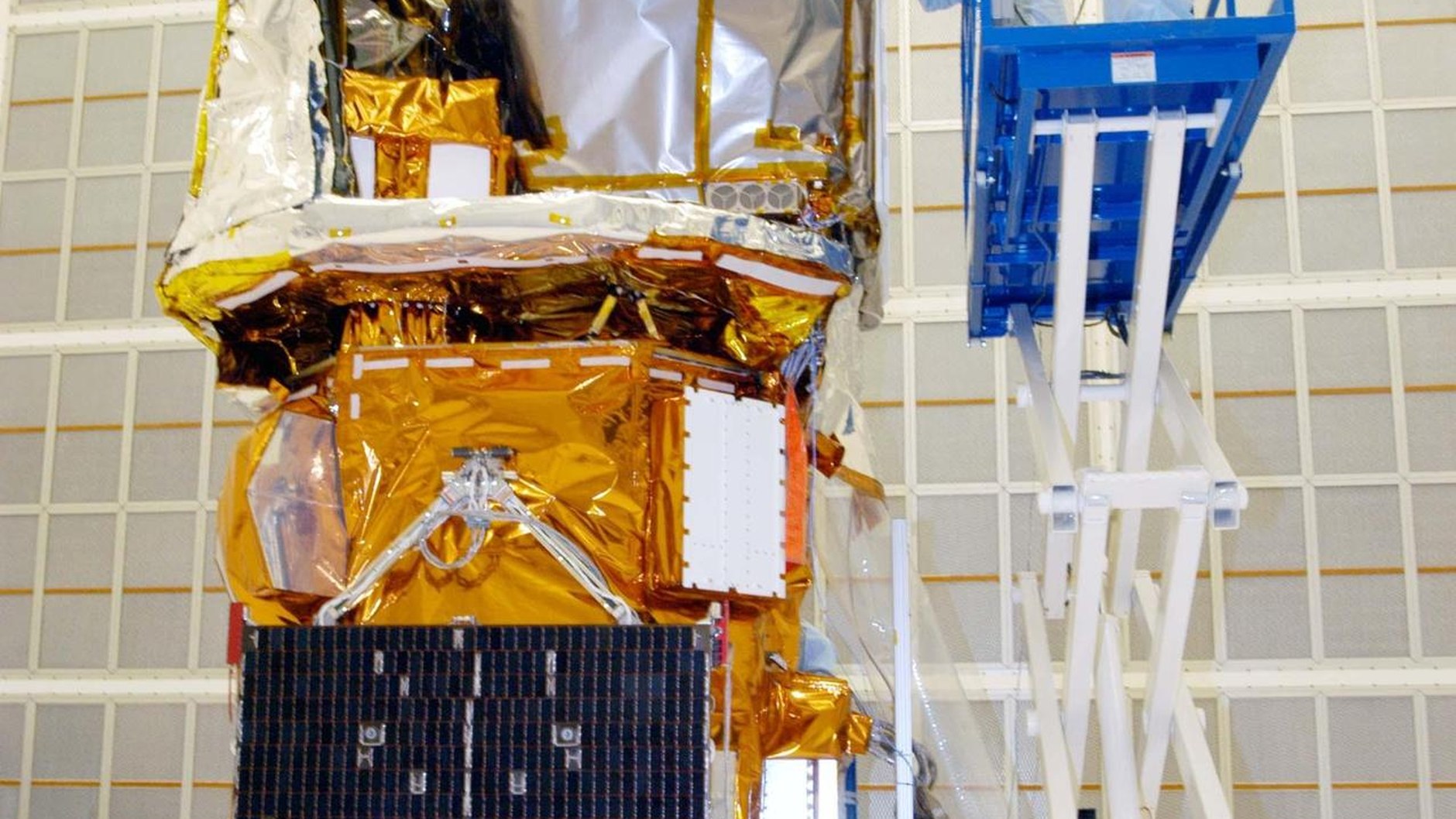
NASA’s Neil Gehrels Swift Observatory is expected to fall back to Earth on Wednesday 4 November, almost 22 years after it launched on a mission planned to last two. In that time it caught more than 2,000 gamma-ray bursts and about 1,400 exploding stars, according to CBS News. It also watched comets, asteroids and black holes tearing stars apart. The spacecraft has been switched off, and its end will be uncontrolled.
What a 2004 satellite kept finding
Gamma-ray bursts are brief, intense flashes of high-energy light from some of the most violent events in the universe. Swift was built to chase them. NASA says it carried three telescopes covering a wide range of light, could turn quickly towards a short-lived outburst and sent alerts so other observatories could follow up. That relay role is why its work reached well beyond bursts, into active galaxies, X-ray flares from stars, supernovae and objects in our own solar system.
The numbers explain the value. A mission designed for two years ran for about eleven times that. Because Swift sent alerts, its reach was wider than its own detectors. Other facilities could turn to an outburst it had flagged. NASA’s list of findings runs from distant active galaxies to comets in our own solar system.
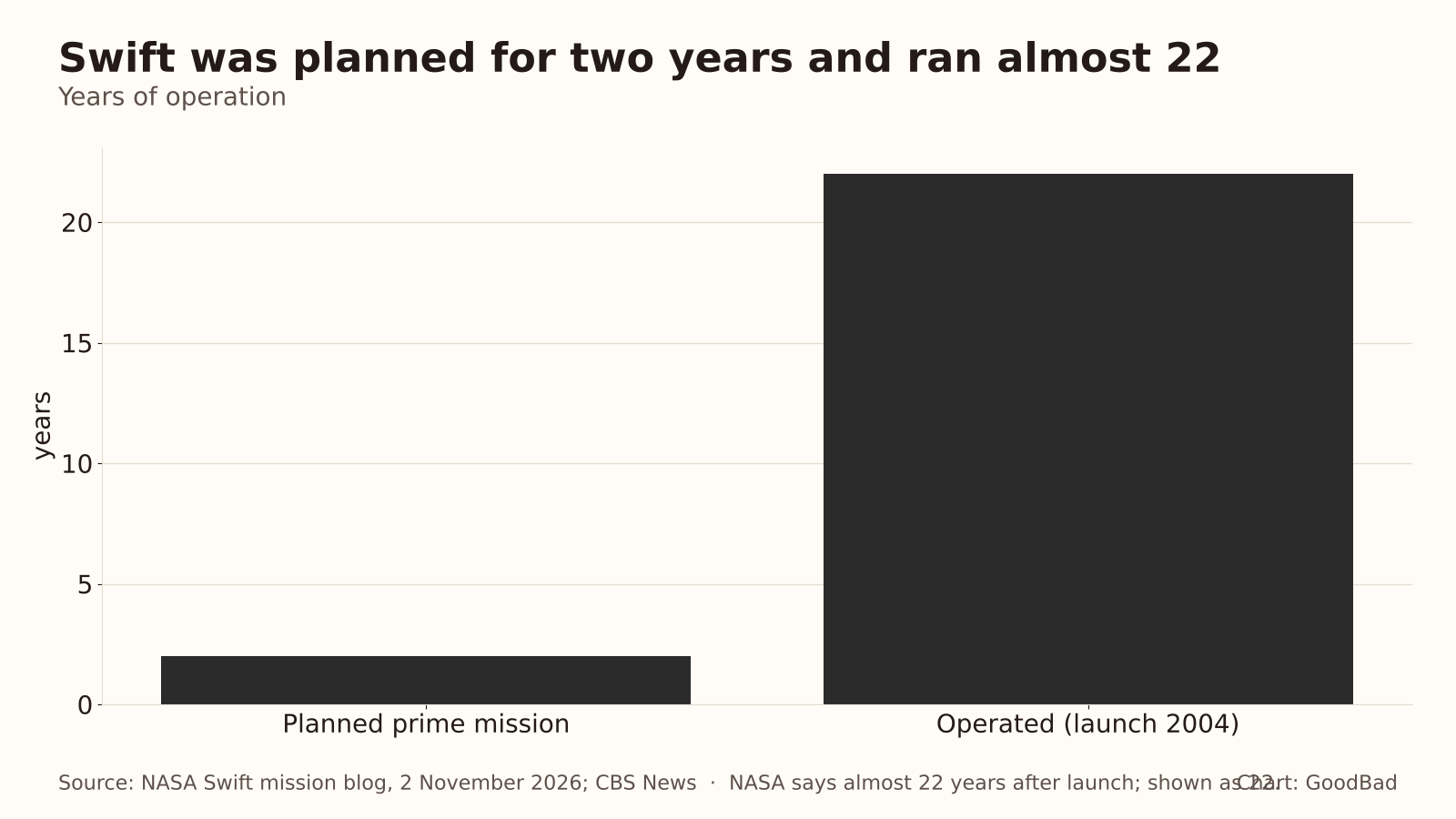 Chart: GoodBad. Data from NASA’s Swift mission blog, 2 November 2026, and CBS News.
Why it is coming down
Swift never had engines of its own to hold its altitude. Atmospheric drag lowers any low orbit slowly, and CBS reports that intense solar activity over the past few years pulled Swift down faster than expected. NASA tried to raise it: it hired Katalyst Space about a year ago, and the company’s robot, called Link, launched in July. Link never came closer than 7 to 9 miles to Swift and fell back to Earth in September, and the rescue was called off.
By late October the telescope was too low to hold steady for observations, so its systems were shut down. John Nousek, the Pennsylvania State University astronomer who led the control team, told CBS the day had been expected since before launch.
What the re-entry looks like
The US Space Force predicts re-entry at about 3:30 a.m. Eastern time on 4 November, with an uncertainty of 11 hours. The spacecraft weighs roughly 3,200 pounds. NASA expects most of it to burn up, though some components should survive, and CBS reports that tungsten pieces and mirror parts are the likeliest survivors. Swift’s orbit is inclined at a low angle, so any fragments can only land between 20.6 degrees south and 20.6 degrees north of the equator.
NASA puts the risk of harm to anyone on Earth at roughly 1 in 2,100. That is its own estimate, and NASA and the Space Force say they will keep tracking the spacecraft and update the prediction.
| Swift in numbers | Figure | Source |
|---|---|---|
| Launch | 20 November 2004 | CBS News |
| Planned prime mission | Two years | NASA |
| Time in orbit | Almost 22 years | NASA |
| Gamma-ray bursts detected | More than 2,000 | CBS News |
| Exploding stars detected | About 1,400 | CBS News |
| Forecast re-entry | About 3:30 a.m. EST, 4 November, give or take 11 hours | NASA, citing US Space Force |
| Risk of harm to anyone | About 1 in 2,100 | NASA |
What it means for you
For almost everyone the answer is nothing. The footprint covers a broad band of the tropics, and most of that is ocean. If you are in that band, NASA and the Space Force will keep publishing updated predictions as the date comes closer. The sources do not give a cost for the failed rescue. None of them names a dedicated replacement for Swift, so what comes next is a question for NASA rather than for this week’s re-entry.