Bad news
Australia Win a Fourth Straight World Cup, 18 Years After New Zealand’s Only Title
Australia’s Kangaroos beat New Zealand 32–12 for a fourth straight men’s Rugby League World Cup, and the Jillaroos won the women’s final 34–10. Only New Zealand, in 2008, has broken Australia’s hold in 16 editions.

Read the good side of this story
Australia Win a Fourth Straight World Cup as 52,461 Fill Lang Park
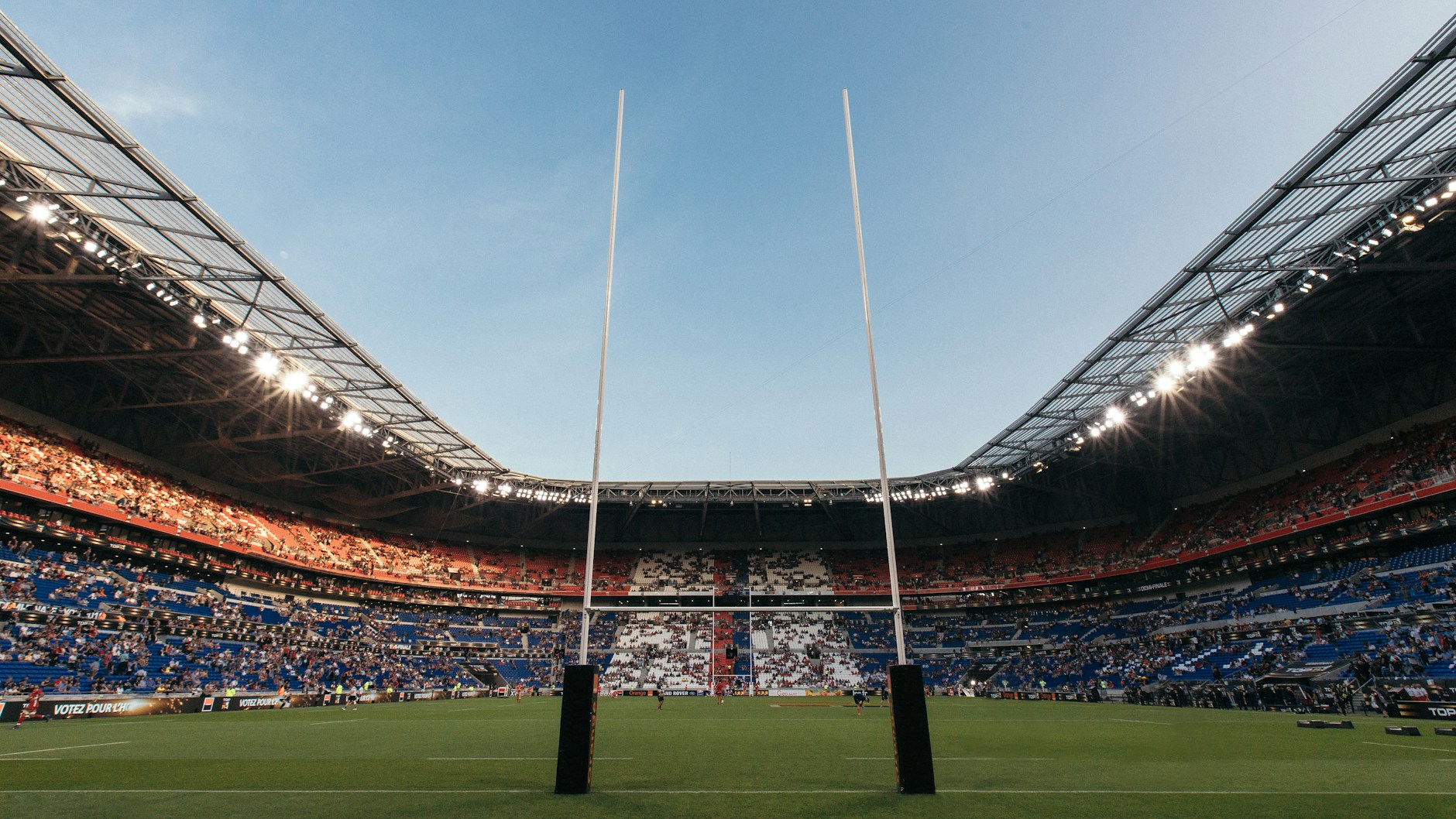
Australia have now won 13 of the 16 men’s Rugby League World Cups, and New Zealand’s only title came in 2008. On Sunday night at Lang Park in Brisbane the Kangaroos beat the Kiwis 32–12 for a fourth straight championship. The Reuters account carried by SABC News puts the crowd at 52,461.
New Zealand were chasing their first title in 18 years, according to Sky Sports. They fell 24–6 behind by half-time and missed 37 tackles over the match. Earlier the same day the Jillaroos beat the Kiwi Ferns 34–10 at the same ground, for a fourth straight women’s title.
A final settled by half-time
Four of Australia’s six tries came before the break. Liam Martin scored inside the opening two minutes and again before half-time, and Jack Bostock and Bradman Best added a try each. Tom Trbojevic scored three minutes after the restart and Bostock added his second. Cameron Munster kicked three conversions and a penalty, the Reuters account says.
New Zealand’s reply was two tries, from Casey McLean before the break and Isaiah Papali’i in the 65th minute. Neither was converted, so the Kiwis finished 20 points short. Sky Sports reports they were undone by errors. New Zealand’s Kalyn Ponga called it a disappointing performance, as the Reuters account reports.
The tournament opener had promised a harder fight. Australia beat New Zealand only 24–22 in October, which Sky Sports describes as a stuttering start for the holders. By the final the margin was 20 points, and in the women’s final it was 24.
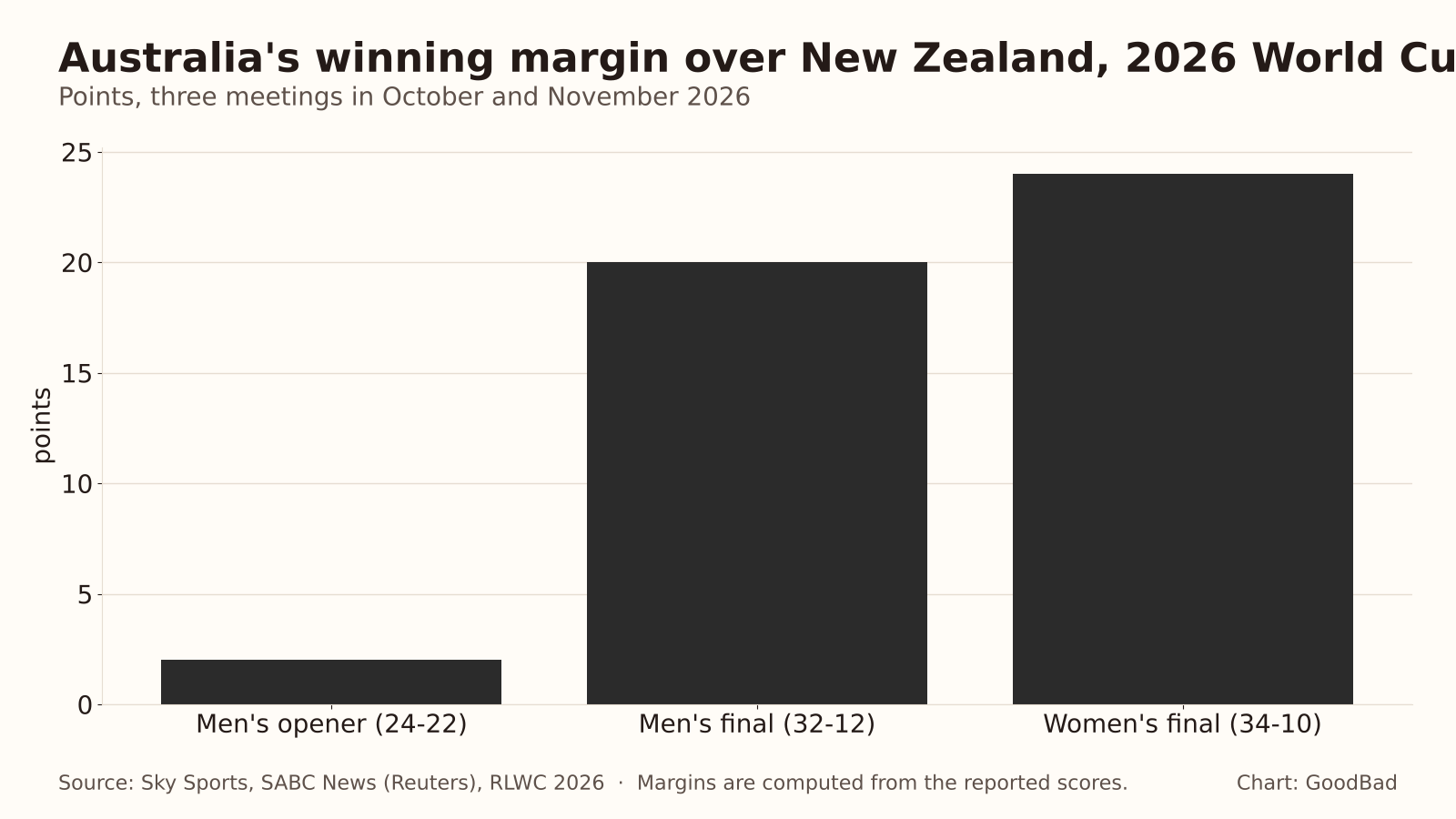 Chart: GoodBad. Data from Sky Sports, SABC News (Reuters) and the RLWC 2026 site, October to November 2026. Margins computed from reported scores.
| Final | Score | Venue | Detail |
|---|---|---|---|
| Men’s | Australia 32–12 New Zealand | Lang Park, Brisbane | 52,461 attendance; fourth straight title |
| Women’s | Australia 34–10 New Zealand | Lang Park, Brisbane | Fourth straight title; Chapman hat-trick |
| Wheelchair | England 50–38 France | Wollongong | Played on Friday |
A small field and a short list of winners
The men’s field was ten nations: Australia, New Zealand, Samoa, France, Papua New Guinea, Lebanon, England, Tonga, Fiji and the Cook Islands, per the tournament site. The women’s and wheelchair competitions had eight teams each. In the men’s game, a final between the same two nations that opened the tournament says something about how narrow the top of the sport is.
Samoa and Tonga lost their semi-finals, and the Reuters account credits their supporters and their play with reviving the World Cup. That is praise for the challengers, and it also shows who is missing from the final. Outside Australia and New Zealand, no nation reached the decider this year, and the margin over the Kiwis is the only competitive gauge the final offers.
The women’s game shows the same pattern in a shorter record. Eight teams entered, and the women’s final was the same pairing as the men’s final, with the same winner. The Jillaroos have won four straight, and Jaime Chapman scored a hat-trick in this year’s final, per the Reuters account. Australia’s margin was 24 points.
What the margin says
The arithmetic of the final is plain. Australia’s 32 points were six tries (24), three conversions (six) and a penalty (two). New Zealand’s 12 were two tries and no conversions. A side that misses 37 tackles and fails to convert either of its tries gives the champions a margin that grows through the night, and this one did.
The opening game points the other way. A two-point win in October is the closest this tournament came to an upset, and it was the very pairing that met again in the final. The 18-point swing between the two meetings, from 2 to 20, is a gap a fan can read without a model.
Who carries the cost
The cost of a long run of one-sided finals falls on the sport’s other nations. A World Cup that Australia win by 20 points, 18 years after anyone else, gives a rival little proof that the gap can close. The sources we have read give no data on funding or participation, so that cost is a risk, not a measured loss.
Australia won without a full-strength squad. Two selection stories sat behind the result, and neither slowed them. James Tedesco, drafted in after Latrell Mitchell withdrew ill, confirmed his international retirement after the match, according to Sky Sports. The tournament site names Ponga and Stacey Waaka as joint Golden Boot winners.
What comes next
The next World Cup is due in 2030, the Reuters account says. It will be played as “Magic Rounds” across five cities in the Pacific and the United States, and the Australian Rugby League Commission is organising it. No source we have read yet gives the format, the number of teams or the venues. Whether the tournament gets a wider field, and whether anyone else can reach the final, is not yet answered.
Australian captain Isaah Yeo called this the most competitive and best World Cup to date, a verdict from one of the winners. The wheelchair final went to England 50–38 over France in Wollongong on Friday, per the same account. The record, in the men’s game, is four straight for one nation and one gap of 18 years. The 52,461 who filled Lang Park saw a good night for the winners. What the sport needs next is a final that is still undecided at half-time.