Good news
Australia Win a Fourth Straight World Cup as 52,461 Fill Lang Park
Australia’s Kangaroos beat New Zealand 32–12 in Brisbane for a fourth straight men’s Rugby League World Cup, hours after the Jillaroos won the women’s final 34–10. A crowd of 52,461 watched at Lang Park.

Read the bad side of this story
Australia Win a Fourth Straight World Cup, 18 Years After New Zealand’s Only Title
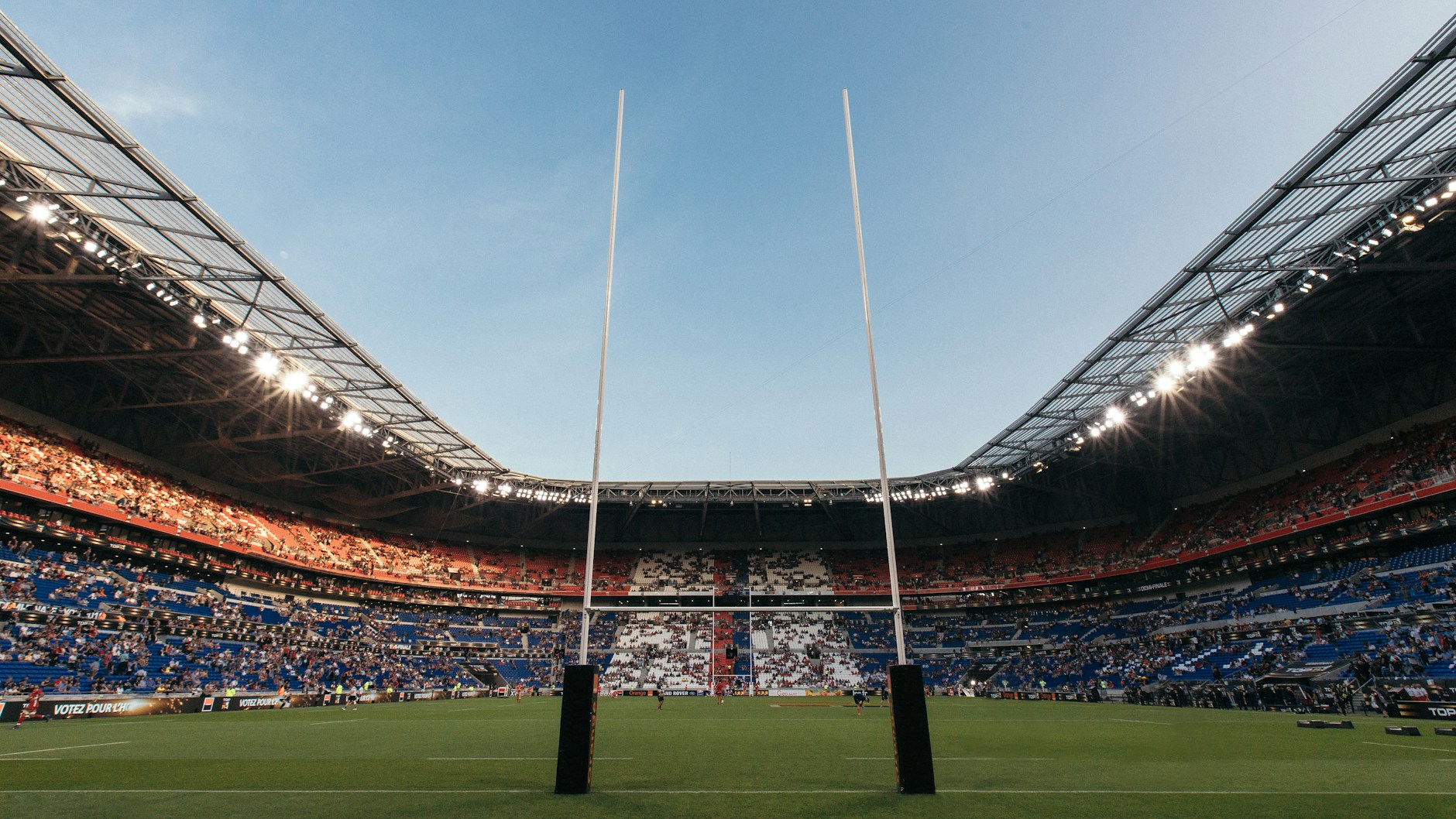
Australia’s Kangaroos beat New Zealand 32–12 at Lang Park in Brisbane on Sunday night to win a fourth straight Rugby League World Cup. Sky Sports named Jack Bostock, who scored twice, player of the final. Earlier that day the Jillaroos beat the Kiwi Ferns 34–10 at the same ground for their own fourth straight women’s title.
A crowd of 52,461 watched the men’s final, according to a Reuters report carried by SABC News. The tournament’s own site describes three World Cups played side by side across Australia, New Zealand and Papua New Guinea. That is 26 teams in total: ten in the men’s event, eight in the women’s and eight in the wheelchair competition.
How the final was won
Australia led 24–6 at half-time. Liam Martin crossed inside the opening two minutes and again before the break. Bostock and Bradman Best added a try each, so four of the six Australian tries came in the first half. Tom Trbojevic scored three minutes after the restart and Bostock added his second. Cameron Munster kicked three conversions and a penalty, per the Reuters account.
New Zealand replied through Casey McLean before half-time and Isaiah Papali’i in the 65th minute. Sky Sports reports that the Kiwis missed 37 tackles and were undone by errors. They were also chasing their first World Cup since 2008, so the final was a test of how far Australia’s depth has run ahead of the field.
Two selection stories ran through the week. James Tedesco, drafted in after Latrell Mitchell withdrew ill, confirmed his international retirement after the match, according to Sky Sports. Kalyn Ponga returned from a broken arm suffered in the opener and shares the tournament’s Golden Boot with Stacey Waaka, the tournament site says.
How the points add up
The 32 points break down simply. Six tries are worth 24, Munster’s three conversions add six, and his penalty adds two. Australia’s tally came from tries, not from kicking: the second half produced two tries and no conversions, so the 8 points after the break were all from the try line.
New Zealand’s 12 were two tries without a conversion between them, which left them 20 points behind. For a reader new to the code, that is the useful way to see the margin: more than three converted tries separated the sides.
A tournament that opened tight
The opener was the close one. Australia beat New Zealand 24–22 in October, a two-point game that Sky Sports describes as a stuttering start for the holders. By the final the margin was 20 points, and in the women’s final it was 24.
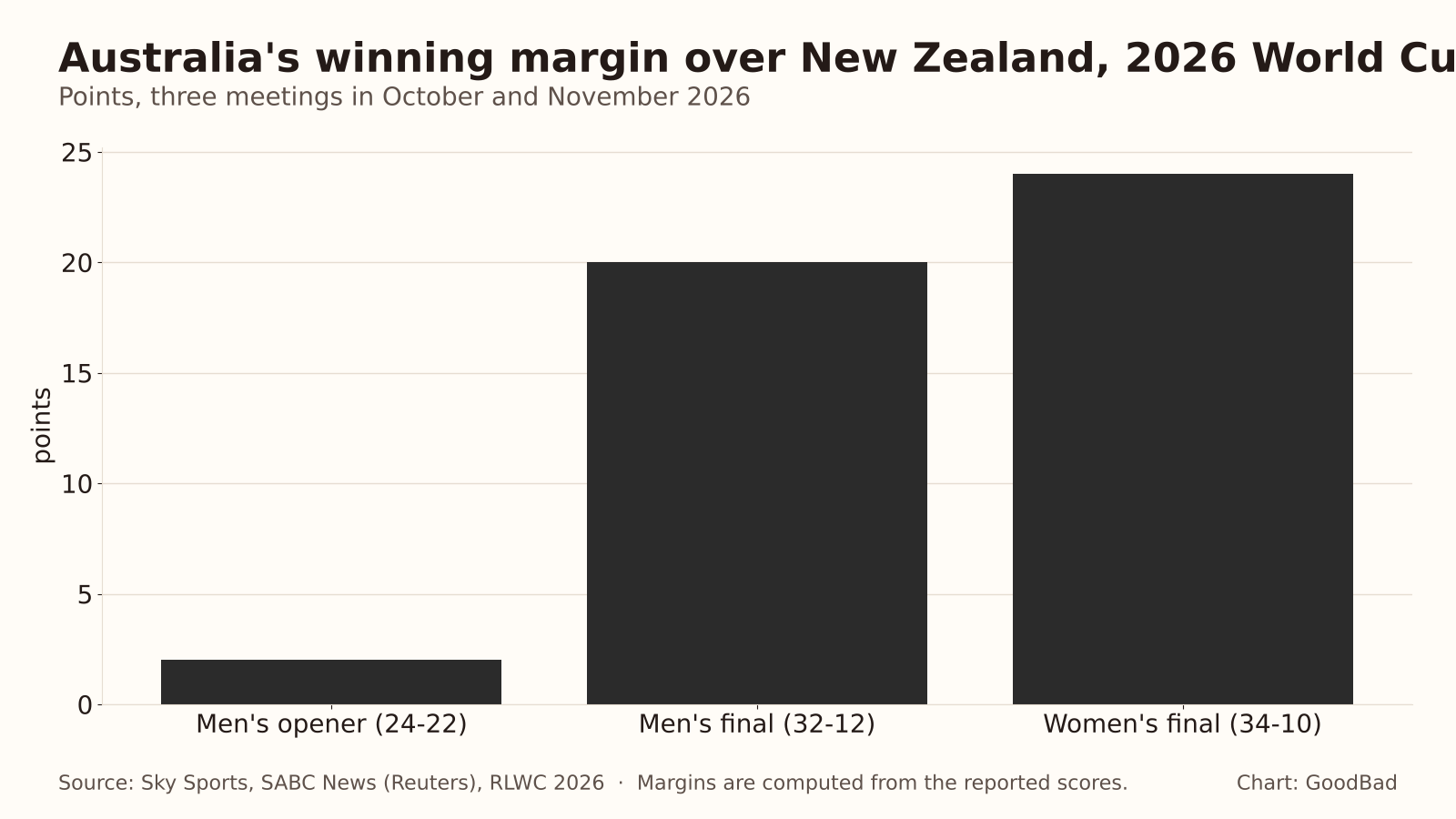 Chart: GoodBad. Data from Sky Sports, SABC News (Reuters) and the RLWC 2026 site, October to November 2026. Margins computed from reported scores.
Australia’s men have now won 13 of the 16 World Cups played, the Reuters account says, and New Zealand’s only title came in 2008. The women’s side has a shorter history, and the Jillaroos have turned it into a four-title run of their own. Jaime Chapman scored a hat-trick in the women’s final, according to the same account.
| Final | Score | Venue | Detail |
|---|---|---|---|
| Men’s | Australia 32–12 New Zealand | Lang Park, Brisbane | 52,461 attendance; fourth straight title |
| Women’s | Australia 34–10 New Zealand | Lang Park, Brisbane | Fourth straight title; Chapman hat-trick |
| Wheelchair | England 50–38 France | Wollongong | Played on Friday |
The wider field
The wheelchair competition finished first. England beat France 50–38 in Wollongong on Friday, the Reuters account says, so the weekend closed three world finals in three days. A spectator who followed the whole programme saw one competition among several, with the women’s and wheelchair games given their own finals rather than a sideshow slot.
Samoa and Tonga lost their semi-finals, and the Reuters account credits their supporters and their play with reviving the World Cup. That matters beyond one night. The men’s field was ten nations: Australia, New Zealand, Samoa, France, Papua New Guinea, Lebanon, England, Tonga, Fiji and the Cook Islands, per the tournament site. Two Pacific sides reaching the last four is a real return on a field that size.
What it means for fans
For a casual fan, the practical gain is a bigger stage for the women’s and wheelchair games. The women’s final was played on the same pitch as the men’s final, and the tournament presents all three competitions under one brand. Fans who want to see what the Kangaroos or Jillaroos look like when they are pushed can look back to the 24–22 opener, which Sky Sports covered as a close call.
The next date is 2030. The Reuters account says the next World Cup will be played as “Magic Rounds” across five cities in the Pacific and the United States, organised by the Australian Rugby League Commission. No source we have read yet gives the format, the number of teams or the venues, so those questions are open.
Australian captain Isaah Yeo called this the most competitive and best World Cup to date, a verdict from one of the winners that the finals alone do not settle. What is firm is the 52,461 crowd, four straight titles on both sides, and Samoa and Tonga in the semi-finals. Those are the figures this tournament will be judged on when the 2030 plans arrive. Whether the next edition gives the Pacific and women’s sides the same spotlight is the thing to watch.